Cosmetology License Renewal, Exams, and Transfer Rules by State

Are you planning to turn your interest in beauty into a real licensed career? For many future stylists, the dream starts with creativity, independence, and the chance to build a life around hands-on work. But before you can take paying clients, you have to understand the licensing rules, training hours, testing steps, renewal deadlines, and transfer requirements that control the industry.

That process can feel stressful at first. You may be trying to fit school around work, worrying about the state board exam, or wondering what happens if your license expires later. If you already work in the beauty field, moving to another state can also raise serious questions about whether your credential will still protect your income.

Some people also hesitate because they are not sure whether beauty school is meant for someone with their background. If you are still deciding whether this path fits you, start by reading what you actually need to know before applying so you can better understand how students from different life stages and backgrounds can begin training.

Quick Licensing Notes Before You Start

  • Rules depend on the state: Age minimums, education standards, required hours, exam structure, fees, and renewal deadlines are set by each state board, not by one national agency.
  • Lower-hour models are becoming more common: Several major states now use 1,000 hours for cosmetology, and recent research suggests hour reductions can reduce tuition and improve completion without showing a detectable drop in cosmetologist earnings.
  • Moving states still requires planning: The Multi-State Cosmetology Licensure Compact may reduce some reciprocity barriers in participating states, but it does not create automatic license transfer across the entire country.
  • Renewal rules protect your ability to work: Continuing education and renewal systems help boards reinforce sanitation, legal compliance, infection control, consumer protection, and safer product handling.

Why Beauty License Rules Change From State to State

Cosmetology is regulated at the state level. That means the legal requirements for practicing in Missouri, Texas, New York, California, Georgia, Florida, or Arkansas may not look exactly the same. Each board decides who can practice, what services are included, how many hours students must complete, and what exams applicants must pass.

These rules are not designed to judge your artistic taste. Their main purpose is public protection. State boards focus on sanitation, infection control, skin and hair safety, chemical services, disinfection procedures, and the legal limits of each license type. Understanding this early helps you avoid training delays, licensing problems, and accidental work outside your approved scope.

What Boards Usually Check Before Approval

When you compare cosmetology license requirements by state, you will usually see several repeating categories: minimum age, education level, approved school hours, exam format, application documents, fees, and criminal-history questions. The exact details change by location.

For example, the Texas Department of Licensing and Regulation lists a 1,000-hour cosmetology operator course and a minimum application age of 17. The New York Department of State requires a 1,000-hour approved course and both written and practical examinations.

That is why a general checklist is never enough by itself. Your licensing plan should always start with the state where you want to work. A strong school can help you stay organized with age documents, transcripts, school records, exam applications, payment deadlines, and any required disclosures.

Because cosmetology can cover several beauty services, many students also want to know what they can legally do after earning the license. If you want a clearer breakdown of service boundaries, read this guide on working as an esthetician, barber, lash tech, or nail tech with a cosmetology license.

How Required School Hours Affect Your Timeline

Training hours are one of the biggest practical differences between states. If you are comparing cosmetology school hours, you will quickly see that nearby states can still have different expectations.

New York requires 1,000 hours. California now lists 1,000 school hours for cosmetologists through the California Board of Barbering and Cosmetology. Texas also sets its cosmetology operator course at 1,000 hours. Other states, including Ohio, Arkansas, Georgia, and Missouri, commonly use a 1,500-hour pathway for standard cosmetology licensure, though license names and exam structures may differ.

Before enrolling, compare the cosmetology hours for the state where you plan to build your career. This helps you avoid paying for a program that does not satisfy your board’s requirement. It also helps you understand how long school may take before you can sit for licensing exams and begin working legally.

A 2025 EdWorkingPaper from the Annenberg Institute at Brown University found that lowering cosmetology-hour requirements can raise completion, lower tuition, and expand enrollment among some groups, with no detectable decline in cosmetologist earnings. That does not mean every graduate will earn the same amount. It does suggest that very high hour requirements can increase the cost of entry without clearly improving earnings outcomes.

Preparing for the Licensing Exam Without Freezing Up

After your school hours are completed and reported, the next major step is the licensing exam. This stage can make even talented students nervous, especially if they are more comfortable with hands-on work than written testing.

Build a Review Plan Around Safety and Rules

A useful cosmetology state board exam review should go beyond the services you enjoy most. The written or theory portion usually focuses on sanitation, infection control, chemical safety, hair care, skin care, nail care, state laws, and professional responsibilities.

Using a cosmetology practice test free online can help you understand the format before test day. A cosmetology written exam study guide can also help you review disinfection, product safety, chemical texturizing, infection control, and service procedures in a more organized way. The goal is not to prove that you are the most creative stylist in the room. The goal is to show that you can work safely and competently within your license scope.

Know the Exam Structure Before Test Day

  • Question count: You should check how many questions are on the cosmetology state board exam for your specific state and testing vendor. The NIC National Cosmetology Theory Examination, for example, contains 110 items, with 100 scored questions used for the final score.
  • Practical testing: Do not assume every state still requires the same hands-on exam. California states that effective January 1, 2022, the practical exam is no longer required for all license types, and candidates only need to pass the written exam. Other states may still require practical, written practical, theory, or state-law exams.
  • Testing fees: Always check how much it costs to take the state board for cosmetology through your own board or testing vendor. Fees may differ depending on whether you need written, practical, state-law, or combined exams.
  • Scheduling: Your school may help with graduation paperwork, but you are still responsible for understanding how to apply for cosmetology state board exam access and how to schedule cosmetology exam dates through official vendors such as PSI, Pearson VUE, Prov, or another approved provider.
  • Difficulty level: Students often ask how hard is the cosmetology state board exam to pass. The exam is built around baseline safety and competency. If you understand sanitation, infection control, chemical handling, and the services included in your license, you can prepare with a much clearer strategy.

As you calculate exam fees, supplies, tuition, and living expenses, remember that you may not have to pay for everything out of pocket. For help comparing funding options, read this guide to cosmetology school financial aid using FAFSA, grants, 529 plans, and payment options.

Keeping Your License Active After Graduation

Getting licensed is a major milestone, but it is not the end of your responsibility. Every license has a renewal system. If you miss a deadline, take time away from the industry, or forget to update your file, your credential can lapse and interrupt your ability to work legally.

Renewal Deadlines Are Not the Same Everywhere

Each state decides its own renewal cycle. Some renewals are tied to a fixed calendar date, some to a birth month, some to the issue date, and others to a board-specific schedule. Some states renew every year, while others use two-year or longer cycles.

If you live on the West Coast, you may wonder, can I renew my CA cosmetology license online? In many states, online renewal portals now make the process faster. Still, you should confirm the exact renewal method, fee, deadline, and continuing education rule for your own board.

If your license expires, check the state registry right away. You need to know how long after cosmetology license expires you can wait before penalties increase, your status changes, or your file becomes harder to restore. You should also check how much it costs to renew cosmetology license fees in your state so you can avoid unnecessary downtime. Managing your renewal online is often the fastest way to protect your work schedule.

When an Expired License Becomes Harder to Fix

If a license remains expired for multiple years, a board may classify it as cancelled, expired beyond renewal, or null and void. The wording depends on the state, but the result can be serious.

For example, the Florida Department of Business and Professional Regulation states that a license becomes null and void after the licensee fails to renew for two consecutive licensure cycles. If you need to reinstate a null and void cosmetology license in Florida, it generally cannot be restored unless the applicant can show illness or economic hardship, and each application is reviewed case by case. A simple late fee may not be enough.

Many boards also require continuing education courses for cosmetology renewal. The Georgia State Board of Cosmetology and Barbers requires five hours of board-approved continuing education for renewal, including three hours in health and safety. These requirements help reinforce sanitation, infection control, law updates, and safe professional practice.

Occupational health research also supports the importance of long-term safety habits in salon work. A study published in Occupational and Environmental Medicine found associations between hairdresser work and certain hormone-related outcomes, including higher odds of prebaseline hysterectomy and higher rates of incident endometriosis, while not finding notable associations with several cancers studied. This does not mean every stylist will experience the same outcome, but it does support the value of ventilation, product awareness, protective practices, and careful chemical handling.

Moving Your License When Life Takes You Somewhere New

Relocation can be exciting, but it can also complicate your beauty career. If you move for family, marriage, work, or a fresh start, you need to know whether your current credential will be accepted in your new state.

Reciprocity and Endorsement Are Not Always the Same

If you are researching how to transfer cosmetology license to another state options, you will likely see the words reciprocity and endorsement. They are related, but they are not always identical. Reciprocity usually means one board recognizes another state’s licensing standards. Endorsement usually means the new state reviews your active license, training hours, exam history, and sometimes work experience before deciding whether you qualify.

Most transfer processes require an application, a fee, and official license verification from your original board. If your first state required fewer hours than your new state, you may need additional testing, more hours, a state-law exam, or documented work history.

Arkansas is a useful example. The Arkansas Department of Health explains that a person transferring hours from another state without holding a current out-of-state license must pass written and practical examinations to qualify for an Arkansas license. Florida uses a different structure. The Florida DBPR states that applicants who qualify for a Florida cosmetology license by endorsement do not have to take the Florida cosmetology examination, but they must hold a valid out-of-state cosmetology license and complete the required HIV/AIDS course.

Compact Licensing May Help, But It Is Not Nationwide Transfer

If you are asking, do cosmetology licenses transfer to other states easily, the honest answer is that it depends on the destination state. Some boards now allow online applications for cosmetology license transfer from state to state, which can reduce paperwork delays. But you still need to check the exact rules before moving, signing a lease, or accepting clients.

Understanding portability also helps you plan the full range of careers you can pursue with a cosmetology license, whether you want to become a salon stylist, color specialist, platform artist, editorial stylist, salon manager, or beauty entrepreneur.

Legal and structural analysis from the University of Missouri School of Law Scholarship Repository discusses the development of the Multi-State Cosmetology Licensure Compact. The official Cosmetology Compact explains that the compact is designed to create a multistate license pathway for eligible cosmetologists who live in compact member states and hold an active, unencumbered license.

Once fully implemented, the compact should help qualifying professionals practice across participating state lines without completing a separate traditional reciprocity package for each member state. However, it should not be described as automatic nationwide license portability. It only applies to participating states, and eligibility still depends on the licensee’s home-state license, compact rules, and implementation timeline.

Start Your Beauty Career With Clearer Direction

Licensing rules, training hours, renewal deadlines, and state transfer requirements are easier to handle when you train with a school that understands the practical side of entering the industry. At Neosho Beauty and Barber College, students can build the hands-on foundation and professional habits needed for a licensed beauty career.

Neosho’s cosmetology program is built around real salon skills, including haircutting, coloring, perming, styling, manicures, pedicures, acrylic sets, lash and brow services, facials, waxing, and makeup application. The program also introduces career-focused skills such as salon business, client retention, resume writing, and job seeking skills.

By building practical skills, professional habits, and licensing-focused knowledge throughout your training, the exam process can feel more organized and less intimidating. This kind of preparation helps you move from classroom learning toward professional work with more confidence.

Beyond the exam, the goal is to help you think about your future career path. Whether you want to work behind the chair, grow into management, build a client base, or explore specialized beauty services, your education should help you understand both the creative and regulatory sides of the profession.

If you are ready to review admission steps, tour details, and application requirements, visit the Enrollment page. You can also use the contact form below if you have questions about scheduling, start dates, or next steps.

Frequently Asked Questions

Can I offer cosmetology services from home without a license?

No. State boards generally require the proper beauty license for professional cosmetology services, whether the work happens in a salon, home studio, mobile setting, or event location. Performing hair, nail, or skin services for compensation without the correct credential can lead to fines, disciplinary problems, legal exposure in some states, and possible future licensing issues.

Why do some states combine barbering and cosmetology regulation?

Historically, barbering and cosmetology were often handled through separate regulatory structures, with different license categories, school approvals, and exam rules. Some states now use a combined administrative model. Texas, for example, combined its Barbering and Cosmetology programs under TDLR through HB 1560, and the Texas Department of Licensing and Regulation now manages Barbering and Cosmetology under one unified program. This can help standardize sanitation, establishment, health, safety, and administrative rules, but it does not mean every state has merged its boards or eliminated the legal difference between barber and cosmetology licenses.

Do higher beauty school hour requirements always create better customer results?

Not necessarily. A landmark econometric review hosted by San Jose State University found that stricter licensing rules did not show a general positive association with higher consumer ratings for the beauty-service occupations studied. The study used Yelp ratings as a customer-satisfaction measure, so it should not be treated as a perfect measure of safety or technical quality. Still, it supports the idea that more required hours do not automatically equal better customer-rated service.

For a visual overview of how interstate mobility is changing, you can also watch this breakdown of the Cosmetology Licensure Compact and State Board Rules. It explains how compact participation may simplify movement for eligible beauty professionals without turning license transfer into automatic nationwide portability.

Cosmetology School Financial Aid Guide: FAFSA, Grants, 529 Plans, and Payment Options

Starting a career in the beauty industry can be exciting, but planning the money side of your training can feel stressful fast. Tuition is only one part of the picture. Students may also need to prepare for professional kits, books, registration fees, uniforms, supplies, and licensing-related expenses before they ever begin working with clients.

The good news is that you do not always have to pay the full cost from your savings on day one. Because approved beauty programs are built around structured training hours for state licensing, many students may be able to use legitimate funding options to manage the cost. If you want to understand the basic requirements before applying, it helps to review what you actually need to know before applying to cosmetology school so you can see what admissions teams commonly look for. By comparing federal aid, scholarships, workforce support, 529 plans, tax credits, and payment options, you can build a safer plan for funding your education.

Main Points to Know Before You Budget

  • FAFSA Depends on School Eligibility: Federal student aid may be available for beauty school, but only when the school participates in Title IV federal student aid programs. Accreditation is important, but students should also confirm the correct Federal School Code and make sure their exact program is aid-eligible.
  • The Sticker Price Is Not Always the Full Price: Tuition alone may not show the complete cost. Students should also plan for tools, textbooks, uniforms, registration fees, kits, supplies, and state licensing-related expenses.
  • Attendance Can Affect Aid Timing: Many beauty and trade programs use clock hours instead of standard college credits. Missing required hours can slow your progress and may delay financial aid disbursements.
  • Funding Rules Can Vary Widely: State workforce support, private scholarships, VA benefits, 529 plans, institutional payment plans, and federal tax credits may reduce your out-of-pocket cost, but eligibility depends on the school, program, student status, and location.

What Beauty Training Really Costs

Before you compare financial aid options, it is important to understand how beauty schools usually organize their pricing. A common mistake is looking only at tuition and assuming that number is the final amount you will need. Trade school costs can be more layered than a traditional college bill, so the better question is not just how much is tuition for cosmetology school, but what is included in the full cost of attendance.

The overall cosmetology school cost can change based on location, program length, school type, curriculum, and whether supplies are included in the advertised price. According to SoFi Financial Insights, the average cost for cosmetology school generally falls between $5,000 and $20,000 across the United States. If you are looking for a cosmetology school under 10k, your options will often be found through regional vocational centers, community college programs, shorter certificate tracks, or schools in smaller markets.

To understand your actual cosmetology school cost, you need to look beyond the instructional rate. Many accredited schools require students to purchase a professional student kit. This may include items such as shears, styling irons, mannequins, sanitation supplies, textbooks, and sometimes uniforms. These are not optional extras if the school requires them for daily classroom and clinic-floor training.

Data compiled by the Renaissance Academie Cost Analysis shows that kits and learning materials can create a major required expense, with one example listing student kit and textbook costs at about $2,498. Some schools include these items in tuition, while others charge them separately before classes begin. When comparing how to pay for cosmetology school, ask the admissions office whether your kit, books, uniforms, registration fees, supplies, and state board preparation materials are included or billed separately.

You should also request the school’s full cost of attendance, not only the tuition amount. A complete budget may include tuition, required fees, books, course materials, supplies, equipment, transportation, and licensing-related costs. This matters because cost of attendance is often the figure used when calculating how much financial aid for cosmetology school you may qualify for.

How FAFSA Works for Eligible Beauty Programs

Many students want to know whether they can use FAFSA for cosmetology school tracks. Federal student aid may be available for trade programs when both the institution and the specific program are eligible to participate in Title IV federal student aid programs. Accreditation can help show that a school meets certain standards, but it is not the only thing to verify. The U.S. Department of Education maintains Federal School Code Lists for institutions participating in Title IV student aid, so students should confirm that the school appears under the correct campus or institution name.

Submitting the Free Application for Federal Student Aid (FAFSA) can help eligible students access federal Pell Grants, federal student loans, and other aid. However, a cosmetology school with FAFSA approval may handle disbursements differently from a traditional college. Universities often release aid by academic term. Many beauty schools, by contrast, measure progress through clock hours, which track the actual time students spend in class, training, and supervised practice.

At a cosmetology school with financial aid, funds may be released in installments tied to completed hours and weeks of instruction rather than simple calendar dates. The Federal Student Aid Handbook explains that payment periods for clock-hour programs are based on successful completion of clock hours and weeks of instructional time. As explained by the Continental School of Beauty Financial Guides, aid in beauty school is often released in segments as students pass specific program milestones. Because of this structure, poor attendance can delay clock-hour completion, slow financial aid disbursements, and leave a student with a temporary balance until required hours are caught up.

Before enrolling, ask the financial aid office whether you can use FAFSA for cosmetology school options at that exact campus. You should also ask which Federal School Code to use, whether your program is measured in clock hours or credit hours, and when aid is expected to be disbursed.

Grants, Scholarships, and Other Help You Do Not Have to Repay

If your goal is to graduate with less debt, start by looking for financial aid for cosmetology school that does not require repayment. The largest federal source of need-based grant aid is the Federal Pell Grant, which is calculated through the FAFSA process. For the 2026–27 award year, the maximum Federal Pell Grant scheduled award is $7,395, although the actual amount a student receives depends on eligibility, enrollment status, program structure, and federal aid rules.

Students should also look for specialized grants for cosmetology school from private foundations, professional associations, and beauty brands. As noted by the American Association of Cosmetology Schools, non-profit organizations such as Beauty Changes Lives offer seasonal scholarships that may help cover tuition, tools, supplies, or other training expenses for qualifying students.

Students with family responsibilities may also find demographic-based support, such as cosmetology grants for single mothers or training assistance for displaced workers, low-income adults, and career changers. These awards are not always labeled specifically for cosmetology. Local workforce boards, community foundations, vocational rehabilitation agencies, and nonprofit job-training programs may offer vouchers or tuition support for approved career-training programs.

State aid can also help reduce costs, but students should verify every detail before making plans around it. For example, the Georgia Student Finance Commission provides the HOPE Career Grant to HOPE Grant-qualified students enrolled in selected high-demand programs of study. Students should not assume every beauty or personal care program qualifies. The safer move is to check the current eligible program list and ask the school’s financial aid office whether the exact program is approved. Similarly, students reviewing Paul Mitchell The School Arkansas financial aid pathways should ask whether Arkansas workforce funding, vocational rehabilitation support, or other regional training resources can apply before counting on those funds.

Students with military backgrounds may wonder if does VA pay for cosmetology school training. Veterans and eligible dependents can often use GI Bill® education benefits for approved trade school training. The VA GI Bill Comparison Tool notes that Post-9/11 GI Bill benefits can be used at colleges, universities, trade schools, apprenticeships, and for licensing or certification tests, including cosmetology license tests. To use VA benefits for a beauty program, the school or program must be approved for VA benefits. Students should speak with the school’s VA certifying official to confirm tuition coverage, book and supply support, licensing-test coverage, and housing allowance details.

529 Plans, Tax Credits, and Payment Plans

If grants and scholarships do not cover the full balance, other funding tools may help close the gap. Families often ask whether can 529 be used for cosmetology school programs. According to the latest Chase Investment Insights on 529 Rules, 529 funds have generally been usable for college, graduate, and vocational school tuition and fees, books, supplies, and certain education-related costs. Newer federal rules also expanded 529 use for qualified postsecondary credentialing expenses, including tuition, fees, books, equipment, exam fees, and costs required for earning or maintaining certain professional credentials.

Students should still be careful with the phrase “tax-free.” For federal tax purposes, 529 withdrawals are generally tax-free when used for qualified education expenses, but state tax treatment can vary. Saving for College notes that some states may define qualified expenses differently, so families should keep receipts, match withdrawals to qualified expenses in the same tax year, and check state rules before using 529 money for licensing or credentialing costs.

If you are figuring out how to pay for cosmetology school without financial aid, you may not need the entire balance saved before your first class. A common question is whether do you have to pay for cosmetology school upfront. Many beauty schools offer internal installment plans that divide the remaining balance across the length of the program. Some plans may be interest-free, while others may include fees, late penalties, or withdrawal-balance rules. Before signing, read the enrollment agreement carefully so you understand what happens if your schedule, attendance, or enrollment status changes.

Tax credits may also help reduce part of your education cost later. You can potentially claim your cosmetology school expenses on taxes through the federal Lifetime Learning Credit if the school is an eligible educational institution and you meet IRS requirements. If you have been wondering if can you claim cosmetology school on taxes, the IRS Lifetime Learning Credit equals 20% of the first $10,000 in qualified education expenses, up to a maximum of $2,000 per tax return. This is a tax credit, not a deduction, and it is non-refundable. That means it can reduce tax you owe, but it will not create a refund if you do not owe enough tax.

Be Careful With “Free Cosmetology School” Promises

While researching funding options, you may see ads or articles claiming that you can find a cosmetology school for free. Some of these claims are misleading. Unaccredited online entities may use “free school” language to collect personal information or sell certificates that do not qualify students for a state licensing exam.

A real zero-out-of-pocket beauty education usually requires combining several legitimate funding sources. A student might use a Federal Pell Grant, private scholarships, state workforce support, VA benefits, vocational rehabilitation assistance, institutional aid, or a payment plan to lower the final balance. The right combination depends on income, residency, military status, program approval, school eligibility, and scholarship deadlines.

Instead of chasing shortcuts, students should focus on choosing training that can support long-term career goals. According to data from the U.S. Bureau of Labor Statistics, employment for barbers, hairstylists, and cosmetologists is projected to grow 5% from 2024 to 2034, which is faster than the average for all occupations.

Industry career resources from the Boulevard 2026 Cosmetology Career Outlook also show that structured beauty training can lead toward salon services, bridal styling, beauty entrepreneurship, film production makeup, color specialization, salon management, and related paths. Some graduates may explore advanced esthetics or medical spa support roles, but those services can be heavily regulated and may require a separate license, additional training, or medical supervision depending on the state. Because beauty credentials can open several different career questions, it is helpful to read about whether you can work as an esthetician, barber, lash tech, or nail tech with a cosmetology license. It is also useful to understand the broader careers you can pursue with a cosmetology license before choosing a training path. A properly licensed and accredited program helps students build a foundation that fits their state’s legal scope of practice.

Take the Next Step With a Clear Funding Plan

Investing in beauty education is a major decision, and the right funding plan can make the process feel much more manageable. Once you understand tuition, required supplies, financial aid timing, grants, scholarships, 529 rules, tax credits, and payment options, you can compare your choices with more confidence.

To learn how the enrollment process works at Neosho Beauty & Barber College, visit the Enrollment page and review the next steps. You can also use the contact form below this article to ask questions, request more details, and connect with the admissions team about your program options.

Financial Aid Questions Students Often Ask

Can I keep working while I attend beauty school?

Yes, but it depends on the school’s available schedules and how much time you can realistically commit. Some beauty schools offer full-time, part-time, or evening options, which may help students continue working while completing required training hours. Because clock-hour programs depend heavily on attendance, students should choose a schedule they can maintain consistently.

What if I withdraw or need a leave of absence?

Because many trade programs are measured by clock hours, a leave of absence can pause progress and affect future financial aid disbursements. If you withdraw permanently, the financial aid office uses federal return-of-aid rules to calculate how much aid was earned based on the completed portion of the payment period. Depending on the situation, a student may owe a remaining balance to the school or may have to repay unearned aid.

Can financial aid include licensing exam costs?

It may, but students should ask the school how those costs are handled. The Federal Student Aid Handbook explains that for programs requiring professional licensure, certification, or a first professional credential, cost of attendance must include an allowance for costs such as licensing exam fees and application costs. Timing still matters because some fees may need to be paid while the student is still enrolled. Students may also be able to use 529 funds for eligible professional licensing or credentialing costs if the expense qualifies under federal and state rules.

Are beauty school scholarships hard to win?

Some national scholarships are competitive, but many local and industry-specific awards receive fewer applications than students expect. Scholarship committees may consider creative goals, financial need, community involvement, work ethic, and career plans, not only grades. Students who clearly understand what they want to do with their license often have stronger material for scholarship applications.

How Much Do Beauty School Instructors Make? Salary, Jobs, and Career Paths

If you are feeling the physical strain of working on the salon floor or worrying about inconsistent paydays, transitioning into a classroom setting can be a smart career move. Salon work can take a real toll on the body. NIOSH notes that nail technicians can face chemical exposure, repetitive motions, awkward positions, and strain on muscles, joints, and ligaments, while OSHA has warned that some hair-smoothing products may release formaldehyde during salon use. Moving into education lets you share your hard-earned expertise with students while building a more predictable, long-term career path. Before you make the leap, it helps to understand what the role actually looks like. I recommend reviewing our detailed guide on the meaning, duties, and salary of a beauty instructor to see what a typical career path involves.

Key Takeaways

  • Financial Stability: Moving into education can replace volatile salon commissions with more reliable hourly or salaried pay scales, especially in full-time school roles.
  • Competitive Compensation: Federal data from the U.S. Bureau of Labor Statistics highlights a median annual wage of $62,910 for career and technical education teachers in May 2024.
  • Specialized Demand: Broader growth in medical aesthetics can make safety, documentation, compliance, and scope-of-practice knowledge more valuable for educators in advanced beauty training settings.
  • Less Physical Burnout: Digital platforms and online tools can help reduce heavy paperwork and ease administrative tasks, though practical training floor coaching usually remains in person.

How Much Do Beauty School Instructors Make?

When you look at what a beauty education specialist earns, the numbers point to a level of baseline stability that is often missing from traditional salon environments. A position at an established beauty academy generally offers a steady beauty school instructor salary that does not fluctuate based on the number of clients you see in a single day.

Your actual compensation depends on the type of school, the state, your specialized credentials, and whether you work full-time, part-time, adjunct, or contract-based. Private schools, community colleges, vocational programs, and corporate training teams all structure their pay scales differently. However, the basic shift away from a client-dependent schedule to structured teaching hours can create a more predictable financial lifestyle.

To accurately calculate how much beauty school instructors make, you have to look beyond just the raw hourly pay rate. Because many institutional educators are hired as standard employees rather than independent contractors, full-time roles may include benefits like paid time off, health insurance, and retirement plans, depending on the employer and employment status.

Understanding Your Total Compensation Package

Cosmetology instructor planning desk with lesson plan notebook, class schedule, grading sheet, calculator, mannequin head, combs, shears, clips, and coffee.

On the salon floor, an empty chair often means you are not generating income. In an academic setting, instructors are usually paid for scheduled teaching, lesson preparation, classroom grading, student supervision, and administrative work. This setup can reduce the stress of unpaid gaps between appointments. Preparing yourself through a formal training program gives you the curriculum management and leadership skills that public and private academies look for. You can see how these technical skills are structured by reading our overview of what you learn in beauty instructor school before teaching students.

According to the official U.S. Bureau of Labor Statistics Occupational Outlook Handbook, beauty educators are commonly discussed under the wider umbrella of career and technical education teachers. In May 2024, the median annual wage for these teachers was $62,910. Postsecondary instructors earned a median of $61,490, while secondary school educators earned a median of $63,910. Within this broader group, the highest-earning 10% brought home more than $101,510 annually.

It is important to read this data carefully. Federal statistics bundle multiple roles together rather than tracking one specific beauty instructor salary on its own. The agency also projects that overall employment for technical teachers will decline slightly from 2024 to 2034. This does not mean schools have stopped hiring; instead, it shows that the best career opportunities may come from standard employee turnover, replacement needs at private academies, and rising demand for specialized instructors with strong compliance backgrounds.

Breaking Down Cosmetology Instructor Income and Pay Structures

A standard cosmetology instructor salary can vary quite a bit depending on your location, school type, employment status, and state board rules. Even so, national trends show that technical education can provide a dependable income track for professionals who want to move away from seasonal slowdowns and the constant pressure of client retention.

If you are trying to find out what is the average salary for a cosmetology instructor or what the average cosmetology instructor pay looks like per hour, the size of the school is a major factor. Large, multi-location academies may feature clear pay structures and regular performance reviews. Smaller operations might offer simpler hourly cosmetology instructor income arrangements, while community colleges may tie pay to public education step systems. Knowing exactly how much do cosmetology instructors make requires looking closely at these distinct environments.

Federal data also confirms that pay scales shift depending on the specific educational sector. In May 2024, technical teachers at private trade schools earned a median annual wage of $58,860, while those at junior colleges, universities, and professional schools earned a median of $63,920. These broad benchmarks are useful for setting your expectations, but your individual salary for cosmetology instructor positions will ultimately depend on your license, active salon experience, technical specialty, and whether the role includes benefits.

To land a higher starting wage within these institutions, you must navigate your state’s certification process successfully. To help you plan out this career change step by step, we created a thorough guide covering the requirements to become a beauty instructor, which details the necessary training milestones and prerequisites.

Specialized Tracks: Esthetics and Nail Educator Salaries

The growth of specialized niches within the beauty market has created dedicated educational tracks with different pay dynamics. General cosmetology programs provide a broad student base and a wide selection of job openings. However, a specialized esthetics track can strengthen your earning potential if a school needs an expert in advanced skin science, sanitization protocols, and medical-spa boundaries. Similarly, focusing on nail technology opens doors for teaching roles and brand training positions for professionals with deep product chemistry and safety knowledge.

Advanced Skin Care Instruction

Beauty educator reviewing online theory lesson on a laptop beside a mannequin head, printed curriculum notes, student assignments, combs, clips, and shears.

The rising popularity of advanced skincare treatments has made specialized aesthetics knowledge more valuable to modern schools. This does not automatically guarantee that an esthetics instructor salary will outpace a general cosmetology position, but having advanced clinical skin care experience can make you a stronger candidate for schools focused on advanced spa preparation, device safety, and state scope-of-practice limits.

When looking at an esthetician instructor salary or an esthetics teacher salary, many experienced professionals find that the strongest opportunities often go to educators who can blend hands-on skills with strict safety compliance. Instructors in this field guide students through topics like microdermabrasion, advanced sanitation, skin analysis, contraindications, and the behavior of the skin’s lipid barrier. Knowing how much does an esthetics instructor make often comes down to your ability to confidently teach these advanced, medical-adjacent subjects while staying within legal and professional limits.

This educational demand aligns with broader market data. Research from Fortune Business Insights shows that the global medical aesthetics market reached a value of $28.49 billion in 2025 and is projected to grow from $31.96 billion in 2026 to $89.59 billion by 2034. Because advanced treatments like medical-grade peels, lasers, injectables, and other medical-aesthetic services are regulated differently in every state, schools and employers can value instructors who understand legal safety boundaries, documentation, and when services fall under medical supervision rather than standard esthetics licensing. The American Med Spa Association also emphasizes that med spa regulations vary widely by state, including rules around who is legally allowed to operate lasers, perform cosmetic injections, or own and operate a med spa.

Precision Nail Care Education

Specializing in nail care is another alternative for experienced technicians looking to reduce the heavy physical strain of non-stop salon clients. Whether you are tracking a specific nail instructor salary or a traditional nail tech instructor salary, teaching advanced manicuring allows you to enjoy a different daily rhythm than working behind a salon desk all day.

A corporate or regional nail educator salary structure may look very different from a standard school position, especially when the role includes corporate travel, product training, commissions, bonuses, or manufacturer responsibilities. Educators in this space balance their time between teaching structural anatomy, infection control, chemical product safety, technique refinement, and proper ventilation protocols. NIOSH notes that nail technicians can be exposed to dozens of workplace chemicals and that repetitive motions and awkward positions can strain the body, which makes highly professional, safety-oriented instruction especially important in this field. When weighing how much does a nail instructor make, it is also worth considering the physical relief of moving away from full-time manual salon labor.

Navigating the Job Market: Positions, Hiring, and Remote Roles

When you start exploring modern cosmetology instructor jobs, you will find open positions across private academies, corporate school networks, vocational programs, continuing education providers, and product manufacturers. Securing steady cosmetology instructor employment is a matter of matching your current license and practical experience with a school’s specific hiring criteria. A traditional cosmetology instructor vacancy may open because of program growth, staff retirements, schedule changes, instructor turnover, or a school’s need for a modern technical specialist.

The career opportunities are just as diverse across specialized beauty fields:

  • Active openings for esthetics instructor jobs generally prioritize specialists who understand sanitation, client safety, skin analysis, contraindications, and electrical modalities within the limits of state law.
  • Local esthetician instructor jobs often focus on clinic floor supervision, professional documentation, client consultation, and regulatory compliance.
  • Available nail instructor jobs range from school classroom roles to corporate nail tech instructor jobs or manufacturer-sponsored nail educator jobs that focus on product education and training workshops.
  • Standard hair instructor jobs and natural hair instructor jobs are evolving as schools focus more heavily on textured hair and inclusive technical training. For instance, the Milady Standard Cosmetology platform describes its learning materials as including targeted exam-prep tools aligned to national theory exam frameworks developed by NIC or PSI, while newer curriculum materials place stronger emphasis on diversity, inclusion, and all hair types. Knowing how much does a hair instructor make often reflects your ability to confidently teach these modern, inclusive standards.

Can You Teach Beauty Culture From Home?

Beauty educator reviewing online theory lesson on a laptop beside a mannequin head, printed curriculum notes, student assignments, combs, clips, and shears.

Finding true online cosmetology instructor jobs work from home options remains limited because practical training, salon floor coaching, sanitation tracking, and physical skill assessments usually require hands-on, in-person supervision. A vocational cosmetology instructor job is usually tied to a physical campus facility. However, hybrid and technology-supported instruction is becoming more realistic for the theory-heavy portions of beauty education.

Instructors may support online or hybrid lectures covering human anatomy, chemistry, sanitation, business marketing, and state board preparation from a digital space. These remote or hybrid duties, which may appear in some esthetics instructor jobs remote postings, can include grading assignments, reviewing student portfolios, tracking online attendance, updating digital lesson modules, and maintaining compliance documentation.

Data from the AACS / Pivot Point Technology and Beauty Schools white paper points out that beauty institutions are exploring digital tools like automated admin systems, digital learning platforms, and AI-driven tutoring tools. These tools can cut down on manual paperwork and make hybrid theory teaching smoother. However, they are designed to support instructors, not to replace live coaching and supervised practical clinic floor work.

Even with hybrid options, keeping your professional credentials active remains mandatory. To help you stay current with your legal requirements, you can read our detailed beauty instructor license pathway guide to learn about tracking state board exams and meeting your continuing education renewal deadlines.

Summary: Designing Your Career Move

Transitioning into beauty education is not about stepping away from your passion; it is about evolving it. It is a deliberate strategy to swap the heaviest parts of salon burnout and commission anxiety for a more stable, respected professional structure. By moving into the classroom, you can protect your physical longevity, secure steadier income potential, and actively shape the next generation of beauty professionals.

Your long-term success depends heavily on choosing an institution that values regulatory compliance, modern classroom tools, and comprehensive instructor support, helping make your transition from the styling chair to a professional educator more seamless and sustainable.

Ready to Step Into Your Legacy?

Trading the physical stress of the salon floor for a reliable, respected position in beauty education requires the right school partner. Your years of practical salon experience have given you valuable insights that new students truly need. You have spent a long time mastering your craft—now you can share that knowledge without sacrificing your body or stressing over fluctuating commissions.

At Neosho Beauty College, the Instructor Training program is designed for licensed professionals who are ready to move into the teaching side of the beauty industry. The school’s instructor program includes training in teaching methods, psychology, lesson planning, classroom management, curriculum creation, administration, and state board exam preparation.

If you are ready to take this rewarding next step in your career, I highly encourage you to explore your options. You can find all the details on how to get started by visiting our Enrollment page.

We would love to help you navigate this transition. If you have questions about schedules, qualifications, or the certification process, please fill out the contact form at the end of this article. An admissions advisor will reach out to give you the information you need to build your teaching legacy.

Frequently Asked Questions

Do I need to give up my salon clients if I accept a beauty school instructor job?

Not necessarily. Many educators maintain a hybrid schedule by teaching at an academy during the week while seeing a select group of clients on weekends or evenings. This lets you enjoy the financial stability of scheduled instructor work while keeping your creative outlet and extra salon income. The balance depends entirely on your school’s scheduling options, employer policies, state rules, and personal workload comfort.

What is the difference between a beauty school educator and a brand educator?

School instructors teach a regulated, structured curriculum designed to help students master baseline skills and prepare for state board licensing exams. Brand educators work directly for product manufacturers, tool companies, or beauty distributors. They may travel to run specialized workshops, train licensed professionals, and demonstrate specific product lines or advanced technical trends.

How long does it take to get certified to teach cosmetology or esthetics?

The exact timeline depends entirely on your specific state board regulations. Some states allow experienced licensed professionals to qualify partly through documented work experience, while other states require a dedicated teacher training program covering lesson planning, educational psychology, classroom management, testing, and student supervision. Always verify the current rules with your local licensing board before enrolling in a program.

Beauty Instructor License Pathway: Online Options, State Board Testing, and CEU Renewal

Many experienced beauty professionals eventually reach a point in their careers where the physical demands of working behind the salon chair start to take a toll. Standing on your feet for ten hours a day, managing back-to-back clients, and repeating the same physical movements can lead to chronic fatigue. If you love the beauty industry but want a career path with more predictable hours, better professional stability, and a way to protect your long-term health, transitioning into education is a natural next step. Becoming an instructor allows you to use your hard-earned expertise to shape the next generation of stylists while stepping into a rewarding leadership role.

This comprehensive guide covers everything you need to know about instructor requirements, state board testing preparation, and the process of keeping your teaching credentials active.

Key Takeaways

  • Career Evolution: Moving into education helps save your body from chronic fatigue while establishing you as an industry authority. It brings steadier hours and more predictable professional stability than traditional salon booth rentals.
  • Curriculum Trends: Modern beauty classrooms teach far more than basic technical skills. Successful programs now focus on salon business strategy, digital branding, skin and scalp wellness, ingredient knowledge, and client communication.
  • Flexible Schooling: Depending on your local state board rules and school approvals, you can sometimes find hybrid training pathways. These let you study theory online and complete your supervised student teaching in person.
  • Testing Strategy: Overcoming exam anxiety comes down to a clear game plan. Using a dedicated cosmetology instructor study guide, timed practice tests, and your state’s official Candidate Information Bulletin will make all the difference.

Defining the Modern Classroom: What is a Beauty Educator?

Before you start filling out paperwork, it helps to understand how different regions classify this milestone. If you are a generalist covering hair, skin, and nails, you will likely target a beauty school instructor license or a comprehensive cosmetology instructor license. If your expertise is more specialized, you might instead pursue an esthetics instructor license, a nail instructor license, or a natural hair instructor license.

State boards use a mix of titles to describe someone managing a student clinic floor. You might see the role officially called a beauty culture instructor, a cosmetology teacher, or an approved educator. In some areas, like Texas, the state has actually removed the separate instructor license entirely. Instead, licensed schools are responsible for verifying that their teachers hold an active practitioner license for the specific skills they teach, according to the Texas Department of Licensing and Regulation. Regardless of the exact title on your wall, your core mission is shifting from performing services to teaching the theory, safety mechanics, and client communication behind them.

To get a clearer picture of what your daily routine might look like, I recommend checking out this deep dive into the meaning, duties, and salary of a beauty instructor. Learning how to teach ensures you can explain complex procedures to a room full of beginners instead of just doing them yourself.

Setting the Foundation: Prerequisite Requirements and Education

Most states expect a clear baseline of hands-on salon experience, an active license, and formal schooling before you can apply for an instructional credential. You cannot rely on raw talent alone; you have to prove your technical competence and understand your legal scope of practice.

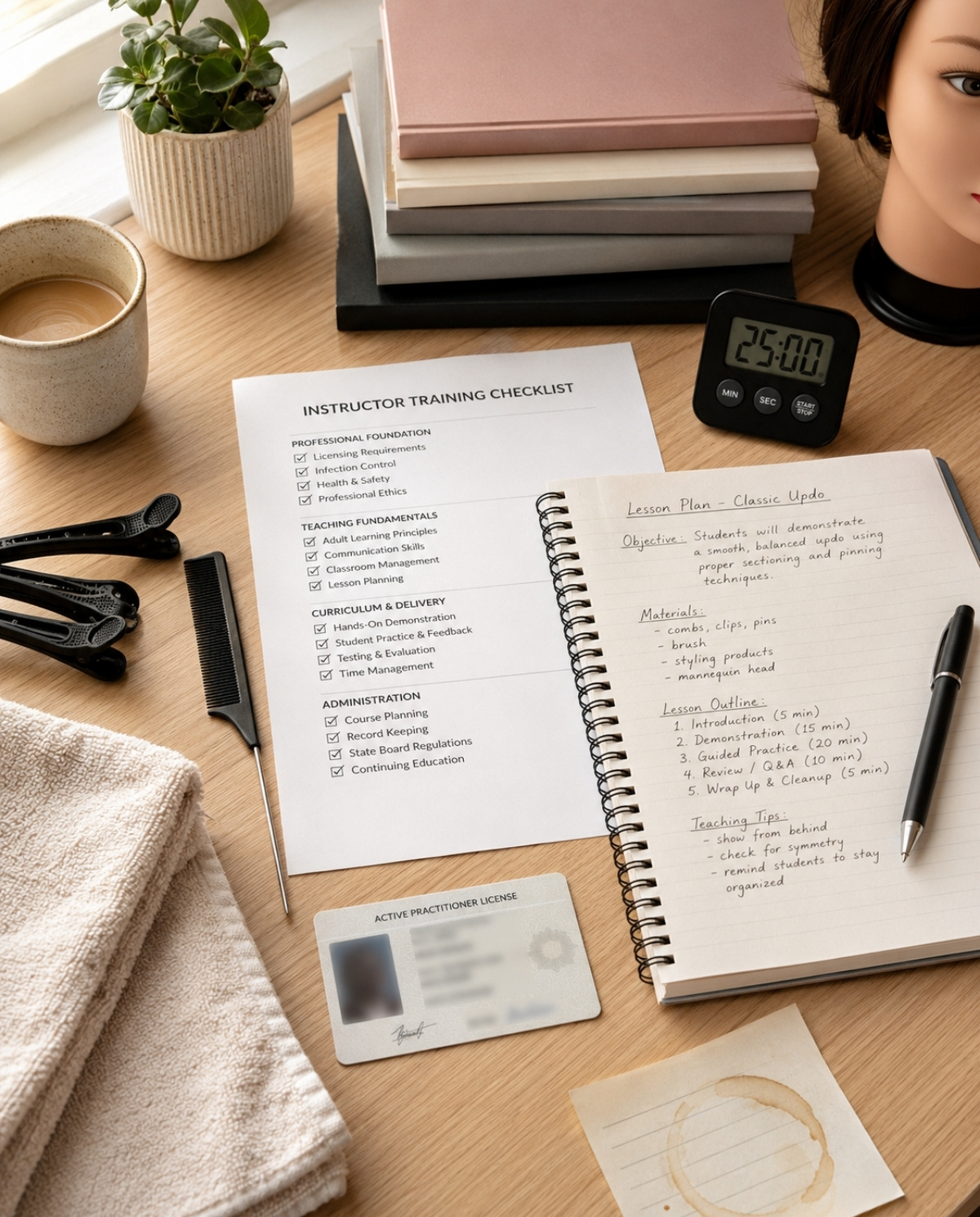
Beauty instructor training checklist, handwritten lesson plan, practitioner license card, timer, comb, sectioning clips, towel, and mannequin head arranged on a classroom preparation desk.

The Baseline Prerequisites

To map out your career transition, you need to understand the underlying cosmetology instructor requirements set by your local board. Usually, the first step is holding an active practitioner license as a cosmetologist, esthetician, or nail technician. From there, your state board might require a specific state approved beauty instructor training program, a certain number of training hours, recent salon work history, a formal exam, or a combination of all three.

I have put together a step-by-step breakdown on how to become a beauty instructor that goes over these foundational benchmarks. Just keep in mind that standard does not mean universal. Always make sure your chosen school program is recognized by the state board where you intend to work before you pay tuition.

Navigating the Classroom Hours

Once you clear your basic work history requirements, you may need to complete formal cosmetology instructor education requirements, depending on your state’s licensing structure. This can mean enrolling in a structured cosmetology instructor training program or reviewing local esthetics instructor license requirements if your passion lies in advanced skincare.

I often see shallow career guides claiming that teaching beauty school is just a low-paying fallback plan, but current industry data tells a different story. The ACTE Career Center lists the national average salary for cosmetology instructors at $52,096 per year, with the top ten percent making around $93,600. Salary.com shows a similar national average of about $50,872. Your actual income will depend on your location, your teaching specialty, and whether you work full-time or part-time, but it is absolutely a viable, serious professional path.

The industry is seeing a huge wave of demand for educators who understand modern salon operations, digital client booking systems, and business automation, as noted by industry resources like ProBeauty AI. Your real-world salon experience is incredibly valuable to modern schools because you can bridge the gap between classroom textbooks and the realities of building a clientele. Rather than teaching you how to cut hair or perform a basic facial, an approved instructor course focuses entirely on the mechanics of teaching. You will study classroom management, lesson planning, student evaluation methods, and how to explain technical skills to different learning styles. Choosing the right academy for this phase is a game-changer, and you can see exactly what to expect in this breakdown of what you learn in beauty instructor school before teaching.

The Digital Transition: Can You Train Online?

If you are currently working full-time behind the chair, the idea of giving up your daily income to sit in a physical classroom all week sounds impossible. This financial reality makes a lot of stylists wonder if they can get a cosmetology instructor license online.

The answer is a mixed bag because it depends entirely on your state regulations and school approvals. Some states allow a hybrid approach where you complete your theory-based subjects online. This includes things like learning styles, academic grading scales, and lesson planning. The same applies to specialized tracks, where an online esthetics instructor course or a digital online nail instructor program can save you hours of commuting time.

However, you should not assume an online course covers everything. Instructor training heavily relies on supervised student teaching, clinic floor management, and live demonstrations that are hard to evaluate through a webcam. For example, the Washington State Department of Licensing requires instructor candidates to hold a current qualifying license, graduate from a state-licensed school with at least 500 instructor hours, and pass state-approved written and practical examinations. This is why board-approved structure matters far more than pure convenience.

Before enrolling in any online cosmetology instructor license options, make sure to ask a few practical questions:

  • Is the school approved by your specific state board?
  • Do online theory hours count toward your graduation requirements?
  • Are you required to do your supervised student teaching hours in person?
  • Will this specific program qualify you to take your local state exam?

Balancing digital convenience with hands-on practice is the absolute best way to build confidence before your test date.

Conquering the State Board: Exams and Preparation Strategies

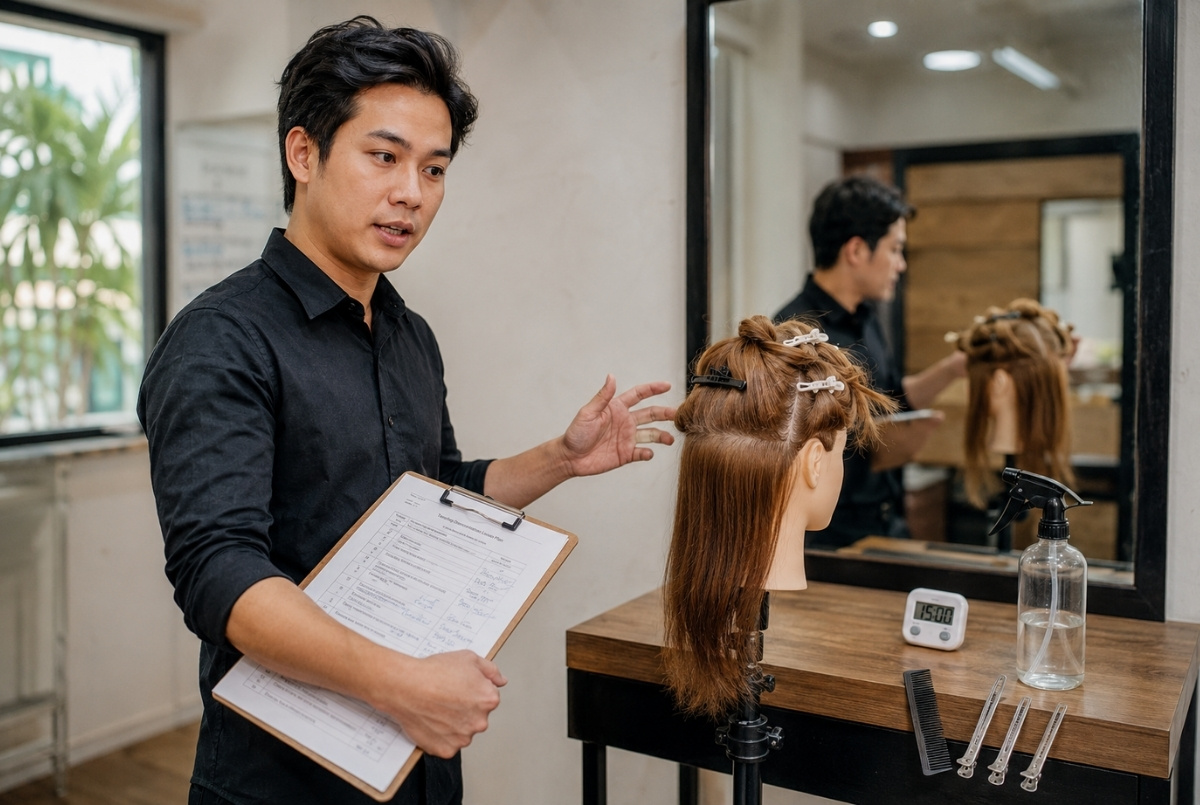
Cosmetology instructor practicing a teaching demonstration with a sectioned mannequin head, clipboard lesson plan, timer, comb, clips, and spray bottle at a salon classroom station.

The biggest mental hurdle for veteran beauty pros is testing anxiety. If you have been out of a school environment for years, facing a formal exam can bring on serious imposter syndrome. Knowing exactly how the test is structured is the easiest way to quiet that anxiety.

In states that require formal testing, the licensing process may include one or more state board cosmetology instructor exams. The exact layout depends on your state and testing vendor, but many pathways include a written theory exam and, in some cases, a practical or teaching demonstration.

  • The Theory Exam: This is usually a computer-based, multiple-choice cosmetology instructor written exam. It may test you on educational psychology, curriculum design, student evaluation, infection control, and state laws. A similar written-test structure may apply to specialized fields, such as esthetics instructor or nail instructor exams, depending on your state’s requirements.
  • The Practical or Teaching Demonstration Exam: In states that require it, this portion judges your actual teaching mechanics. A standard cosmetology instructor practical exam may require you to submit a formal lesson plan, deliver a mini-lecture, explain critical safety protocols, and show that you can supervise a classroom safely. They are not just grading your technical skill; they are grading your ability to teach it legally and safely to others.

To give yourself the best chance of passing on your first try, I recommend following a highly structured preparation routine.

First, download the current candidate information bulletin from your state’s official testing vendor. If your state uses PSI, check their official Test Taker Guides and Candidate Information Bulletins. If your state uses the NIC National Instructor Theory Examination, grab their specific bulletin. These packets outline the exact exam categories, testing fees, allowed reference materials, identification rules, and safety steps.

Second, commit to using a comprehensive cosmetology instructor study guide. Spend time with a digital cosmetology instructor practice test to get used to the phrasing of multiple-choice questions. I highly recommend taking a complete cosmetology instructor state board practice test under timed conditions until you are consistently scoring above 80 percent.

If your state requires a teaching demonstration, practice your lesson plan out loud in front of another licensed stylist. Have them check your pacing, clarity, and sanitation language to ensure your instructions are easy for a beginner to follow. Once your scores are up, gather your graduation certificates, your active practitioner license info, your completed cosmetology instructor application, and your testing fee to lock in your date.

State-by-State Breakdown: Navigating Regional Rules

Because there is not a single national teaching credential, you have to follow the exact laws of your state. I always tell people to treat each state as an entirely independent pathway.

For instance, getting a cosmetology instructor license in Georgia requires a structured, hour-based program. Georgia’s PSI vendor guidelines outline 750 school hours for Master Cosmetology and Hair Designer tracks, 500 hours for Esthetician Instructors, and 250 hours for Nail Technician Instructors.

If you look at getting a cosmetology instructor license nc, North Carolina also sticks to category-specific requirements. The North Carolina Board of Cosmetic Art Examiners requires 800 hours for cosmetology, 650 hours for esthetics, and 320 hours for manicuring or natural hair care in an approved teacher program—unless you can prove a full year of full-time salon work right before you apply.

Compare that to a cosmetology instructor license in texas, where the rules changed completely. The Texas Department of Licensing and Regulation states that an official instructor license is no longer required to teach beauty courses. Instead, a licensed school can hire anyone who holds an active practitioner license for the specific subjects they teach, allowing schools to set their own hiring standards.

California takes a similar approach. The California Board of Barbering and Cosmetology sets strict training hours for practitioner licenses, but it does not offer a separate cosmetology instructor license california pathway. Most schools there simply look for an active, experienced specialty license when hiring faculty, which is common for cosmetology teacher training in California.

In the Midwest, a cosmetology instructor license in illinois goes back to a traditional hour structure. According to Illinois Administrative Code Section 1175.405, the state allows you to qualify with either 500 training hours if you have two years of active salon experience, or 1,000 training hours if you do not have that recent work history.

Out West, a washington state cosmetology instructor license requires a current state practitioner license, 500 formal instructor hours from a licensed school, and passing scores on both the written and practical exams, according to the Washington State Department of Licensing. For a cosmetology instructor license utah pathway, testing is handled through the Division of Professional Licensing, meaning you will need to study their specific Utah cosmetology exam information before scheduling your test date.

Even teacher salaries and license maintenance change across state borders. The ACTE Career Center highlights states like Wisconsin, California, and North Carolina as strong paying markets, but local demand changes quickly. Always double-check your training path, exam steps, and renewal fees directly with your local board before investing in tuition.

Keeping Your Credentials Active: Renewal and Continuing Education

Beauty instructor continuing education workspace with laptop, online course screen, renewal planner, calculator, notes, nail swatches, comb, mug, and folded towel near a window.

Earning your certificate is an incredible achievement, but keeping it active takes regular maintenance. To keep your classroom doors open, you need to stay on top of your renewal dates. Many states require educators to complete continuing education units before they can renew. However, these continuing education rules are not identical across the country. Some states require instructor-specific training, others just require you to keep up with your underlying practitioner license, and some do not require continuing education for instructors at all.

Treat your renewal as a state-specific compliance habit. When your renewal window opens, look up what is the fee to renew a cosmetology instructor license on your board’s website. Check the exact expiration dates, late-payment penalties, and whether your cosmetology instructor ceu classes need to come from a state-approved provider so you do not risk a lapse in your right to teach.

Our approach to education mirrors where the beauty industry is heading as a whole. According to resources like America’s Beauty Show, modern hair trends are heavily focused on overall wellness and sustainability. Similarly, the Rizzieri Aveda School notes that clients are arriving at salons highly informed, expecting their beauty professionals to understand how underlying conditions affect their skin and hair.

As an instructor, your job is not just to teach students how to name a trend; it is to give them a teachable system. They need to learn how to screen for contraindications, protect the skin barrier, explain product ingredients simply, and know exactly when a client’s concern needs to be referred to a medical professional. Continuing education is your best tool for keeping your professional credibility alive in an industry driven by social media and high consumer expectations.

Fortunately, balancing your license maintenance with a busy teaching schedule is simple when your state allows online hours. Many approved providers offer cosmetology instructor continuing education classes online, letting you finish your required hours during school breaks or evenings. Just confirm your state board accepts the specific provider before you sign up.

Frequently Asked Questions

Can I teach out of state if I move?

Licensure does not automatically cross state lines. If you move, you will need to apply for reciprocity or endorsement through your new state board. They will review your original schooling hours, exam scores, and work history to see if you meet their local standards or if you need to take extra training hours or tests.

What happens if my practitioner license expires but my instructor license is active?

In most places, your legal right to teach depends entirely on keeping your underlying practitioner license active. If your cosmetology, esthetics, or nail tech license lapses, you usually lose the ability to teach that subject until it is fully restored. This is incredibly important in states that do not issue separate instructor credentials, as your practitioner license is the main paperwork your school has to verify.

How much does it cost to renew an educator license?

The processing fees vary completely by state. When you are planning your career budget, make sure to check what is the fee to renew a cosmetology instructor license directly on your state board’s website, as these rates change regularly.

Do I need a separate certification for nails or skin if I have a cosmetology instructor license?

Generally, a comprehensive cosmetology instructor credential may allow you to teach subjects covered under the general cosmetology curriculum, including hair, skin, and nails. However, your exact teaching scope depends on state law, school approval, and the license category you hold. Specialized credentials like an esthetics instructor certification or a nail instructor certification usually limit you to teaching strictly within that specific department. Always verify your teaching scope with your school and board before taking on a new class.

Ready to Step Into Your Legacy?

The shift from working behind the chair to leading the front of a classroom is about reclaiming your physical health, setting a stable schedule, and mentoring the next generation of beauty professionals. You already have the hands-on talent and the real-world salon experience. Now, it is just a matter of partnering with an educational team that knows how to turn your everyday expertise into true instructional mastery.

If you are ready to take that next professional step, come find out more on our Enrollment page. We would love to chat with you about your goals, answer your questions, and walk you through how our instructor training helps students build teaching, classroom management, lesson planning, and state board preparation skills.

Have a few questions before you get started? Drop your details in the contact form we have left right below this article. An admissions advisor will reach out to give you all the details, talk through your career options, and help you get started on your new path.