

Client Consultation and Salon Policies for Nail Technicians
What Professional Nail Techs Should Keep in Mind
- Consult Before You Begin: A consistent client consultation process can reveal previous product reactions, relevant health concerns, existing nail damage, and other information that may affect how a service should be performed.
- Put Business Expectations in Writing: Policies covering deposits, cancellations, late arrivals, payments, repairs, and communication make expectations easier for both the technician and the client to understand.
- Respect the Limits of Your License: Nail professionals provide cosmetic services, not medical diagnosis or treatment. Technicians should understand their state's scope of practice and recognize situations that call for postponing, adapting, or declining a service.
- Reduce Preventable Product Exposure: Careful application, proper curing, avoiding uncured product on the skin, and following manufacturer instructions can lower unnecessary acrylate exposure. Nail professionals should also know state-specific restrictions on products such as Methyl Methacrylate (MMA).
Beginning a career behind the nail table involves much more than learning how to create smooth enhancements or polished nail art. New technicians also have to manage appointments, communicate boundaries, evaluate whether a requested service is appropriate, and keep useful client records. A professional system for salon policies and consultations helps turn these responsibilities into a repeatable process instead of leaving you to make decisions on the spot.
Build Your Client Rules Before Problems Start
Good salon boundaries work best when clients know about them before their appointment. Written policies can explain cancellation deadlines, deposits, late-arrival limits, accepted payment methods, repair expectations, and how clients should contact you.
Having these rules available also makes booking conversations more efficient. Instead of repeatedly answering questions about pricing, timing, nail-art requests, deposits, or inspiration photos, technicians can provide clients with a consistent set of expectations before the appointment begins.
Consistency matters just as much as having the policy itself. If rules change depending on the client, they become much harder to enforce. Applying the same standards to no-shows, rescheduling, service changes, refunds, and repairs helps turn personal decisions into established business procedures.
Strong client-management habits belong alongside your technical education. Developing a nail tech skills checklist can help you think beyond application techniques and consider the procedures, tools, safety practices, and professional habits needed for salon work.
The business environment also gives technicians a reason to take professionalism seriously. A Research and Markets industry report estimates the global nail salon market at $14.08 billion in 2026, compared with $12.98 billion in 2025, and identifies greater attention to hygiene and safety standards among developing market trends. Meanwhile, a Grand View Research analysis discusses increasing consumer attention to ingredient safety, sustainability, and clean beauty products. Professional policies and visible safety practices can therefore play an important role in establishing trust with today's clients.
Use Consultation Records as a Safety Filter

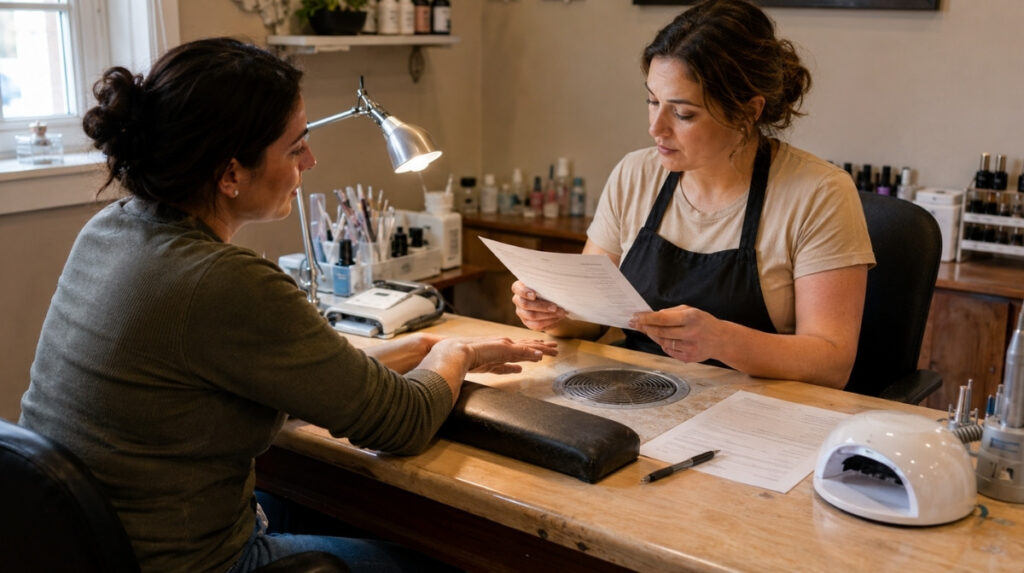
An intake form gives you a repeatable way to collect information that may affect a nail service. Written consultation documentation is not mandated nationwide for every nail appointment, but it can help technicians avoid relying solely on memory or a casual conversation.
For a new client, the initial form can establish important background information. Later appointments provide an opportunity to update that record when allergies, medications, health history, nail condition, previous reactions, or other service-relevant circumstances change.
- Ask About Previous Product Reactions: Clients should have an opportunity to disclose reactions to gel products, acrylic systems, nail adhesives, primers, solvents, or similar products. Acrylates and methacrylates are reactive ingredients found in many nail systems. Repeated exposure, improperly cured material, and uncured product touching the skin can contribute to sensitization and Acrylate Allergic Contact Dermatitis.
- Identify Health Information That Could Affect the Service: Diabetes, peripheral neuropathy, and circulation problems may require additional caution, particularly during foot services. The Centers for Disease Control and Prevention explains that diabetes can cause nerve damage and reduced blood flow in the feet. That can make injuries harder to notice and may interfere with healing. Nail technicians should not diagnose these conditions, but disclosed medical history can help them decide when a conservative approach or healthcare referral is more appropriate.
- Ask What Happened to the Natural Nail: Previous enhancement removal, trauma, aggressive filing, picking, or painful nail services can leave the nail plate thin, sensitive, or damaged. Understanding what happened before the appointment can help a technician determine whether the planned service should proceed unchanged, be adjusted, or wait until the nail has recovered.
- Record What Was Actually Done: Useful service notes may include the products or systems used, changes visible on the client's nails or surrounding skin, reactions observed during the appointment, service modifications, and any recommendation to seek professional medical evaluation. Stick to observable information instead of writing an unsupported diagnosis.
Acrylate sensitivity deserves particular attention because exposure does not always remain a minor salon issue. Research published in PubMed / Nursing for Women's Health describes Acrylate Allergic Contact Dermatitis as an increasing concern for both manicure clients and professionals. The article identifies repeated exposure and improper curing as important risk factors and discusses symptoms that can include itching, redness, swelling, dermatitis near the nails, and nail changes such as onycholysis.
Sensitization can also matter outside the salon. A review of acrylate exposure discusses the use of acrylates and methacrylates in dentistry as well as medical products, including some adhesives and wearable diabetes devices. Having an acrylate allergy does not automatically rule out dental treatment, surgery, or medical-device use. However, someone with a confirmed allergy should make relevant healthcare professionals aware of it so the specific allergen and alternative materials can be considered.
Technicians should also be careful with claims such as HEMA-free. Removing HEMA does not automatically remove every potential acrylate or methacrylate allergen. A laboratory study published in Contact Dermatitis and indexed by PubMed tested 31 gel nail products and six acrylic products. Methacrylates were detected in 32 of the 37 samples, and all 32 showed differences between the methacrylates detected during testing and those disclosed on the product packaging. HEMA itself was found in 20 of the 37 products.
For working technicians, the practical lesson is straightforward: a marketing label should never replace careful product handling. Keep uncured material away from the skin, follow the manufacturer's curing instructions, and use products that are designed to work together as a compatible system.
Stay Inside Your License and Know When to Stop

Being able to recognize when a nail service should not continue is part of responsible professional practice. Nail technicians work within a cosmetic scope; diagnosing or medically treating nail and skin disorders belongs to qualified healthcare professionals.
For technicians practicing in Missouri, the state's definition of a Class MO manicurist includes cutting, trimming, polishing, coloring, cleaning, or otherwise beautifying fingernails and toenails; applying artificial nails; and cleaning or massaging the hands, arms, legs, and feet. You can review that scope through the Missouri Revised Statutes governing cosmetology and manicuring.
The professional goal is not to decide which disease a client has. Instead, look for conditions that make the planned cosmetic service questionable and know when additional evaluation may be appropriate.
Warning signs can include:
- Nails with unexplained lifting, crumbling, marked thickening, unusual discoloration, or significant distortion
- Skin around the nail that appears unusually swollen, hot, painful, intensely red, or is producing drainage
- Bleeding, open wounds, broken skin, significant irritation, or a spreading rash within the service area
- Green discoloration visible beneath a separated natural nail or lifted enhancement, which can occur with bacterial colonization and should not simply be covered by another enhancement
How you document those findings matters. Write down what you can actually observe, such as green discoloration beneath lifted product or red and swollen skin with drainage. Avoid recording terms such as fungus, Pseudomonas, or paronychia as your own diagnosis unless the condition has already been diagnosed by an appropriate healthcare professional.
If the condition appears to fall beyond ordinary cosmetic nail care, explain the concern without diagnosing it. Depending on the circumstances and applicable state requirements, the technician may need to modify or postpone the appointment and encourage the client to consult a physician, dermatologist, podiatrist, or other qualified healthcare provider.
State requirements differ considerably, which is why technicians should rely on the rules governing the state where they actually practice. Missouri's cosmetology sanitation rules, for example, contain requirements for sanitation, implement disinfection, blood exposure procedures, prohibited nail products, and prohibited callus-removal tools.
Other states take their own approaches. For comparison, the Georgia State Board rules require cosmetology services to be performed on intact, healthy skin and nails. Arkansas cosmetology regulations contain their own restrictions involving infectious or communicable conditions and prohibit massage on areas of skin that are inflamed, open, irritated, infected, or affected by an eruption. These differences are exactly why a technician should not assume that a rule from one state automatically applies in another.
Technicians interested in serving clients who require a greater degree of risk awareness can also explore medical nail technician education, safety, and professional boundaries. Advanced private training can strengthen knowledge of screening, infection prevention, and appropriate referral, but a private credential does not turn a nail technician into a medical provider or enlarge the legal scope granted by a state license.
Declining a service does not require frightening the client or pretending to know the cause of the problem. Explain the visible concern, tell the client why you are uncomfortable proceeding cosmetically, and recommend appropriate professional evaluation when necessary.
Know the Sanitation Rules Behind Your Services
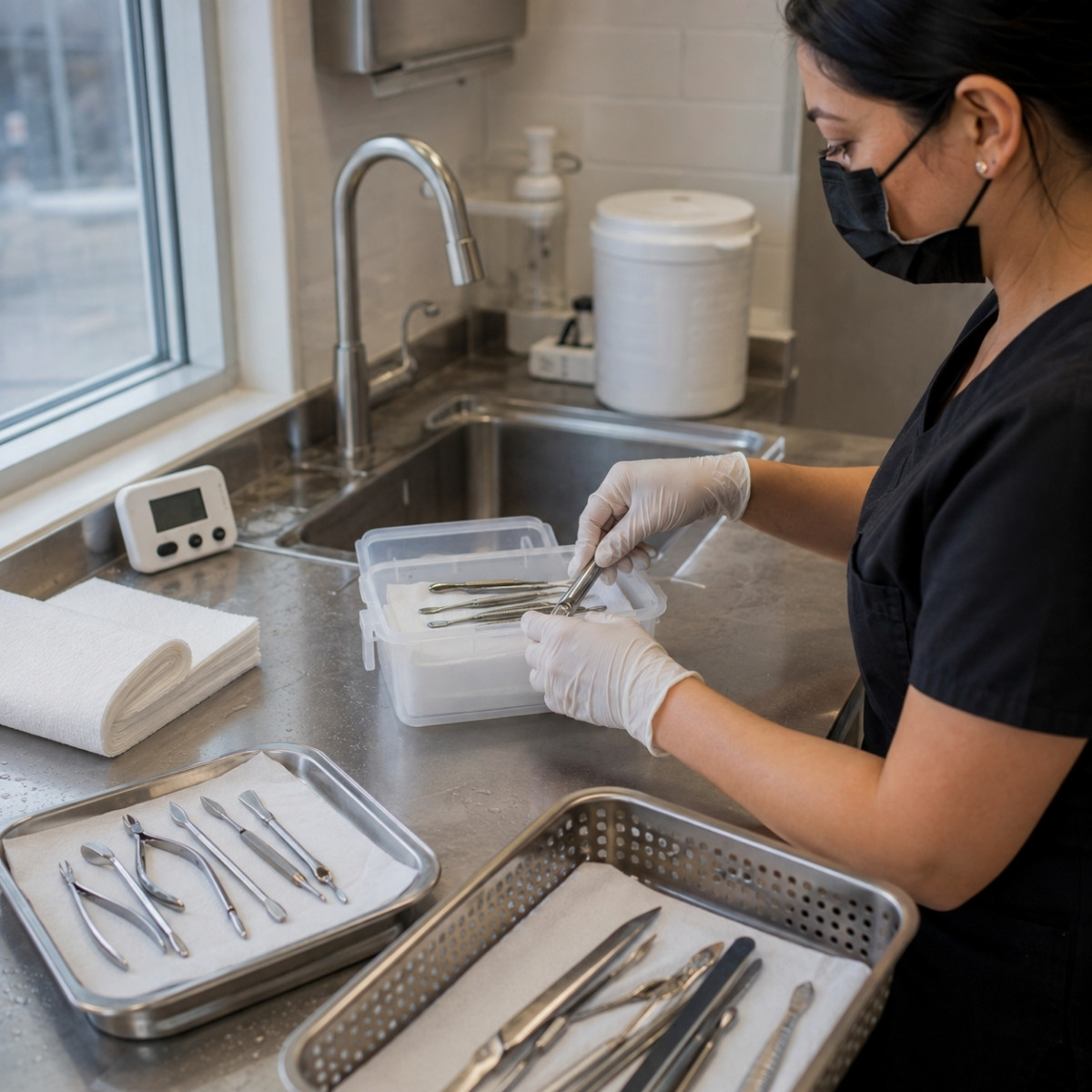
A clean-looking salon is not enough by itself. Technicians need to understand which tools and products are permitted and how reusable equipment must be handled under applicable rules.
Missouri's cosmetology sanitation regulations require implements that may directly or indirectly contact a client to be cleaned and disinfected with an EPA-registered disinfectant meeting the rule's requirements. The same Missouri rule also prohibits razor-type callus shavers designed to cut growths of skin, including Credo blades and similar instruments. These tools may not be used for cosmetology services or kept on the premises of a licensed cosmetology establishment. See the Missouri cosmetology sanitation rules for the full requirements.
Other jurisdictions provide useful examples of why nail professionals should never assume that every device marketed for salons qualifies as an infection-control tool. The Connecticut Department of Public Health infection-control guidance, for instance, prohibits razor-type callus shavers and explains that UV light boxes are not approved as infection-control devices. UV cabinets may instead serve as dry-storage units for implements that have already been properly disinfected.
Disinfectant contact time is another area where guessing can create problems. The U.S. Environmental Protection Agency explains that contact time is the period during which a treated surface must remain visibly wet for a disinfectant to be effective against the organisms listed on its label. Required times differ among products, so technicians should follow both applicable state requirements and the manufacturer's EPA-approved label instead of assuming that every disinfectant works on the same schedule.
Managing Client Changes, Complaints, and Product Concerns
Professionalism is tested most when the situation is uncomfortable. Clients may leave, misunderstand a policy, question a charge, or raise concerns about another technician. Nail professionals may also encounter practices that appear unsafe or unlicensed.
A client who decides to change salons because of hygiene, pricing, communication, or service quality should be able to do so without unnecessary conflict. On the professional side, clearly documented policies reduce confusion when a client relationship changes or ends. A useful website FAQ can also answer common questions before new clients book, including what information they should provide, how repairs work, what happens if they are late, and what to expect from the consultation.
Client confidence is also easier to build when sanitation practices are visible and understandable. Educating clients about professional nail salon hygiene and aftercare helps explain how cross-contamination is reduced during the appointment and what clients can do to care for their nails afterward.
When a situation appears to involve unlicensed practice or a violation of professional regulations, technicians should use the complaint system for the state where the conduct occurred. For Missouri, the Missouri Board of Cosmetology and Barber Examiners Consumer Complaint Guide explains that written complaints may be filed regarding a licensee, registration holder, unlicensed individual, or unlicensed entity when the alleged conduct may violate Missouri's cosmetology or barber laws.
State boards do not necessarily have authority over every customer-service disagreement. Complaints should focus on conduct within the regulator's jurisdiction rather than assuming every pricing, refund, or contractual dispute is a licensing violation. Procedures also vary by state. For example, the Georgia State Board of Cosmetology and Barbers complaint process separately explains what types of matters its Board can review. Technicians should therefore use the complaint authority that governs the location where the alleged violation occurred.
Why MMA Requires Special Attention in Missouri
Methyl Methacrylate, commonly shortened to MMA, is one nail-product issue where understanding the difference between federal and state regulation is especially important.
At the federal level, the U.S. Food and Drug Administration explains that no federal cosmetic regulation specifically prohibits MMA monomer. FDA also notes that after receiving reports of injuries associated with artificial-nail products containing 100% MMA monomer in the 1970s, it pursued enforcement actions that included court proceedings, seizures, and recalls.
That federal position does not prevent states from adopting their own restrictions.
Missouri is especially clear. Under the state's cosmetology sanitation rules, a cosmetology licensee may not provide a service involving a liquid product containing MMA. Licensees are also responsible for making sure nail-service products do not contain MMA as a monomer agent. The rule separately states that products containing ethyl or butyl methacrylate are acceptable for nail services.
This means a Missouri nail professional should not rely only on the broader federal discussion when selecting products. Missouri's own professional regulation directly controls what a Missouri licensee may use during cosmetology services.
The Arizona Barbering and Cosmetology Board also discusses practical concerns associated with MMA. Its guidance notes that MMA can be considerably cheaper than other acrylic nail products and can produce very hard enhancements that are difficult to file or remove.
Price alone is not a reliable way to determine what is inside a product. Nail professionals should purchase from traceable suppliers, maintain product information, review labels and safety documentation, and follow the regulations of the state where they practice.
Common Questions About Forms and Salon Policies
Is there a standard number of years that nail client forms must be saved? No nationwide retention period applies universally to every nail salon's consultation records. Check your state requirements, your professional liability insurance terms, and the record-retention policy established for your business. Health-related and consultation information should be stored securely for whatever period applies to your situation.
Can one intake form cover every nail service? A general form can collect baseline information such as allergies, previous reactions, and relevant health history, while additional questions can be added for services such as pedicures, gel enhancements, acrylics, or hard gel. Maintaining product and service notes can also make future consultations more useful.
What if a client will not complete the consultation process? Explain why your consultation process exists and what information is needed before you begin. If a completed form is required by your salon's established policy, applicable regulation, or insurance requirements, follow that standard. Even where a specific written form is not legally mandated, a technician should not perform a service when there is insufficient information to determine whether it can be carried out appropriately within the technician's professional scope.
Turn Good Technique Into Professional Practice
Strong nail work involves more than product application. Successful professionals also learn how to communicate expectations, recognize service limitations, document important information, follow sanitation rules, and make responsible decisions when a client's condition requires additional caution.
If you are considering professional nail training, visit the Neosho Beauty & Barber College Enrollment page to learn more about getting started and use the contact form at the end of the article to connect with the school.