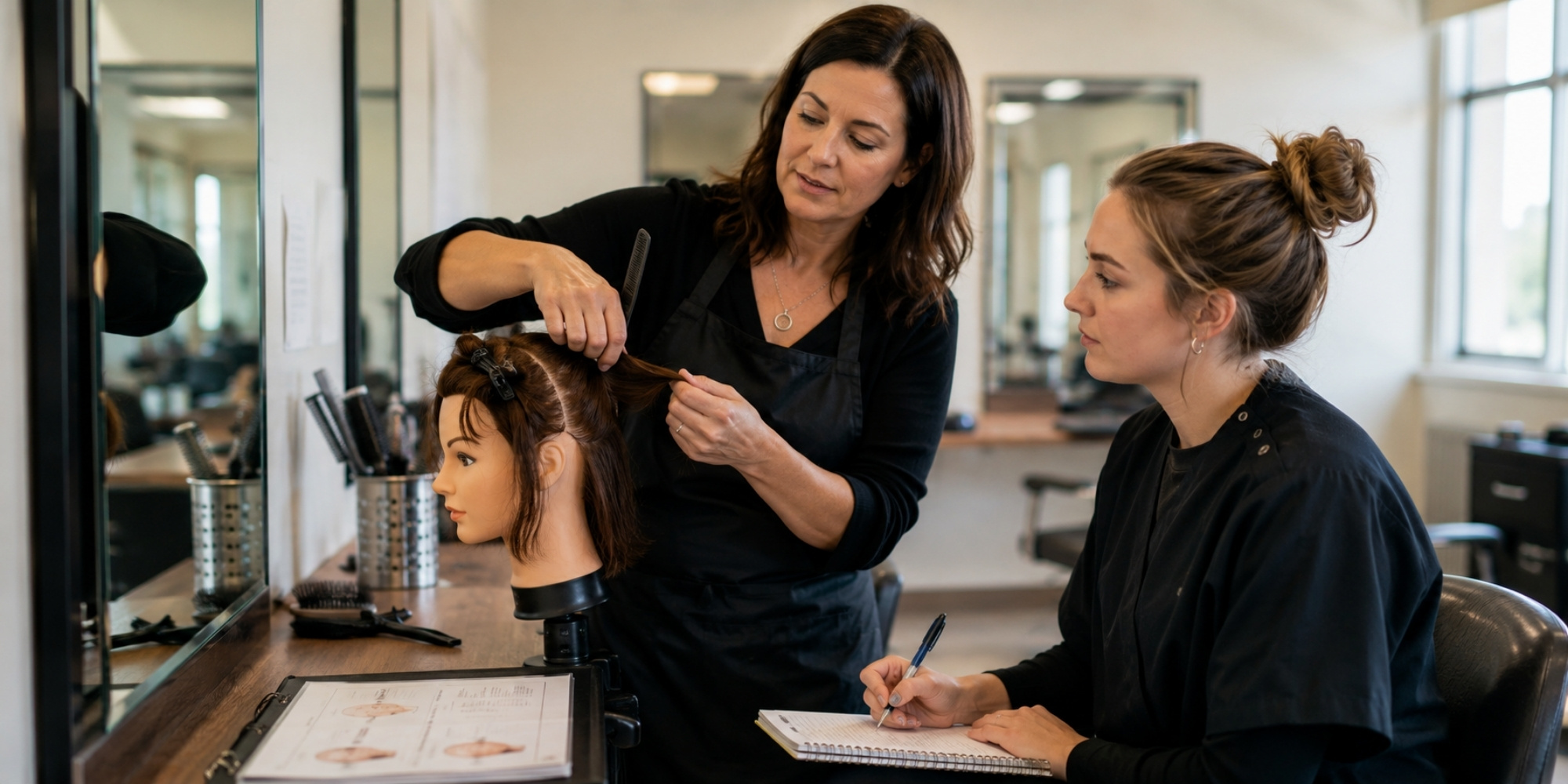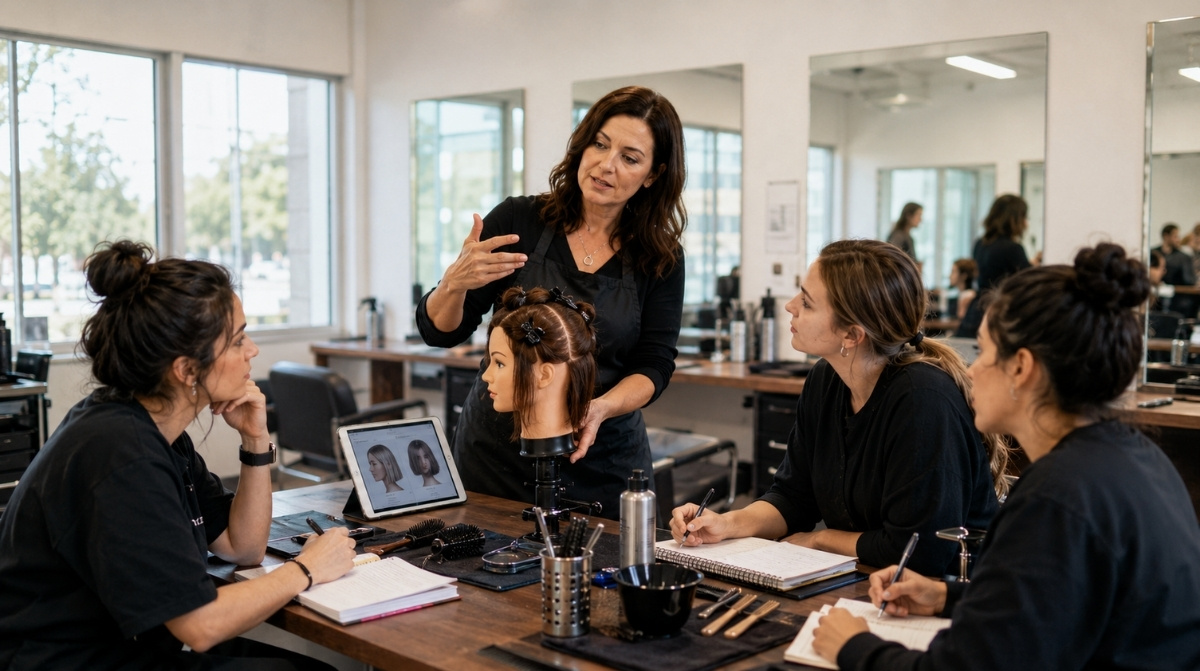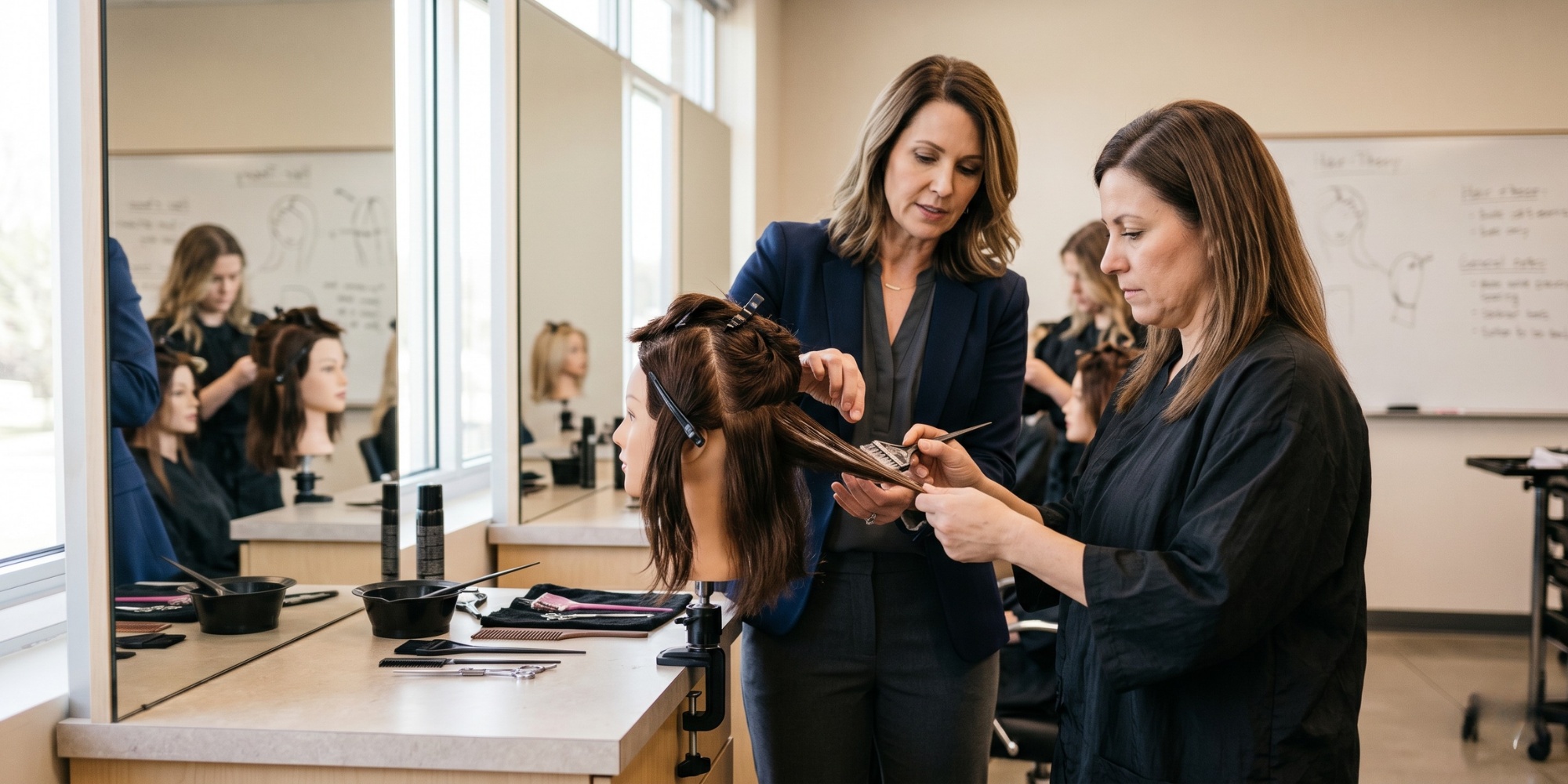
Making the jump from working behind the chair to teaching can feel intimidating, but it is one of the smartest career moves an experienced beauty professional can make. After years of building a clientele, perfecting chemical formulations, and managing client temperaments, many stylists, estheticians, and nail technicians hit a physical limit. Spending ten hours a day on your feet takes a toll on your body, and your income remains entirely tied to your physical stamina. Becoming an educator allows you to step into a position of professional authority, transitioning away from the physical fatigue of the service floor while shaping the next generation of talent.
If you have hesitated because you do not feel ready to manage a busy classroom, it helps to understand that teaching is a distinct skillset. You already know how to perform high-quality services; a dedicated beauty instructor school focuses entirely on helping you transfer that knowledge to beginners. Instead of re-testing your technical execution, instructor training functions as a professional development incubator that transforms your hands-on talent into systematic pedagogical authority.
Key Takeaways
- Pedagogy Over Practicality: The curriculum focuses on instructional design and teaching methodologies rather than basic trade skills.
- Psychological Mastery: Coursework covers the foundations of educational psychology, public speaking, and classroom control to build confident educators.
- Modern Technical Integration: Training prepares you for digital operations, including learning management platforms, digital records, and video-supported instruction.
- Regulatory Frameworks: Future teachers learn to navigate state administrative laws, documentation requirements, student-hour tracking, and compliance metrics.
Shifting Your Mindset From Stylist to Educator
The biggest hesitation I hear from seasoned pros considering a beauty instructor program is the worry that they will pay tuition just to practice basic hair, skin, or nail services again. Fortunately, a state-approved beauty instructor training program starts with the assumption that your technical talent is already up to par. Your time in school will actually be spent studying pedagogy, which is the formal science of educational delivery and instructional design.
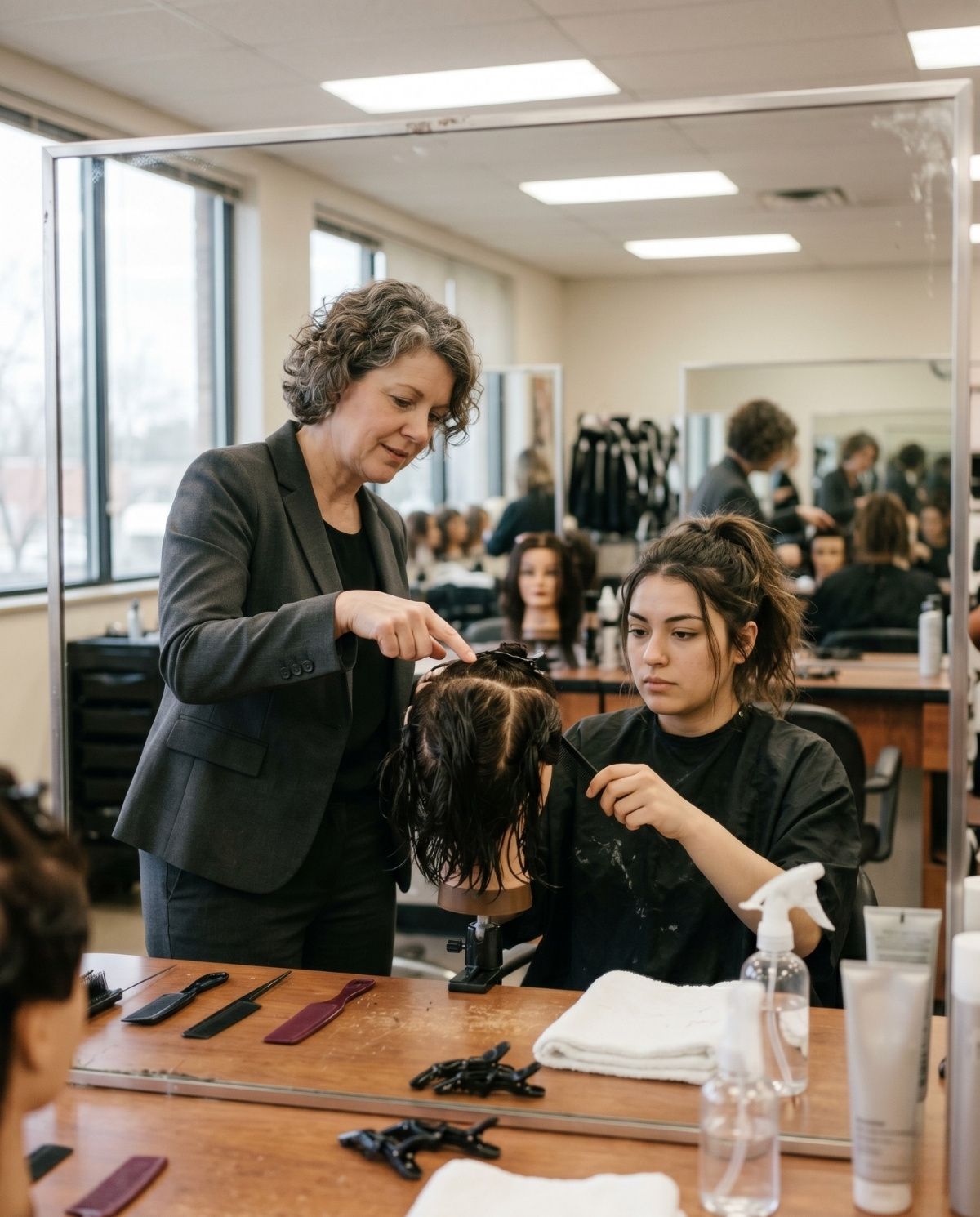
When you enroll in a cosmetology instructor program, your real job is learning how to explain the things you do automatically. Experienced beauty pros survive on intuition and muscle memory. You know the exact angle to hold your shears or the perfect pressure for extractions without even thinking about it. A teacher training course forces you to take those unconscious physical habits and break them down into clear, structured verbal steps.
Instead of relying on vague explanations like telling a student to just look at how it feels, pedagogical training teaches you to give precise directives, such as holding a subsection at a clean 45-degree angle parallel to your parting line.
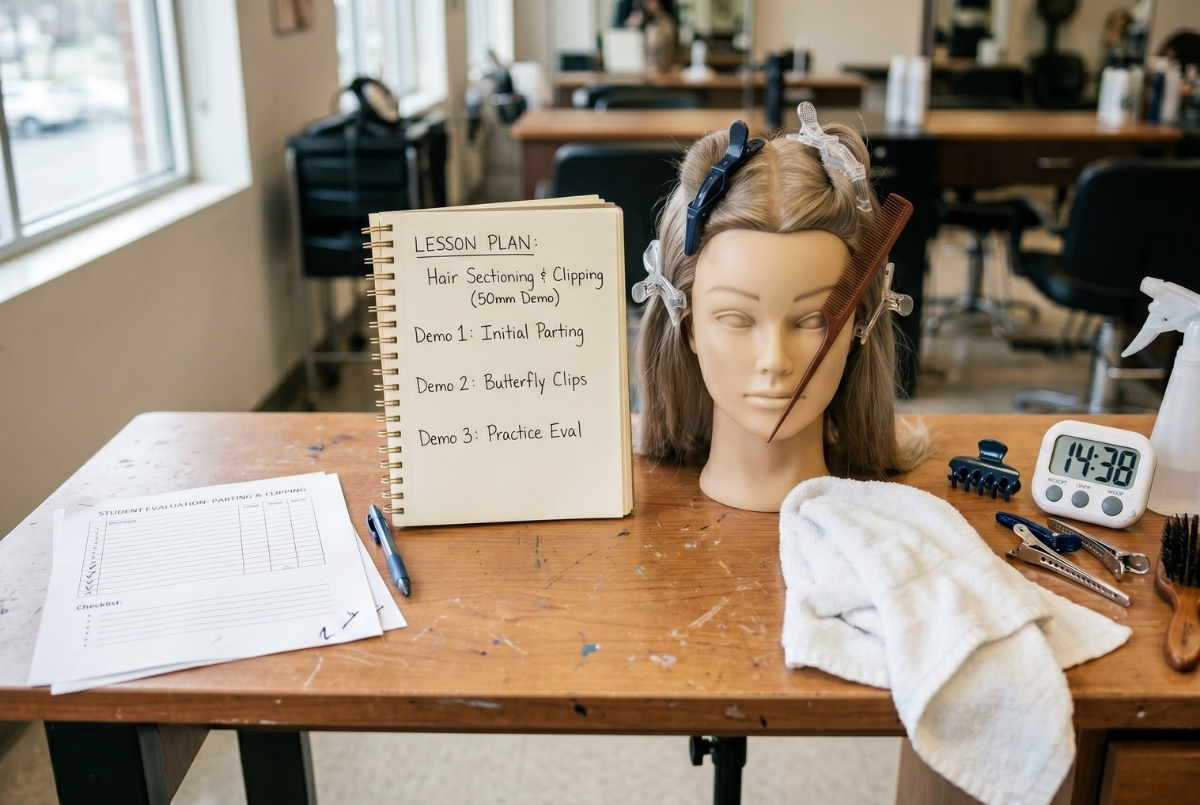
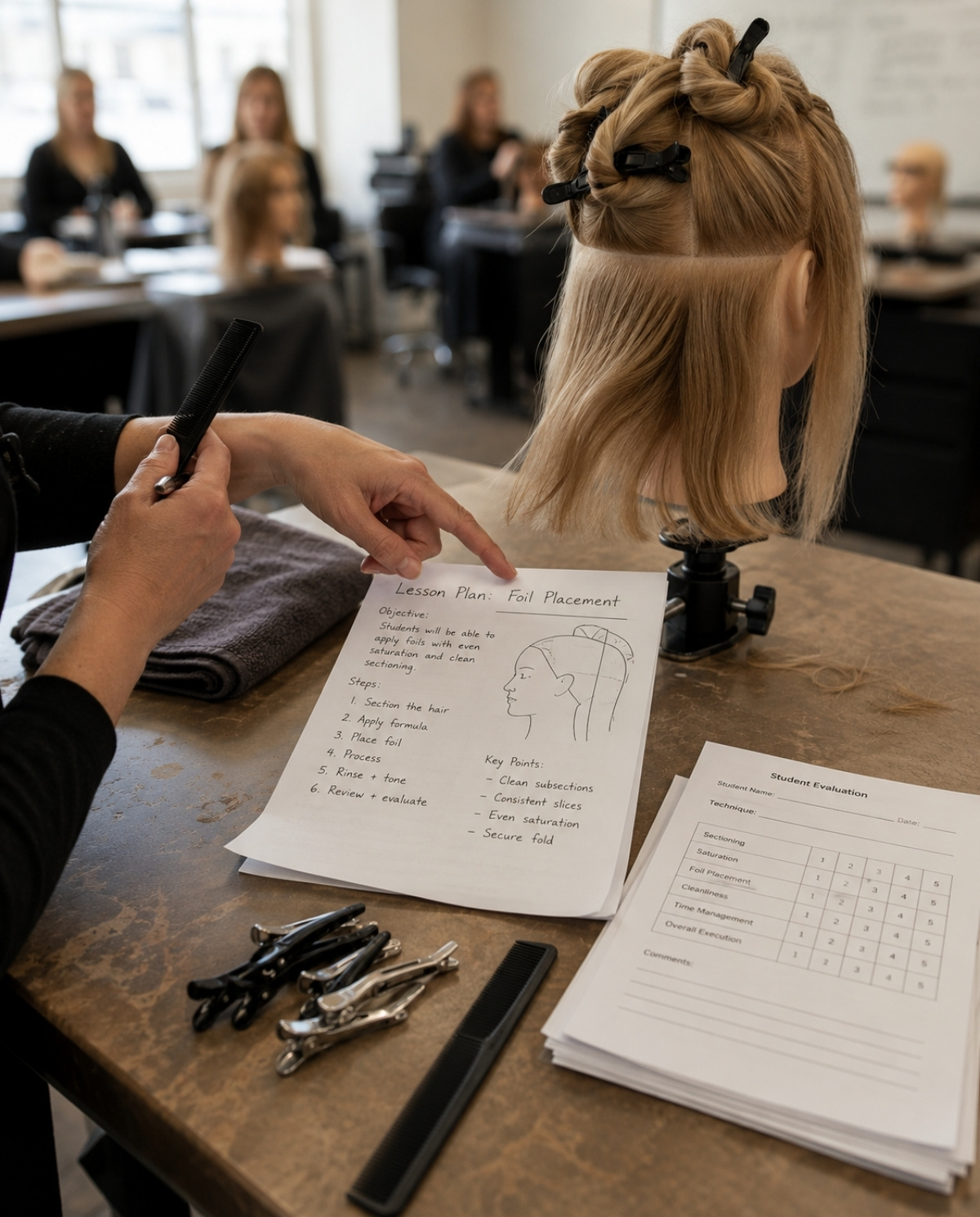
Through systematic beauty school instructor training, you learn to build a syllabus from scratch, organize daily lesson outlines, use visual aids, score student work objectively, and tie daily practice to state testing metrics. This aligns perfectly with how a professional cosmetology instructor course splits up its curriculum. You will cover student motivation styles, lesson delivery, testing rubrics, and actual supervised salon floor instruction. To see how these educational responsibilities translate into a long-term career path, take a look at our complete breakdown on what is a beauty instructor, understanding the meaning, duties, and salary. This structured preparation is what helps a top-tier stylist become an elite educator who can jump seamlessly from lecturing on theory in the morning to managing a busy student clinic floor in the afternoon.
The Core Teaching Methodology
Well-designed educator programs focus heavily on the practical application of core teaching steps, much like the training frameworks utilized by institutions like the International School of Beauty and Coastal Alabama Community College. For example, Coastal Alabama’s cosmetology instructor training places heavy emphasis on structural curriculum creation, teacher-student mentorship, active lesson implementation, and objective testing methods. Standard training tracks across the country are designed to cover basic instructional strategies, classroom management, performance evaluation, and supervised direct student leadership.
The objective here is not to treat you like a freshman beauty student. Instead, your instructors will grade you on how well you organize a lesson, explain a topic, guide hands-on practice, and critique performance without bias. Rather than simply telling a student that a service looks wrong, you learn to use performance objectives and standardized grading sheets so the student can see exactly where their technique drifted from the benchmark.
Classroom Management and Adult Learning Concepts
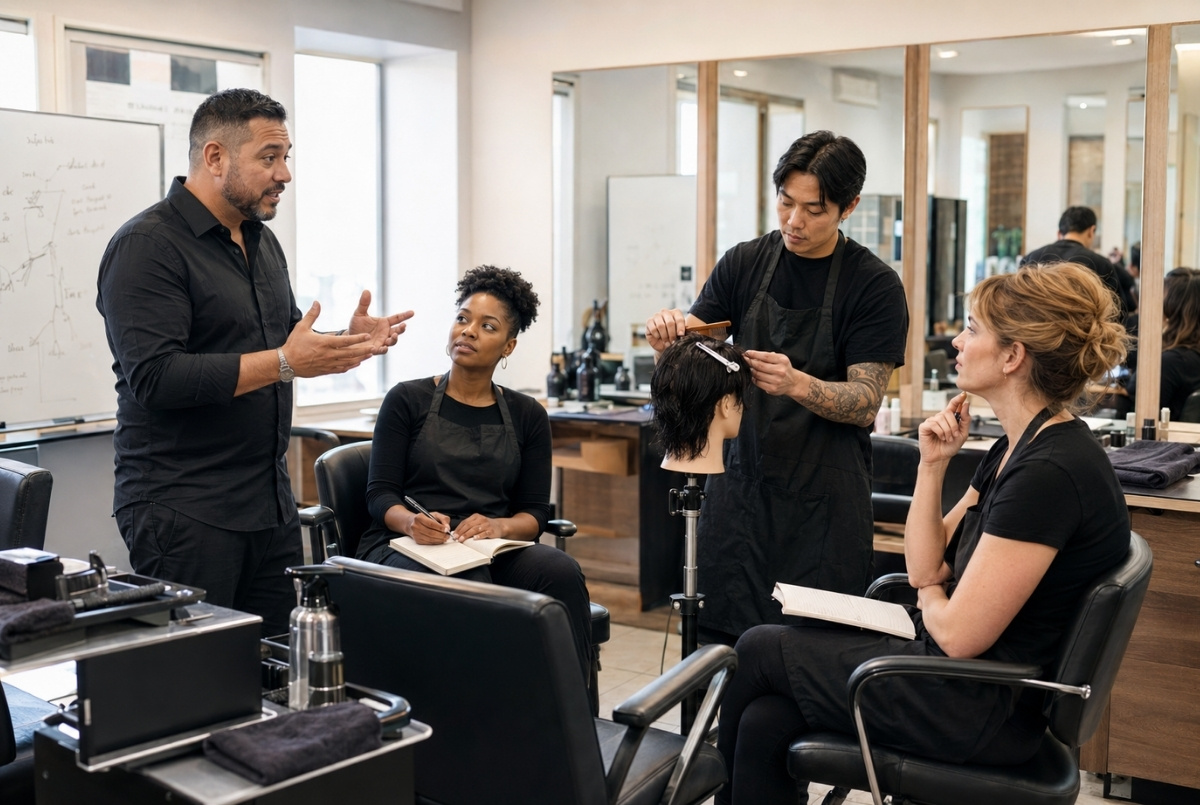
The fear of freezing up during a presentation or losing control of student behavior keeps a lot of talented stylists from entering the classroom. To overcome this anxiety, your beauty instructor training will dive deep into educational psychology, public speaking, and adult learning behaviors.
Teaching adults requires an entirely different approach than teaching children. Adult students are highly practical, focused on their career goals, and bring their own life experiences into the classroom. Because of this, your lesson plans cannot just stay theoretical. I have learned that the most engaging lectures tie the textbook directly back to real-world business risks: chemical over-processing, cross-contamination, client injury, failed licensing exams, and the direct financial loss that comes with poor technique.
You will learn how to identify and support different learning styles, ensuring your beauty instructor training plans speak to visual, auditory, and hands-on learners simultaneously. A student who feels completely lost reading a textbook chapter might experience an immediate breakthrough during a live demo, a whiteboard drawing, or a guided side-by-side correction on a mannequin.
You will also master practical classroom management strategies. This goes far beyond enforcing rules; you will learn how to balance students with different learning speeds, calm down competitive friction on the salon floor, redirect distracted individuals, and keep tech-focused students engaged while maintaining your professional authority. Understanding how adult minds process and adopt new skills gives you the confidence to guide them through their licensing requirements with a calm, commanding presence.
Adapting to the Digital Beauty Classroom
Modern salons run on technology, from online booking apps to digital client files. Because the industry has changed, modern beauty education has evolved past old textbooks and standard dry-erase boards.
When you sign up for a beauty educator course, you will get comfortable working with online learning management platforms, hybrid lesson structures, digital tracking books, and video-supported teaching tools. If you are looking into a cosmetology instructor program online or exploring a hybrid path, keep a close eye on the requirements: while theory lectures may be handled online in some approved programs, licensure-focused instructor training often still requires state-approved supervised teaching, practical evaluation, documented experience, or in-person clinic/lab components, depending on the state.
Your daily setup expands from physical classroom prep to organizing content inside virtual platforms, tracking attendance metrics, and utilizing digital learning materials without losing the critical hands-on coaching that beauty education requires.
You will learn to assess student growth through documented testing tools, create homework assignments that connect digital theory with practical work, and record clean video demonstrations. This technical preparation gives you the flexibility to work inside a modern academy floor while opening doors to alternative career tracks like corporate brand education, remote consulting, and virtual curriculum design.
Utilizing Tech and Learning Management Systems
Modern classrooms rely heavily on digital software to keep operations organized. Many instructional programs integrate digital grading platforms, school email infrastructure, virtual study guides, and technology orientations to help students track their hours and requirements, similar to the instructional framework published by ABC Adult School. Educator courses may also train future teachers on platforms like Zoom and Milady MindTap to manage distance education when approved by local boards.
For a new teacher, the true skill is not just knowing how to operate the software. It is understanding when a digital tool makes a lesson clearer and when it gets in the way of safety-first, hands-on practice. A skilled instructor knows how to use an online video to preview a service and an automated quiz to lock in sanitation laws, while still requiring strict, supervised practice before a student ever touches a live client.
Compliance, Licensing Laws, and State Board Rules

One of the biggest areas where beauty schools struggle is staying compliant with state laws. Because of this, a massive portion of your education focuses on the administrative rules that govern trade academies.
Your beauty educator training will teach you how to read and apply your state’s scope of practice laws, which define the exact legal boundaries of what a professional can do. You will learn to build practical school exams that mimic state board testing rubrics, document student attendance properly, and keep your lesson plans aligned with current licensing standards. If you want a clear breakdown of the exact credentials needed to make this transition, check out our guide on how to become a beauty instructor, training, license, and requirements.
State boards frequently update their rules to address changing consumer demographics, public safety concerns, and health standards. Your training prepares you to analyze these updates, adjust your school’s lesson plans accordingly, and keep the facility out of legal trouble.
For instance, recent regulatory changes from the Illinois Department of Financial and Professional Regulation (IDFPR) show that barber and cosmetology curricula must include specified training on diverse hair textures and types. The same updates introduce a one-time abnormal skin growth education requirement for new applicants and renewals after January 1, 2026, with IDFPR initially approving Impact Melanoma’s “Skinny on Skin” resource to help applicants and licensees comply. Knowing how to manage this administrative side of cosmetology instructor education turns you into a highly valuable asset for school owners, shifting your role from a basic floor teacher to a compliance leader.
Niche Focus Tracks in Educator Training
While the core principles of teaching apply across the board, a great program teaches you how to adapt those methods to your specific field of expertise.
Esthetics Instructor Specialization
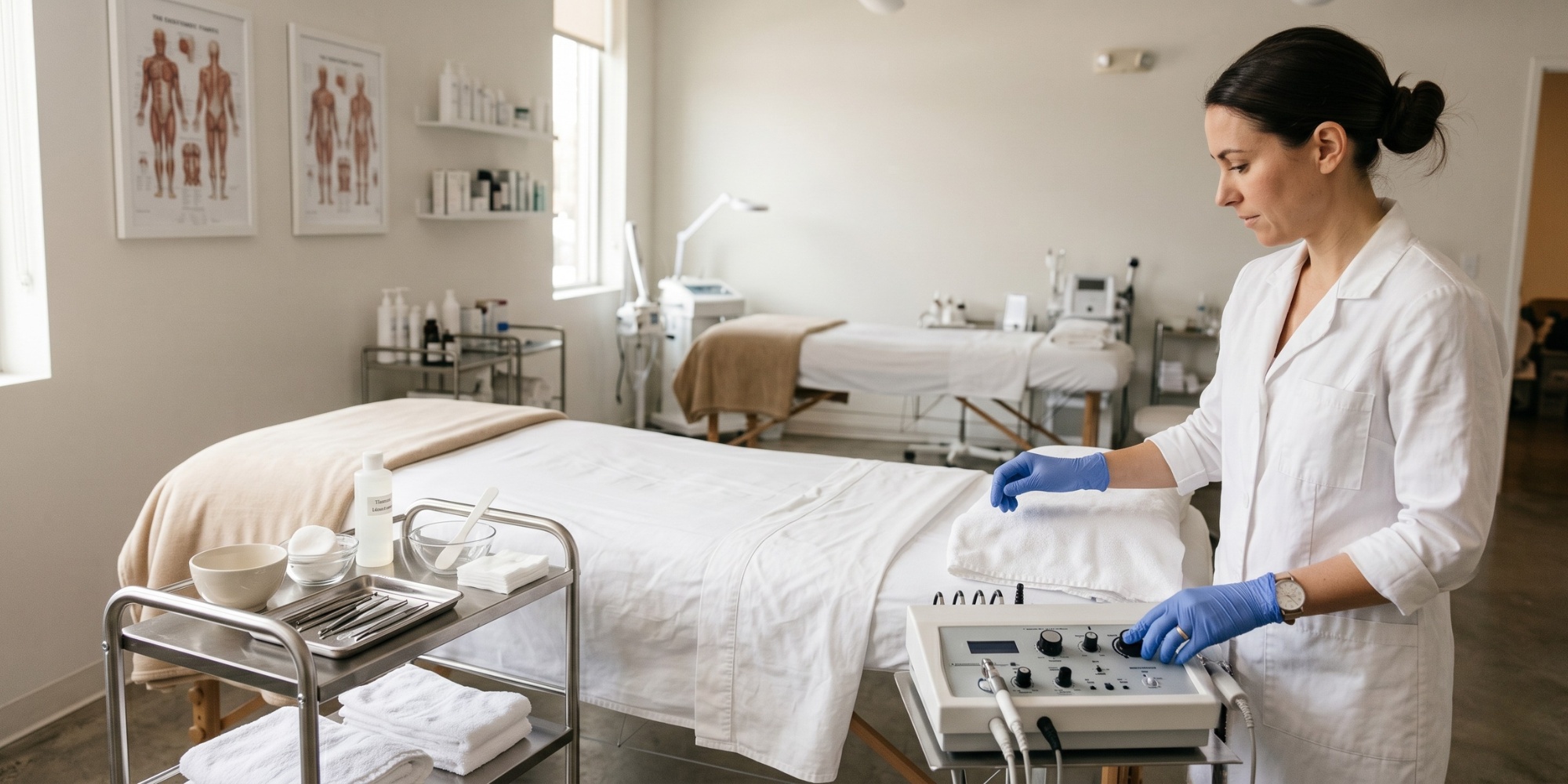
If you choose an esthetics instructor training program, your coursework will target skin analysis, safety protocols, cosmetic chemistry, and skin histology. You will learn how to guide students through the complex science of the skin’s natural lipid barrier, which helps reduce moisture loss, while monitoring exfoliation practice safely within local legal lines.
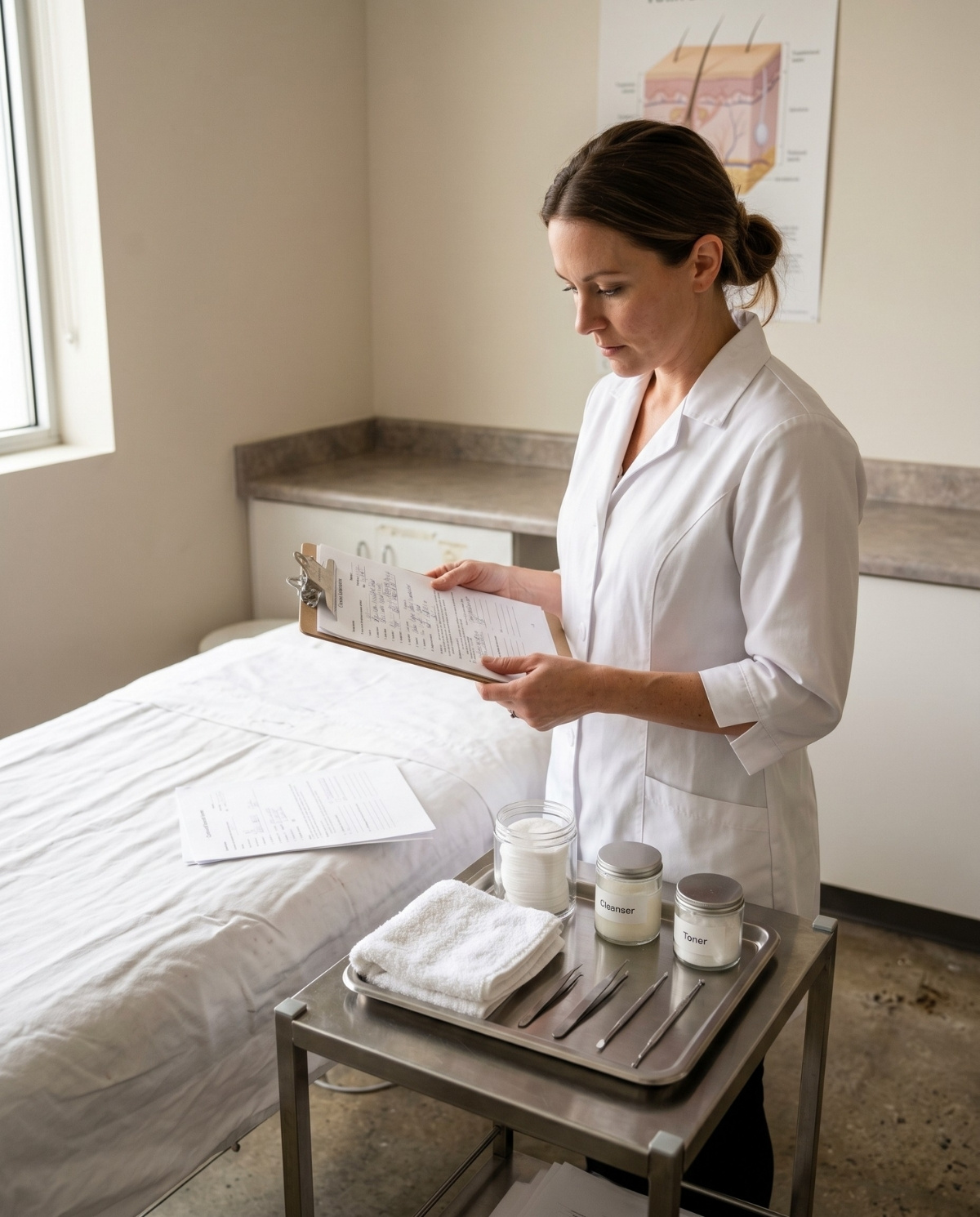
The challenge at the teacher level is moving past basic product instructions. You have to train students to read skin conditions, identify serious contraindications where a service must be turned down, document skin observations accurately, and understand the firm boundary between cosmetic care and medical treatment. Your training ensures you can teach students to analyze ingredient labels critically so they can look past marketing claims and focus on real chemistry.
Nail Instructor Specialization
For professionals inside a specialized nail instructor program, the training zeroes in on ergonomics, infection control, product polymerization, product ratios, dust control, ventilation safety, and safe electric file usage. In this environment, polymerization — the chemical reaction that links individual monomers into durable acrylic chains — is an essential safety topic. It directly affects odor management, proper product curing, skin sensitivity, enhancement strength, and long-term nail health.
You will learn to teach the precise architecture of acrylic and gel enhancements, apex placement, safe e-file pressure, and strict sanitation habits that prevent the spread of infections. The ultimate goal is to graduate students who are technically confident, injury-free, and fully compliant with state safety standards.
No matter which specialty you pursue, completing a structured training program gives you the scientific vocabulary to back up your everyday techniques, boosting your credibility in front of a class.
Streamlining Educational Credentials
The overall demand for qualified trade education continues to rise globally. The beauty school market is projected to expand to a value of $9.61 billion in 2026, according to data from Business Research Insights. This means schools are constantly looking for licensed educators who can manage classrooms, track hours, and adjust to changing board rules. To keep up with this demand, some states are making it easier for dual-licensed pros to add teaching credentials without repeating hours.
Illinois serves as a prime example of this trend. Recent updates from the IDFPR confirm that licensed instructors with verified education and experience may add additional teacher licenses without sitting through redundant introductory classes. Instead, they may be allowed to take only the specific course modules missing from their original training. For example, a licensed cosmetology teacher who wants to earn a barber teacher license may only need to complete modules covering shaving and facial hair subjects, rather than sitting through a much longer crossover curriculum from scratch.
These regulatory updates are helpful because they focus on genuine skill gaps instead of forcing pros to repeat training they have already mastered. For an experienced educator, growing your career is about expanding your credentials efficiently and getting back into the classroom where you can make a difference.
Step Off the Salon Floor and Into Your Authority
Transitioning from a salon stylist, esthetician, or nail technician into a licensed educator is an excellent power move for your career. It shifts you away from the physical fatigue of the service floor and positions you as an industry leader. But to truly command a classroom, you need an educational foundation that matches your ambition. You need a program built on real-world excellence, compliance awareness, and proven results.
When you blend your years of practical salon experience with a professional training structure, you create a long-term career trajectory with massive industry leverage. You have already proven you can master the craft behind the chair. Now, it is time to master the art of teaching it. Don’t let your hard-earned experience stay locked in muscle memory. Turn it into a sustainable, fulfilling career that shapes the future generation of beauty professionals.
If you are ready to take this next step and see how Neosho Beauty College supports future beauty educators, visit our Instructor Training page to learn more about the program pathway.
If you have questions about scheduling, admissions requirements, or the certification process, please leave your information in the contact form below. Our team will reach out to help you map out your transition into educational leadership.
Frequently Asked Questions
What is the difference between a beauty educator and a beauty school instructor?
A licensed beauty school instructor usually works inside a state-approved or licensed school, teaching the curriculum students need for licensure. A beauty educator may work for a brand, salon group, private training company, or product manufacturer, teaching product knowledge, advanced techniques, or business education. Those private or brand roles often do not require a school instructor license unless the person is teaching state-mandated curriculum inside a licensed school.
Do I need to maintain my salon license once I get an instructor license?
Usually, yes, but requirements vary by state. Many instructor licenses are tied to an active underlying cosmetology, esthetics, barbering, or nail technician license, so applicants should verify renewal rules directly with their state board. The safest approach is to keep your base professional license in good standing while maintaining any instructor credential required in your jurisdiction.
What are cosmetology instructor CEU classes, and are they mandatory?
CEU stands for Continuing Education Unit. Some states require instructor-specific continuing education before renewal, while others set general licensee CE rules or no CE requirement at all. When required, these courses may focus on sanitation law updates, scope-of-practice changes, teaching methods, safety standards, educational technology, or classroom management rather than basic salon services. Always check your state board’s current renewal rules before assuming the number of hours or course type required.