

Beauty Instructor License Pathway: Online Options, State Board Testing, and CEU Renewal
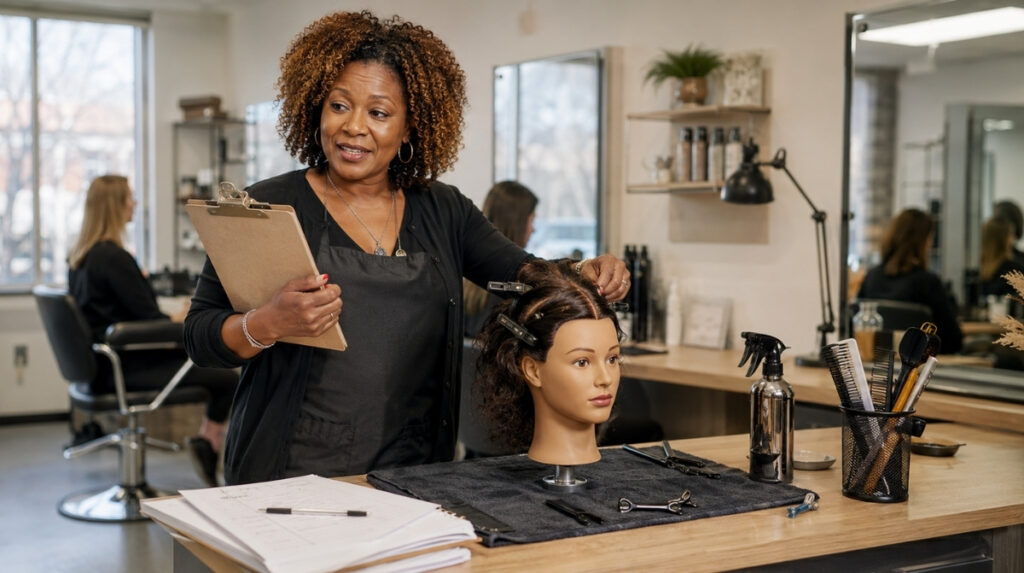
Many experienced beauty professionals eventually reach a point in their careers where the physical demands of working behind the salon chair start to take a toll. Standing on your feet for ten hours a day, managing back-to-back clients, and repeating the same physical movements can lead to chronic fatigue. If you love the beauty industry but want a career path with more predictable hours, better professional stability, and a way to protect your long-term health, transitioning into education is a natural next step. Becoming an instructor allows you to use your hard-earned expertise to shape the next generation of stylists while stepping into a rewarding leadership role.
This comprehensive guide covers everything you need to know about instructor requirements, state board testing preparation, and the process of keeping your teaching credentials active.
Key Takeaways
- Career Evolution: Moving into education helps save your body from chronic fatigue while establishing you as an industry authority. It brings steadier hours and more predictable professional stability than traditional salon booth rentals.
- Curriculum Trends: Modern beauty classrooms teach far more than basic technical skills. Successful programs now focus on salon business strategy, digital branding, skin and scalp wellness, ingredient knowledge, and client communication.
- Flexible Schooling: Depending on your local state board rules and school approvals, you can sometimes find hybrid training pathways. These let you study theory online and complete your supervised student teaching in person.
- Testing Strategy: Overcoming exam anxiety comes down to a clear game plan. Using a dedicated cosmetology instructor study guide, timed practice tests, and your state’s official Candidate Information Bulletin will make all the difference.
Defining the Modern Classroom: What is a Beauty Educator?
Before you start filling out paperwork, it helps to understand how different regions classify this milestone. If you are a generalist covering hair, skin, and nails, you will likely target a beauty school instructor license or a comprehensive cosmetology instructor license. If your expertise is more specialized, you might instead pursue an esthetics instructor license, a nail instructor license, or a natural hair instructor license.
State boards use a mix of titles to describe someone managing a student clinic floor. You might see the role officially called a beauty culture instructor, a cosmetology teacher, or an approved educator. In some areas, like Texas, the state has actually removed the separate instructor license entirely. Instead, licensed schools are responsible for verifying that their teachers hold an active practitioner license for the specific skills they teach, according to the Texas Department of Licensing and Regulation. Regardless of the exact title on your wall, your core mission is shifting from performing services to teaching the theory, safety mechanics, and client communication behind them.
To get a clearer picture of what your daily routine might look like, I recommend checking out this deep dive into the meaning, duties, and salary of a beauty instructor. Learning how to teach ensures you can explain complex procedures to a room full of beginners instead of just doing them yourself.
Setting the Foundation: Prerequisite Requirements and Education
Most states expect a clear baseline of hands-on salon experience, an active license, and formal schooling before you can apply for an instructional credential. You cannot rely on raw talent alone; you have to prove your technical competence and understand your legal scope of practice.
The Baseline Prerequisites
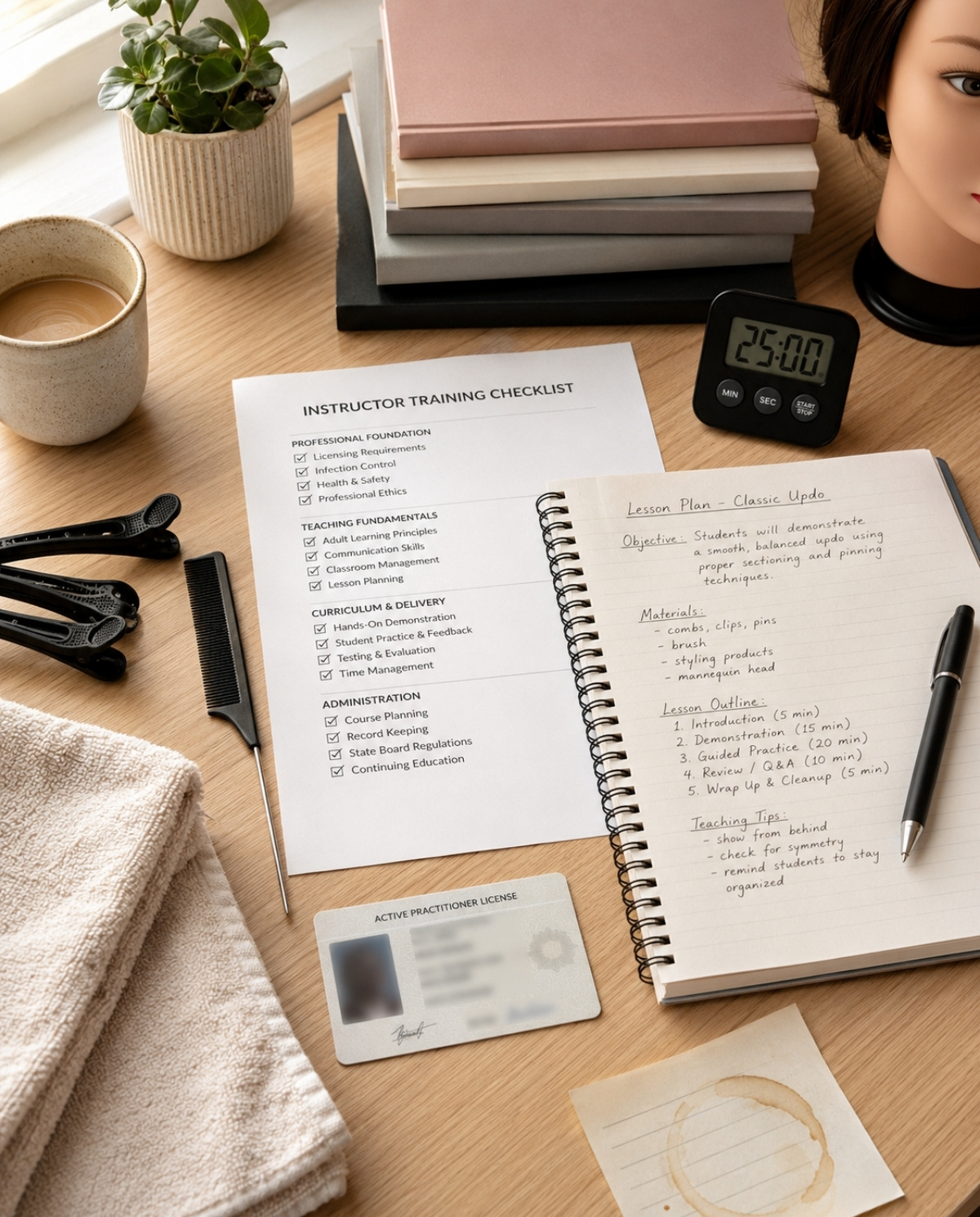
To map out your career transition, you need to understand the underlying cosmetology instructor requirements set by your local board. Usually, the first step is holding an active practitioner license as a cosmetologist, esthetician, or nail technician. From there, your state board might require a specific state approved beauty instructor training program, a certain number of training hours, recent salon work history, a formal exam, or a combination of all three.
I have put together a step-by-step breakdown on how to become a beauty instructor that goes over these foundational benchmarks. Just keep in mind that standard does not mean universal. Always make sure your chosen school program is recognized by the state board where you intend to work before you pay tuition.
Navigating the Classroom Hours
Once you clear your basic work history requirements, you may need to complete formal cosmetology instructor education requirements, depending on your state’s licensing structure. This can mean enrolling in a structured cosmetology instructor training program or reviewing local esthetics instructor license requirements if your passion lies in advanced skincare.
I often see shallow career guides claiming that teaching beauty school is just a low-paying fallback plan, but current industry data tells a different story. The ACTE Career Center lists the national average salary for cosmetology instructors at $52,096 per year, with the top ten percent making around $93,600. Salary.com shows a similar national average of about $50,872. Your actual income will depend on your location, your teaching specialty, and whether you work full-time or part-time, but it is absolutely a viable, serious professional path.
The industry is seeing a huge wave of demand for educators who understand modern salon operations, digital client booking systems, and business automation, as noted by industry resources like ProBeauty AI. Your real-world salon experience is incredibly valuable to modern schools because you can bridge the gap between classroom textbooks and the realities of building a clientele. Rather than teaching you how to cut hair or perform a basic facial, an approved instructor course focuses entirely on the mechanics of teaching. You will study classroom management, lesson planning, student evaluation methods, and how to explain technical skills to different learning styles. Choosing the right academy for this phase is a game-changer, and you can see exactly what to expect in this breakdown of what you learn in beauty instructor school before teaching.
The Digital Transition: Can You Train Online?
If you are currently working full-time behind the chair, the idea of giving up your daily income to sit in a physical classroom all week sounds impossible. This financial reality makes a lot of stylists wonder if they can get a cosmetology instructor license online.
The answer is a mixed bag because it depends entirely on your state regulations and school approvals. Some states allow a hybrid approach where you complete your theory-based subjects online. This includes things like learning styles, academic grading scales, and lesson planning. The same applies to specialized tracks, where an online esthetics instructor course or a digital online nail instructor program can save you hours of commuting time.
However, you should not assume an online course covers everything. Instructor training heavily relies on supervised student teaching, clinic floor management, and live demonstrations that are hard to evaluate through a webcam. For example, the Washington State Department of Licensing requires instructor candidates to hold a current qualifying license, graduate from a state-licensed school with at least 500 instructor hours, and pass state-approved written and practical examinations. This is why board-approved structure matters far more than pure convenience.
Before enrolling in any online cosmetology instructor license options, make sure to ask a few practical questions:
- Is the school approved by your specific state board?
- Do online theory hours count toward your graduation requirements?
- Are you required to do your supervised student teaching hours in person?
- Will this specific program qualify you to take your local state exam?
Balancing digital convenience with hands-on practice is the absolute best way to build confidence before your test date.
Conquering the State Board: Exams and Preparation Strategies
The biggest mental hurdle for veteran beauty pros is testing anxiety. If you have been out of a school environment for years, facing a formal exam can bring on serious imposter syndrome. Knowing exactly how the test is structured is the easiest way to quiet that anxiety.
In states that require formal testing, the licensing process may include one or more state board cosmetology instructor exams. The exact layout depends on your state and testing vendor, but many pathways include a written theory exam and, in some cases, a practical or teaching demonstration.
- The Theory Exam: This is usually a computer-based, multiple-choice cosmetology instructor written exam. It may test you on educational psychology, curriculum design, student evaluation, infection control, and state laws. A similar written-test structure may apply to specialized fields, such as esthetics instructor or nail instructor exams, depending on your state’s requirements.
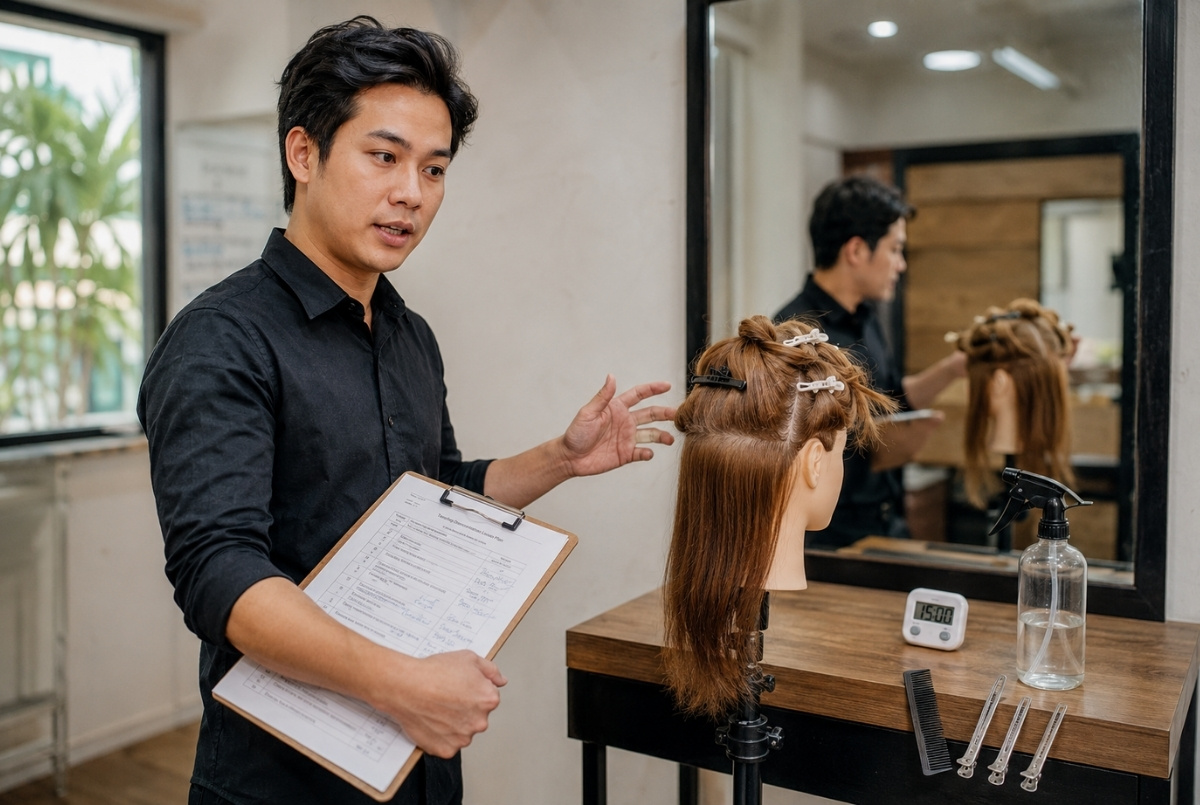
- The Practical or Teaching Demonstration Exam: In states that require it, this portion judges your actual teaching mechanics. A standard cosmetology instructor practical exam may require you to submit a formal lesson plan, deliver a mini-lecture, explain critical safety protocols, and show that you can supervise a classroom safely. They are not just grading your technical skill; they are grading your ability to teach it legally and safely to others.
To give yourself the best chance of passing on your first try, I recommend following a highly structured preparation routine.
First, download the current candidate information bulletin from your state’s official testing vendor. If your state uses PSI, check their official Test Taker Guides and Candidate Information Bulletins. If your state uses the NIC National Instructor Theory Examination, grab their specific bulletin. These packets outline the exact exam categories, testing fees, allowed reference materials, identification rules, and safety steps.
Second, commit to using a comprehensive cosmetology instructor study guide. Spend time with a digital cosmetology instructor practice test to get used to the phrasing of multiple-choice questions. I highly recommend taking a complete cosmetology instructor state board practice test under timed conditions until you are consistently scoring above 80 percent.
If your state requires a teaching demonstration, practice your lesson plan out loud in front of another licensed stylist. Have them check your pacing, clarity, and sanitation language to ensure your instructions are easy for a beginner to follow. Once your scores are up, gather your graduation certificates, your active practitioner license info, your completed cosmetology instructor application, and your testing fee to lock in your date.
State-by-State Breakdown: Navigating Regional Rules
Because there is not a single national teaching credential, you have to follow the exact laws of your state. I always tell people to treat each state as an entirely independent pathway.
For instance, getting a cosmetology instructor license in Georgia requires a structured, hour-based program. Georgia's PSI vendor guidelines outline 750 school hours for Master Cosmetology and Hair Designer tracks, 500 hours for Esthetician Instructors, and 250 hours for Nail Technician Instructors.
If you look at getting a cosmetology instructor license nc, North Carolina also sticks to category-specific requirements. The North Carolina Board of Cosmetic Art Examiners requires 800 hours for cosmetology, 650 hours for esthetics, and 320 hours for manicuring or natural hair care in an approved teacher program—unless you can prove a full year of full-time salon work right before you apply.
Compare that to a cosmetology instructor license in texas, where the rules changed completely. The Texas Department of Licensing and Regulation states that an official instructor license is no longer required to teach beauty courses. Instead, a licensed school can hire anyone who holds an active practitioner license for the specific subjects they teach, allowing schools to set their own hiring standards.
California takes a similar approach. The California Board of Barbering and Cosmetology sets strict training hours for practitioner licenses, but it does not offer a separate cosmetology instructor license california pathway. Most schools there simply look for an active, experienced specialty license when hiring faculty, which is common for cosmetology teacher training in California.
In the Midwest, a cosmetology instructor license in illinois goes back to a traditional hour structure. According to Illinois Administrative Code Section 1175.405, the state allows you to qualify with either 500 training hours if you have two years of active salon experience, or 1,000 training hours if you do not have that recent work history.
Out West, a washington state cosmetology instructor license requires a current state practitioner license, 500 formal instructor hours from a licensed school, and passing scores on both the written and practical exams, according to the Washington State Department of Licensing. For a cosmetology instructor license utah pathway, testing is handled through the Division of Professional Licensing, meaning you will need to study their specific Utah cosmetology exam information before scheduling your test date.
Even teacher salaries and license maintenance change across state borders. The ACTE Career Center highlights states like Wisconsin, California, and North Carolina as strong paying markets, but local demand changes quickly. Always double-check your training path, exam steps, and renewal fees directly with your local board before investing in tuition.
Keeping Your Credentials Active: Renewal and Continuing Education

Earning your certificate is an incredible achievement, but keeping it active takes regular maintenance. To keep your classroom doors open, you need to stay on top of your renewal dates. Many states require educators to complete continuing education units before they can renew. However, these continuing education rules are not identical across the country. Some states require instructor-specific training, others just require you to keep up with your underlying practitioner license, and some do not require continuing education for instructors at all.
Treat your renewal as a state-specific compliance habit. When your renewal window opens, look up what is the fee to renew a cosmetology instructor license on your board's website. Check the exact expiration dates, late-payment penalties, and whether your cosmetology instructor ceu classes need to come from a state-approved provider so you do not risk a lapse in your right to teach.
Our approach to education mirrors where the beauty industry is heading as a whole. According to resources like America’s Beauty Show, modern hair trends are heavily focused on overall wellness and sustainability. Similarly, the Rizzieri Aveda School notes that clients are arriving at salons highly informed, expecting their beauty professionals to understand how underlying conditions affect their skin and hair.
As an instructor, your job is not just to teach students how to name a trend; it is to give them a teachable system. They need to learn how to screen for contraindications, protect the skin barrier, explain product ingredients simply, and know exactly when a client's concern needs to be referred to a medical professional. Continuing education is your best tool for keeping your professional credibility alive in an industry driven by social media and high consumer expectations.
Fortunately, balancing your license maintenance with a busy teaching schedule is simple when your state allows online hours. Many approved providers offer cosmetology instructor continuing education classes online, letting you finish your required hours during school breaks or evenings. Just confirm your state board accepts the specific provider before you sign up.
Frequently Asked Questions
Can I teach out of state if I move?
Licensure does not automatically cross state lines. If you move, you will need to apply for reciprocity or endorsement through your new state board. They will review your original schooling hours, exam scores, and work history to see if you meet their local standards or if you need to take extra training hours or tests.
What happens if my practitioner license expires but my instructor license is active?
In most places, your legal right to teach depends entirely on keeping your underlying practitioner license active. If your cosmetology, esthetics, or nail tech license lapses, you usually lose the ability to teach that subject until it is fully restored. This is incredibly important in states that do not issue separate instructor credentials, as your practitioner license is the main paperwork your school has to verify.
How much does it cost to renew an educator license?
The processing fees vary completely by state. When you are planning your career budget, make sure to check what is the fee to renew a cosmetology instructor license directly on your state board's website, as these rates change regularly.
Do I need a separate certification for nails or skin if I have a cosmetology instructor license?
Generally, a comprehensive cosmetology instructor credential may allow you to teach subjects covered under the general cosmetology curriculum, including hair, skin, and nails. However, your exact teaching scope depends on state law, school approval, and the license category you hold. Specialized credentials like an esthetics instructor certification or a nail instructor certification usually limit you to teaching strictly within that specific department. Always verify your teaching scope with your school and board before taking on a new class.
Ready to Step Into Your Legacy?
The shift from working behind the chair to leading the front of a classroom is about reclaiming your physical health, setting a stable schedule, and mentoring the next generation of beauty professionals. You already have the hands-on talent and the real-world salon experience. Now, it is just a matter of partnering with an educational team that knows how to turn your everyday expertise into true instructional mastery.
If you are ready to take that next professional step, come find out more on our Enrollment page. We would love to chat with you about your goals, answer your questions, and walk you through how our instructor training helps students build teaching, classroom management, lesson planning, and state board preparation skills.
Have a few questions before you get started? Drop your details in the contact form we have left right below this article. An admissions advisor will reach out to give you all the details, talk through your career options, and help you get started on your new path.