Can You Own a Salon Without a Cosmetology License? A Legal Guide

The beauty salon industry is growing fast, with market numbers continuing to climb according to a market analysis by Custom Market Insights. If you are an entrepreneur looking for a solid investment, or a skilled stylist thinking about building a bigger brand, your head is probably full of ideas. You may want to create a welcoming community space, become your own boss, and build something profitable in the beauty industry.

Then the legal side starts to hit. Do you really need to spend hundreds or thousands of hours in beauty school just to run the business side? What about inspections, permits, state board rules, and fines? Let’s walk through the real boundaries so you can plan your salon dream safely, legally, and with more confidence.

Key Takeaways

  • Business ownership is often allowed: In many states, you can own a beauty business entity, sign a commercial lease, or own the physical property without holding a personal beauty credential.
  • Hands-on work is different: Unlicensed owners can manage payroll, marketing, branding, and business strategy, but they cannot perform regulated beauty services.
  • The location needs its own approval: Opening a salon usually requires a location-specific salon, shop, establishment, or similar permit. This is separate from an individual beauty license and may also be separate from a city or county business license.
  • Education gives owners an advantage: Beauty school can help protect your investment, improve staff oversight, and make you less dependent on hired managers for technical decisions.

Can Someone Own a Salon Without a Personal Cosmetology License?

Person compares two blank folders on a salon reception desk with a closed appointment book, comb, and key to show ownership versus licensing.

The direct answer is yes. You can usually own a beauty business without personally holding a cosmetology license. Most regulatory boards separate the legal business structure from the licensed professional who performs services. If your role is to provide financial backing, manage marketing, handle payroll, sign the lease, and build the brand, you generally do not need to attend beauty school just to own the business entity.

However, there is a serious legal boundary called your scope of practice. This means the legal limit of what your professional license allows you to do. While you can run the business side, you cannot practice cosmetology without a valid license. You cannot step in to wash a client’s hair, trim bangs, apply color, perform nail services, or handle skin care treatments during a busy weekend rush. If you want to understand what non-licensed workers may be able to do in the beauty field, you can read our full guide on the ultimate truth about cosmetology jobs without license requirements.

Crossing that line can create real legal risk. According to the official California Board of Barbering and Cosmetology Act and Regulations, working as an unlicensed individual can carry a $1,000 administrative fine, and an establishment license holder can also face a $1,000 fine for employing unlicensed persons. The risk is not ordinary business ownership. The danger starts when an unlicensed owner performs regulated services, handles service work reserved for licensed professionals, or allows unlicensed people to perform licensed beauty services.

If you choose the unlicensed investor path, you also become highly dependent on your licensed staff. If your top stylist calls out sick, you cannot legally step behind the chair to save the appointment. That can turn into lost revenue, frustrated clients, and scheduling problems that a licensed owner may be better prepared to handle.

Salon Permits, State Boards, and the Paperwork Side

To keep your salon open without legal problems, you need to understand the difference between personal credentials and commercial permits. Most states require a specific location-based approval before you can legally serve the public. The exact name changes by state, but the core idea is similar: an individual license authorizes a person to perform beauty services, while a salon or establishment license authorizes a physical location to operate as a regulated beauty business.

Licensed professional checks clean salon tools while an owner reviews a blank staff credential folder beside towels and disinfectant containers.

What Does a Salon Establishment License Do?

A salon establishment license is the state-level approval that allows a physical salon location to operate. Depending on the state, the application may ask for owner identification, business-structure documents, a lease or bill of sale, facility details, equipment information, sanitation setup, plumbing, ventilation, restroom access, posted documents, and inspection readiness.

A simple way to think about it is this: a standard local business license lets you operate as a company in a city or county, but a salon, shop, or establishment license lets you operate as a regulated beauty facility. Those are not always the same thing. For example, the Georgia State Board of Cosmetology and Barbers explains that a salon/shop license is not the same as a business license, and owners must also obtain a business license from the city or county where the establishment is located.

How Salon Rules Change From State to State

Cosmetology regulations by state can differ a lot, so a business model that works in one area may create problems somewhere else. Before signing a lease or opening your doors, you need to check the exact cosmetology rules and regulations for your location. To make that research easier, we put together a guide to cosmetology license renewal exams and transfer rules by state that covers hour requirements, test structures, and moving across state lines.

If you are interested in the salon suite model, the rules can become even more specific. According to the Texas Department of Licensing and Regulation, a facility that rents out private rooms to independent beauty professionals is classified as a gallery establishment. Texas requires establishments that lease space to include an Independent Contractor List with application materials, and the establishment is responsible for maintaining all common areas. That makes salon suite management more involved than simply collecting rent.

Texas also requires specific public-safety postings. Under Texas law, licensed schools and establishments must display an approved human-trafficking information sign in English, Spanish, Vietnamese, and any other language required by commission rule. The official TDLR human trafficking notice states that the sign must be placed in a prominent location where the public can see it.

Other states focus heavily on owner documentation during the application process. The Georgia state board salon and shop application requires a lease or bill of sale, a notarized application and affidavit, secure and verifiable identification documents, and a separate owner affidavit for each owner. Georgia also states that the business name must include the word “salon” or “shop” and must not mislead the public about the operation of the establishment.

In Arkansas, cosmetology regulation connects directly with the state’s public health system. The Arkansas Department of Health Rules for Cosmetology and Body Art require cosmetology establishments and mobile salons to obtain a current establishment license before operating. Arkansas rules also cover facility requirements such as continuous hot and cold running water, approved sewage disposal, toilet facilities, plumbing, garbage control, cleanliness, ventilation, and general repair.

Understanding your state board’s expectations early can save you from signing a commercial lease on a space that cannot legally pass inspection.

What Happens When Salon Owners Ignore Licensing Rules?

It can be tempting to look for shortcuts or let unlicensed friends work out of your space to save money. However, state boards use inspectors to check for compliance, and many state boards allow clients, workers, or others to file formal complaints.

The financial and reputational damage from a citation can hurt a new business badly. Fines for cosmetology violations can add up quickly, ranging from smaller penalties for improper tool sanitation, storage, or disinfection to more serious penalties for allowing someone to perform regulated services without a license. The California Board of Barbering and Cosmetology enforcement page lists complaints involving unlicensed activity, unsanitary conditions, gross negligence, incompetence, and misrepresentation of services.

When someone asks, “Can you practice cosmetology without a license?” the safe answer is no. Beauty services are not just casual cosmetic work. Hair color, chemical texture services, waxing, nail services, skin care treatments, disinfection, and product handling all involve health and sanitation rules. California’s legal guidelines define skin care to include facials, exfoliating, cleansing, and chemical/manual facial services, as long as they do not ablate or destroy live tissue. That is why out-of-scope services can create serious liability for both the worker and the business owner.

If you want to protect your investment and your brand reputation, compliance needs to start before your first client walks in. A safer setup includes verifying every worker’s license, keeping license copies on file, posting required documents, checking sanitation procedures, confirming insurance coverage, and reviewing your state board’s inspection checklist before opening.

Why Beauty School Can Make Salon Ownership Easier

Even if your local laws allow you to operate as a silent financial investor, holding a personal cosmetology license can give you a major business advantage. Relying completely on hired managers can leave you with technical blind spots.

Blank insurance folder, lease documents, keys, ID style card, and folded black apron arranged on a quiet salon office desk.

Understanding the Real Salon Workflow

Modern industry data compiled by SalonIQ shows that successful salons are focusing on client retention, client frequency, operational efficiency, and data-backed decision making. In simple terms, being busy is not enough. Salon owners need to understand why clients return, why they stop booking, which services create better margins, and how the team turns consultations into long-term client relationships.

This is where beauty school training becomes more than a personal credential. A licensed owner can better evaluate consultation quality, color formulation decisions, service timing, sanitation habits, retail recommendations, and product usage. Without that training, it can be much harder to tell whether a stylist is doing strong work, wasting expensive product, or creating unnecessary risk for the business.

When you understand the techniques, product chemistry, and service standards your team uses every day, you build stronger professional credibility. Your staff knows you understand the work, and you can make smarter decisions about inventory, training, hiring, and service quality. Earning your personal credential can also open doors to advanced education, brand networking, and other careers you can pursue with a cosmetology license including remote opportunities.

Building More Flexibility as a Beauty Entrepreneur

If you are concerned that beauty school takes too much time away from your business goals, it helps to know that education rules are changing in some states. However, those changes are not the same everywhere, so you should always confirm current requirements directly with the state board where you plan to study or open a salon.

For example, recent sessions in the North Carolina General Assembly introduced Senate Bill 808, which proposed reducing required cosmetology school hours from 1,500 to 1,200 and changing apprentice-licensure rules. That type of proposal shows that some states are reconsidering education requirements, but proposed bills can change before becoming final law. Always double-check the current rules directly with your state board before making a plan.

Choosing a modern beauty education path gives you more than a certificate to hang on the wall. It gives you the foundation to lead your business with more confidence. After graduation, you can move into steps such as finding a commercial lease, hiring staff, preparing for inspections, and planning your life after cosmetology school licensing steps first salon jobs and career options. Choosing a school that builds both technical skills and smart professional habits can make your long-term salon goals feel much more realistic.

Ready to Build Your Beauty Career Foundation?

Building a profitable beauty brand takes more than capital. It takes practical industry knowledge, technical understanding, sanitation awareness, and the confidence to lead a team. If your long-term goal is to run a salon, manage a beauty space, or become a stronger beauty professional, the right training can make a major difference.

At Neosho Beauty and Barber College, students can explore beauty education paths such as cosmetology, esthetics, manicuring, and instructor training. Visit our Enrollment page to learn more about the steps to get started, schedule a campus tour, and see how professional training can support your goals in the beauty industry.

FAQ: Salon Ownership and Beauty Licensing Questions

Can a licensed esthetician own a full-service hair salon?

Yes, an esthetician can own the business entity in many states. However, their personal license only allows them to perform services within their legal scope, which is usually skin care-related services. To offer haircuts, hair color, chemical texture services, or other hair services, they must hire properly licensed cosmetologists, barbers, hair designers, or other professionals allowed to perform those services under state law.

What insurance should an unlicensed salon owner consider?

You will generally need commercial general liability insurance to protect the business, property coverage if you own equipment or buildout, and professional liability coverage for service-related client risks. As an unlicensed owner, you should also ask your insurance agent how the policy handles employees, booth renters, independent contractors, and claims involving unlicensed or out-of-scope services. Most importantly, keep proof that every person performing regulated services holds an active license for those services.

Can I sell professional hair color or chemical products without a cosmetology license?

It depends on the product, supplier, and state rules. Many professional-only product lines are restricted by distributors and require a licensed professional account. However, general consumer hair color and cosmetic products may be sold if they are legally sourced, properly labeled, and allowed by applicable law. The FDA explains that most hair dyes fall under the coal-tar hair dye category, which generally does not require FDA premarket approval when the required caution statement and directions are included. However, color additives, labeling rules, and eyebrow or eyelash dye restrictions still matter.

Selling a product is not the same as applying it to a client. Even if you can legally retail a product, you still cannot allow an unlicensed person to apply hair color, chemical texture treatments, lash or brow dye, skin treatments, or any other regulated beauty service on a client.

Life After Cosmetology School: Licensing Steps, First Salon Jobs, and Career Options

Finishing the last required hour of beauty school can feel exciting and overwhelming at the same time. You have made it through classes, clinic practice, client services, and long days on your feet, but stepping into the professional world can still feel intimidating when your resume looks new. Many graduates wonder how hard it is to get a job after cosmetology school, especially when they are moving from supervised student work into a real salon, spa, or beauty business.

Every experienced stylist, salon leader, educator, and beauty entrepreneur once had a first job, a first client, and a first nervous interview. The difference between feeling lost and feeling prepared is having a clear plan. Your training is not just a school milestone. It is the base for licensing, job hunting, skill-building, and eventually creating a beauty career that fits your goals.

Key Takeaways

  • A cosmetology license can open doors across hair, nails, makeup, waxing, and some skin-related services, but your exact legal scope is always controlled by your state board.
  • Beauty income is more complicated than a single hourly wage because tips, commissions, rebooking, retail sales, booth rental, and self-employment can all affect take-home pay.
  • MoCRA may matter if you manufacture, process, package, distribute, or market cosmetic products, but the exact requirements depend on your role, product type, and whether an exemption applies.
  • The Interstate Cosmetology Licensure Compact has been enacted in participating states, but the compact is not yet active for multistate license applications.

The Career Map Hidden Inside One License

A modern beauty education gives graduates more flexibility than many people realize. Your training helps establish your scope of practice, which is the legal boundary for the services you are allowed to perform. That scope can include several areas of beauty, but the details are not identical in every state.

When people search for careers with a cosmetology license, they are usually trying to understand how one credential can support several different career directions. Our guide to careers you can pursue with a cosmetology license shows how graduates may move between salon work, retail beauty, brand education, events, management, freelance services, online beauty-related work, and long-term business ownership.

A cosmetology graduate reviews unreadable licensing papers at a wooden table beside a salon kit, clipped documents, a pen, and disinfected combs.

What Your Training Can Help You Offer

Cosmetology training usually gives students a broad base in hair cutting, styling, coloring, chemical texturizing, basic nail services, makeup, waxing, and introductory skin-related services. The important detail is that “usually” does not mean “everywhere.” A service that is legal under a cosmetology license in one state may require a separate license, a restricted specialty credential, or additional training in another state.

Hair remains the center of most cosmetology programs. Students learn haircutting, styling, color theory, chemical services, client consultation, product use, sanitation, and safe service habits. This foundation can prepare graduates for everyday salon services as well as more specialized work such as dimensional color, smoothing services, formal styling, and corrective appointments after more experience.

Many cosmetology programs also include nail services, makeup, facial waxing, lash and brow basics, and introductory skincare. That does not mean every advanced beauty trend automatically falls under a basic cosmetology scope. Advanced lash extensions, lasers, microneedling, deep chemical peels, medical aesthetics, and clinical procedures often involve separate rules. Before advertising any specialized service, a new graduate should confirm the current rule with the state board instead of relying on social media advice or another stylist’s experience.

The U.S. Bureau of Labor Statistics projects employment for barbers, hairstylists, and cosmetologists to grow by 5% from 2024 to 2034, with about 84,200 openings each year on average. BLS also reports that the highest 10% of hairdressers, hairstylists, and cosmetologists earned more than $33.76 per hour in May 2024. BLS wage figures include reported tips, but Occupational Employment and Wage Statistics data does not include self-employed workers, which matters in a field where booth rental and independent work are common.

Choosing a Specialty Without Throwing Away Your Training

Your first license does not have to lock you into one chair forever. Some graduates discover that they love color corrections, while others feel more drawn to skincare, short hair, nails, bridal services, education, or brand work. The key is to build from your foundation while respecting the legal limits of your license.

If you are interested in skincare, nails, lashes, or barbering, review whether you can work as an esthetician, barber, lash tech, or nail tech with a cosmetology license before promoting those services. The legal line often becomes stricter around advanced skin treatments, straight-razor shaving, device-based services, and procedures that cross into medical or clinical territory.

In many states, cosmetologists may perform basic facials, facial waxing, makeup application, and basic nail services. If your long-term goal shifts toward medical spa work, advanced esthetics, or device-based treatments, you may need state-approved esthetics training, a specialty credential, or another license path depending on where you live.

If you prefer clipper work, fades, beard shaping, and traditional barber services, a cosmetology-to-barber crossover may be worth researching. Some states allow licensed cosmetologists to receive credit for prior training and complete only the barber-specific requirements instead of repeating a full program from the beginning.

Travel-focused graduates may also consider cruise ship salons, resort spas, destination bridal work, or event beauty. These jobs may require a license, a portfolio, product knowledge, customer service skill, and sometimes previous salon experience. They are usually stronger options after you have built confidence with a range of clients.

State rules can also change quickly. Georgia, for example, now requires cosmetologists and barbers licensed in the state to register and report continuing education through CE Broker beginning January 1, 2026. Arkansas also passed Act 964, tied to warning-label requirements for hair relaxers containing certain chemicals. These examples do not replace Missouri rules, but they show why beauty professionals should stay alert to both licensing updates and product-safety rules.

What Beauty Income Looks Like Beyond the Basic Wage Number

Many new graduates worry about whether cosmetology can become a real living, especially when online salary calculators show one flat number without much context. Those numbers can be useful as a starting point, but they rarely explain how beauty income actually works inside salons, suites, spas, and independent businesses.

Your cosmetology salary depends on your pay structure. Some salons pay hourly wages. Others use commission, hybrid pay, team-based systems, or booth rental. Independent professionals may also earn through services, tips, retail, bridal work, extensions, color packages, classes, or product education. To understand your real earning potential, you have to look at pricing, tip policy, product cost, taxes, scheduling, rebooking, client retention, and how consistently your chair stays booked.

The American Association of Cosmetology Schools 2026 earnings survey, prepared with Azurite Consulting, points to a gap between standard income reporting and what cosmetologists and estheticians may actually earn. The survey suggests that cosmetologist and esthetician earnings may be 1.3 to 1.4 times the annual income reported to the IRS. It also lists a 40-hour-normalized annual earnings estimate of $54,220 for cosmetologist and esthetician respondents licensed in 2014 or earlier.

That number should not be treated like a government wage table. It is an industry survey, and it includes both cosmetologists and estheticians. Still, it supports an important point: beauty income often includes more than a base hourly rate. A professional may earn through services, tips, retail recommendations, event styling, extensions, premium color, rebooking systems, and repeat-client packages.

The strongest earners usually do more than perform good services. They understand consultations, timing, pricing, home-care recommendations, rebooking, and trust. A stylist with three loyal high-value color clients in one day may outperform someone rushing through many low-price services without a clear plan. Long-term income is built through skill, but also through organization, sanitation trust, client communication, and retention.

Landing Your First Beauty Job Without Years of Experience

A new beauty graduate observes an experienced stylist sectioning a client’s hair in a bright salon while holding a notebook and watching professional technique.

It is normal to feel nervous when applying for your first salon role. The good news is that salon owners do not expect a new graduate to have ten years of commercial experience. They are usually looking for reliability, clean habits, a safe technical foundation, a willingness to learn, and a professional attitude.

When building a cosmetology resume with no experience, do not treat your school clinic work like nothing. List your student clinic experience as practical training. Include the types of services you performed, the guest-care habits you practiced, the sanitation standards you followed, and the client communication skills you developed under instructor supervision.

Make the resume simple to scan. Put your license status near the top. If your license is active, write that clearly with your state board and license status. If you are waiting on exam results or final board approval, say that accurately instead of implying that you are already licensed. Then group your technical skills, such as haircutting, blowouts, color, chemical services, manicures, acrylic sets, waxing, or makeup, into a clean section.

Do not ignore business and customer-service skills. Many new graduates forget that front-desk experience, booking software, product knowledge, retail comfort, consultation habits, rebooking, and professionalism can matter as much as technique. A salon can train you in a house color line, but it is harder to train someone to show up on time, follow sanitation rules, listen carefully, and take feedback well.

If you want more structure after graduation, assistant roles and apprenticeship-style positions may help where your state allows them. These roles can place you near experienced stylists while you support shampoos, blowouts, color prep, salon flow, cleaning, client comfort, product setup, and appointment timing. That bridge can help a new graduate become confident before managing a full book alone.

From Final Hours to Legal Work Authorization

Finishing school is not the same thing as being legally cleared to perform paid licensed services. After graduation, your next steps usually include submitting your state application, confirming that school records or hours were reported, paying required fees, and passing any written or practical exams required by your state.

If you want to study with more structure before testing, our cosmetology exam prep guide can help you review written-test topics, practical skills, sanitation, disinfection, chemical safety, and exam-day habits.

Record handling varies by state and school. In some places, the school sends your final hours directly to the board or testing vendor. In others, the graduate may need to complete more of the application process. If you later need transcripts or proof of training for license transfer, moving, or continuing education, request them from the school while it is operating.

There is no universal timeline for how long it takes to receive a cosmetology license. Some boards update online license verification quickly. Others take longer because of exams, application review, background checks, mailed documents, or processing volume. The safest rule is simple: do not perform paid licensed services until your license, temporary permit, apprentice registration, or other legal authorization is active according to your state’s system.

If you plan to move later, review our guide to cosmetology license renewal and transfer rules by state so you understand training hours, renewal cycles, exam rules, continuing education, and transfer pathways. The Interstate Cosmetology Licensure Compact may eventually make multistate practice easier for eligible licensees in member states, but it is not active for multistate license applications yet. Always check the official compact site before assuming you can work across state lines.

Working for Yourself Still Means Following the Rules

Many graduates want freedom. They search for cosmetology jobs remote, home salon rules, salon suite options, freelance beauty jobs, or ways to build a flexible schedule. While you cannot cut hair through a screen, your beauty background can support online-friendly work such as brand education, beauty content, product support, customer education, social media work, copywriting, and virtual consultation services where allowed.

Hands-on services are different. If you want to provide hair, nails, makeup, waxing, or other beauty services from a residential space, you need to check state board rules, local zoning, business licensing, insurance, sanitation standards, and inspection requirements. A home-based beauty setup may feel informal, but the legal requirements are not informal.

For a Missouri audience, this point matters. Missouri rules for barber and cosmetology establishments require an establishment application, fee, floor plan details, minimum equipment information, inspection, and approval before an establishment opens. The rule also references city business or occupational licenses where applicable. That means a graduate should not assume a spare room, basement, or home studio is legal just because clients are willing to come there. Review the applicable state and local rules before opening any physical service space.

You may also wonder if you can open a salon without personally holding a cosmetology license. In many places, salon ownership and service practice are treated differently. Someone may be able to own or invest in a salon business without personally performing services, but anyone cutting, coloring, waxing, or doing other licensed work must hold the proper authorization. The facility itself may also need an establishment license or permit before services can be offered.

Product businesses bring another layer of regulation. Selling a private-label lash serum, repackaging bulk products, making body care, mixing cosmetic products, or launching a beauty line is not the same as performing services behind the chair. The FDA’s MoCRA overview explains that modern cosmetic oversight includes requirements such as adverse-event reporting, facility registration, product listing, safety substantiation, records access, and recall authority depending on the business role and product type.

Legal analysis of MoCRA compliance also shows that companies need to pay attention to registration, product listing, safety substantiation, labeling, manufacturing practices, adverse-event reporting, and future FDA rulemaking. Some small-business exemptions exist, so not every small creator has the exact same obligations as a large manufacturer. The safest takeaway is this: before selling homemade, repackaged, or private-label cosmetic goods, treat it like a regulated product business, not a casual side project.

Teaching Can Become a Strong Later-Career Path

A blank salon career planning corkboard with pinned cards, hairstyle photos, color swatches, a blurred calendar, clips, brushes, and styling tools.

Cosmetology is creative, social, and hands-on, but it is also physically demanding. Standing for long shifts, repeating motions, managing chemicals, and working evenings or weekends can become tiring over time. That is why some experienced beauty professionals eventually move toward education.

Becoming a cosmetology instructor can let you use your experience in a different way. Instead of focusing only on daily guest services, you can train students, demonstrate techniques, teach sanitation, explain theory, prepare learners for state board exams, and help new professionals build confidence.

Instructor requirements vary by state. Many states require an active license, professional experience, and instructor training focused on lesson planning, classroom management, demonstrations, assessment, student supervision, and state board preparation. Always confirm the current instructor licensing rules in the state where you want to teach.

A teaching role may offer more structure than a full client book, but it should not be treated as guaranteed stability. The BLS profile for career and technical education teachers reports a May 2024 median annual wage of $62,910 for CTE teachers. BLS also reports a median wage of $61,490 for career/technical education teachers at the postsecondary level, and $58,860 for CTE teachers in private technical and trade schools. Actual pay, schedule, benefits, and job security depend on the employer, school type, location, and role.

For professionals who enjoy explaining, demonstrating, coaching, and mentoring, education can be a meaningful way to stay connected to the beauty field while helping new students enter it with better habits.

Start Planning With Neosho Beauty and Barber College

Your license can open the door, but your training affects how confidently you walk through it. At Neosho Beauty and Barber College, students can explore programs in cosmetology, esthetics, manicuring, and instructor training while building practical beauty skills, sanitation habits, and professional confidence.

Neosho Beauty and Barber College is located in Neosho, Missouri, and is accredited by the National Accrediting Commission of Career Arts and Sciences. The school offers daytime courses, and financial aid is available for those who qualify in cosmetology, esthetics, and instructor training. Students can also use the school’s Enrollment page to learn about admission requirements, schedule a campus tour, and connect with admissions.

If you are ready to move from uncertainty into a clearer beauty-career plan, start by learning which program fits your goals, asking questions, and seeing the campus environment for yourself. A strong beginning can make the licensing process, job search, and first professional steps feel much more manageable.

Frequently Asked Questions

Can you work in a salon after graduation if your license is not active yet? You may be able to work in a support role, such as receptionist, salon coordinator, retail assistant, inventory helper, shampoo assistant where allowed, or front-desk team member. However, you should not perform paid licensed services until your state license, temporary permit, apprentice registration, or other legal authorization is active. Always check your state board rules before accepting duties that involve client services.

What should you do if your beauty school closes and you need transcripts later? Start with the state where the school operated. The U.S. Department of Education explains that when schools close, the usual practice is for records to be arranged through the state licensing agency. If you are looking for records from a closed school, contact the appropriate state licensing agency and ask where the records are stored.

How are modern booking habits changing new stylist careers? New stylists cannot rely only on walk-ins. A SalonIQ benchmark discussion points to client frequency, new-client retention, retail conversion, online booking, and rebooking as important business signals for modern salons. Because SalonIQ is a salon software company, its data should be treated as business benchmark insight, not government labor data. Still, the lesson is useful: salons value team members who can retain clients, rebook professionally, recommend appropriate home care, and use digital systems responsibly.

Does passing state board automatically mean you are ready for every beauty service? No. Passing state board is a major step, but it does not mean every advanced beauty service is automatically within your scope. Lasers, medical aesthetics, advanced skin procedures, certain lash services, and straight-razor work may require additional authorization depending on your state. Before offering a new service, check your board rules, training requirements, insurance coverage, and local regulations.

Cosmetology Exam Prep Guide: Written Questions, Practical Skills, and Smart Study Tips

Stepping away from the familiar beauty school clinic floor and into an official testing environment can make even skilled students feel nervous. The pace changes, the rules feel stricter, and suddenly your knowledge has to show up through timed questions, sanitation steps, organized supplies, and calm decision-making. This guide helps make that process feel less confusing by breaking the cosmetology state board exam into clear, manageable parts so you can prepare with more confidence.

Key Points Before You Test

  • The Written Portion Can Be Tough: Published state data shows that the written exam can be the bigger obstacle for many candidates. For example, the Texas Department of Licensing and Regulation reported a much lower FY2025 Operator Written pass rate than its practical pass rate.
  • Safety Matters More Than Flashy Styling: Practical exam scoring focuses heavily on infection control, client protection, disinfection habits, clean organization, and the ability to follow directions rather than trendy finished looks.
  • Product Labels Are Not Universal: Some states require original or photocopied manufacturer labels for disinfectants and hand sanitizers, while rules for simulated products can be different depending on the official exam packet.
  • Online Accounts Are Part of the Process Now: Many boards and testing vendors use digital portals, eligibility notices, online applications, and electronic scheduling, but candidates still need to follow the current Candidate Information Bulletin or Test Taker Guide for their own state.

Before You Choose an Exam Date

Cosmetology student reviews a blank calendar, blurred online exam portal, forms, calculator, and folder while planning a board exam date.

The first step toward a smoother testing experience is understanding how your state handles eligibility, applications, and scheduling. In many states, the process starts after your beauty school reports your completed training hours to the state board or assigned testing vendor. Once your eligibility is reviewed, you may receive an approval notice or instructions explaining how to create an online account, pay fees, and schedule your exam through the system your state uses.

Testing costs also need to be checked early because fees are not the same everywhere. Many states charge separate fees for the theory and practical portions. For instance, the official Georgia PSI Test Taker Guide lists a $45 theory exam fee and a $64 practical exam fee for cosmetology. Meanwhile, the Arkansas Department of Health fee schedule lists practitioner testing costs at $60 for the written portion and $65 for the practical test.

Because state rules control training hours, exam structure, fees, score validity, renewal deadlines, and transfer requirements, it helps to review a broader licensing breakdown before you schedule. For more context on how these rules can change from state to state, you can read our guide on cosmetology license renewal, exams, and transfer rules by state.

Old forms and outdated school handouts can also create problems because testing systems are becoming more digital. As detailed by the Maryland Board of Cosmetologists, PSI no longer processes Maryland applications by mail, fax, or email as of March 31, 2025, and candidates must submit the application online. That specific rule applies to Maryland, but it shows why candidates should not assume last year’s instructions still apply.

Testing agencies update candidate materials regularly. A practical kit rule, label requirement, dress code, retake policy, or online scheduling step can change from one testing cycle to the next. Before buying supplies or selecting a test date, download the newest Candidate Information Bulletin, Test Taker Guide, or state board notice from the official board or testing vendor.

Why Theory Prep Needs Real Attention

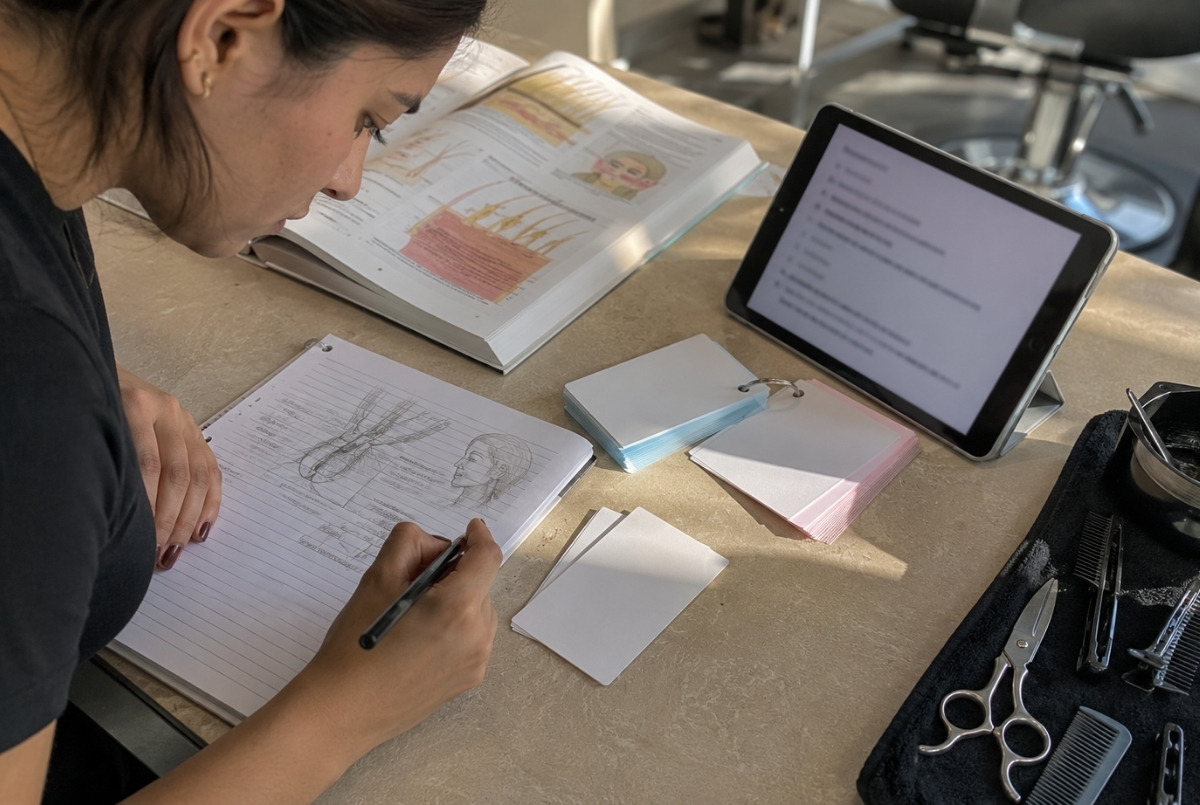
Cosmetology student studies theory exam topics with blank flashcards, anatomy notes, blurred tablet questions, and clean salon tools nearby.

Many students naturally worry most about the hands-on portion, but the written exam deserves serious preparation. This part of the test checks your understanding of science, sanitation, safety, infection control, chemicals, state law, and professional judgment. It does not measure how creative your styling is.

A large part of your study time should go toward consumer health and protection. You may see questions about sanitation, disinfection, hair and skin structure, chemical services, nail care, contraindications, and when a service falls outside the cosmetology license. These questions are designed to test whether you understand how to protect clients, not just whether you remember beauty terms.

Your local scope of practice also matters. Scope of practice means the services you are legally allowed to perform under your license. If a test question asks whether a cosmetologist can perform deep tissue medical massage, advanced skin procedures, tattooing, or permanent cosmetic services, you need to know where your state sets the legal boundary.

State rules and product-safety updates also keep changing. For example, the Arkansas Department of Health posted a notice stating that any hair relaxer product sold in Arkansas that contains a carcinogen or reproductive toxicant must follow the warning-label requirements of Act 964 of 2025. That does not mean the exact notice will appear on your test, but it does show why chemical safety, consumer protection, and state law are active parts of cosmetology licensing.

The pass-rate data makes the point even clearer. The Texas Department of Licensing and Regulation exam records show that the FY2025 Operator Written pass rate was 49.05%, while the Operator Practical pass rate was 89.10%. That does not prove every state follows the same pattern, but it does show why salon-floor experience alone is not enough. You need focused theory study.

Smarter Ways to Practice for the Written Test

Because the theory exam relies on memory, reading accuracy, and applied safety knowledge, the way you study matters. Reading a huge textbook from front to back and highlighting random paragraphs may feel productive, but it is not always the best method for hands-on learners. You need practice that forces your brain to retrieve information before exam day.

A digital cosmetology practice test can help you get used to how exam questions are phrased. A strong cosmetology written exam study guide should divide the material into smaller sections covering infection control, hair care, chemical services, skin care, nail care, state law, and client safety.

Free prep tools can also be useful when used correctly. A free practice test for the cosmetology state board lets you check your current knowledge without adding more pressure to your school budget. When reviewing cosmetology exam questions and answers, do not only memorize the correct option. Pay attention to why the other options are wrong, because that is where you often learn how test writers think.

Keep a simple list of the topics you keep missing. If you are repeatedly getting questions wrong about chemical relaxing, infection control, anatomy, skin conditions, nail disorders, or cosmetology state law questions, those are the areas that need extra review during your final week. A focused cosmetology theory practice test or targeted cosmetology exam practice session can help turn weak areas into stronger ones.

What Happens When You Arrive to Test

A lot of exam anxiety comes from not knowing what to expect. While the exact check-in process can vary by testing vendor and state, most professional testing centers follow a structured routine.

On test day, arrive at least thirty minutes early unless your own bulletin gives different instructions. Testing staff will usually verify your identification, confirm your registration, and make sure you are approved to test. Security is strict because the testing agency has to protect exam integrity. You may be required to store personal belongings such as your phone, watch, bag, notes, and other restricted items in a secure area before entering the testing room.

After check-in, an administrator or proctor will guide you to the testing area. If you are taking the theory portion at a physical center, the exam is usually computer-based and timed, so you need to pace yourself. The number of questions and time limit depend on your state, license type, and testing vendor.

Some candidates may also see remote testing options, but you should not assume they are available everywhere. The PSI Cosmetology and Barber National Exams page notes that remote theory testing and virtual practical testing are available for certain participating states. This is why the phrase cosmetology online test can mean very different things depending on where you live. Always check the current bulletin for your exact license type and location before assuming the exam can be taken from home.

Packing Your Practical Kit Without Guesswork

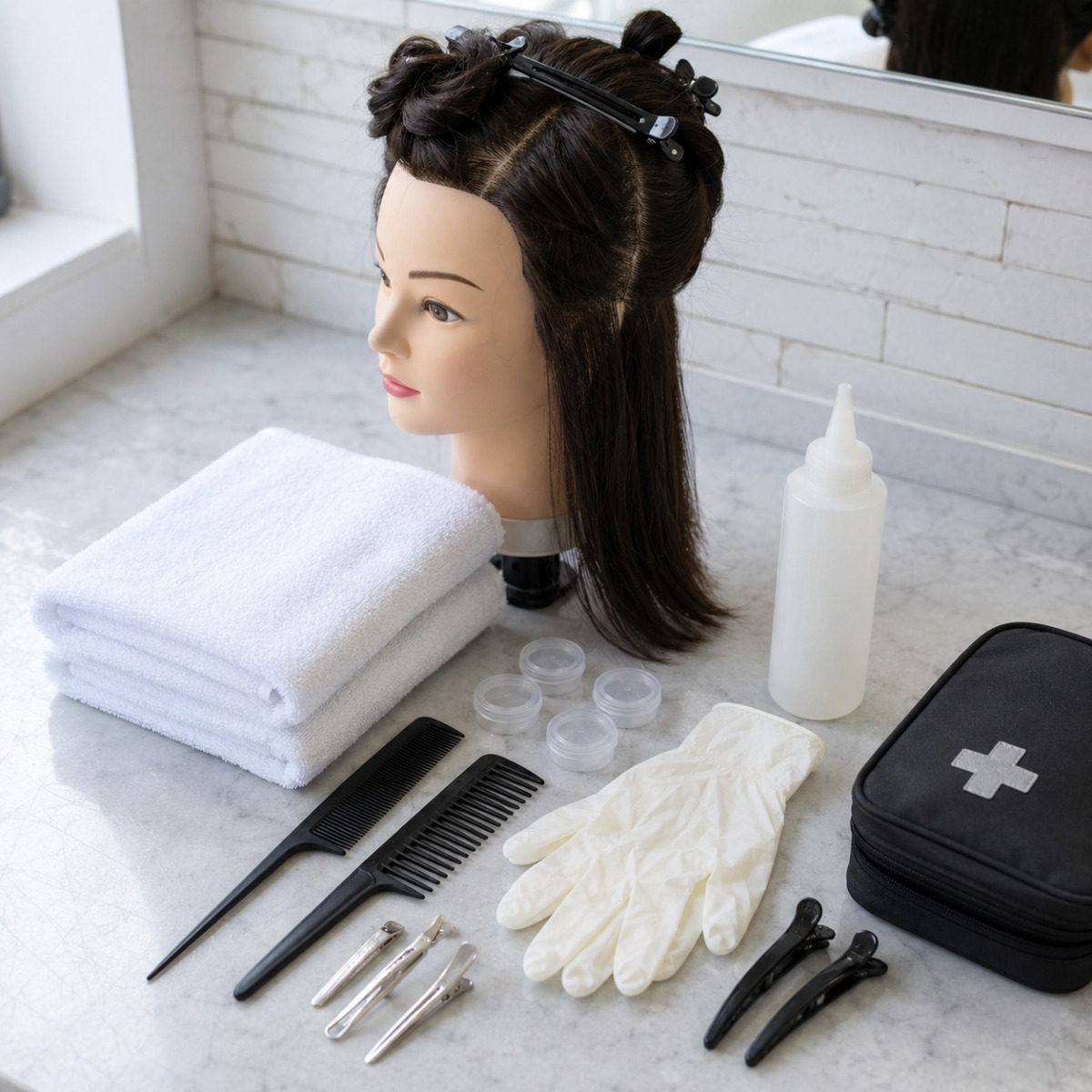
Organized cosmetology practical exam setup with a sectioned mannequin head, combs, clips, gloves, towels, containers, and first aid pouch.

The practical exam is where your hands-on training becomes visible, but the goal is not to create a dramatic salon transformation. Evaluators are watching for safe habits, infection control, clean transitions, organized setup, proper client protection, and your ability to follow instructions under pressure.

Your cosmetology kit for the state board must be packed according to the official rules for your state. There is no single kit list that works everywhere. You should use your state’s cosmetology kit list, Candidate Information Bulletin, Test Taker Guide, or practical testing packet as the final authority. For example, the Georgia PSI Test Taker Guide explains that PSI National Practical Tests do not use one standardized supply list, so candidates must bring the professional equipment, products, and containers needed to perform the required topic areas while following the listed rules.

Dress rules also vary by state. For Georgia PSI testing, candidates must arrive in neat, clean, professional attire, wear a sleeved smock or lab coat, and wear closed-toe shoes. The current Georgia guide does not require all-black clothing, so do not rely on older blog posts or advice from someone who tested under a different rule set.

Blood exposure or injury procedures are another important part of practical preparation. If an injury occurs during the test, or if your exam requires a blood exposure demonstration, you must follow the exact process in the official packet. The Ohio State Cosmetology and Barber Board practical testing packet, for example, gives specific blood exposure instructions involving antiseptic, wound covering, gloves or finger guards, disposal of soiled materials, and infection-control steps.

Organizing your kit before exam day can save you from wasting valuable time during transitions. If you drop a comb, clip, or implement during a practical exam, you should treat it as contaminated, avoid reusing it, sanitize your hands as instructed, and use a clean replacement from your kit. Practicing directly from the packed kit helps your hands learn where everything is before the pressure of test day.

Labeling is one of the easiest areas to overlook. According to the Ohio practical testing directives, disinfectants and hand sanitizers must have original or photocopied manufacturer labels, and handwritten or typed labels are not acceptable for those products. Georgia’s PSI guide allows self-created or actual labels for certain simulated products, but it requires manufacturer labels for disinfectants and other products that must meet safety-data requirements. The safest rule is to follow your exact state bulletin, label everything early, and avoid last-minute improvising.

Where Licensure Can Take Your Beauty Career

When studying starts to feel stressful, it helps to remember what the exam is actually leading toward. Passing the state board is not just about earning a piece of paper. It is the step that allows you to move from student practice into licensed professional work.

The beauty field is no longer limited to one traditional salon-chair path. Licensed professionals may build careers in salons, spas, independent studios, education, bridal and event styling, film and production work, beauty retail leadership, product support, brand training, or online beauty-related roles. The habits you build while preparing for licensure can shape how confidently you enter those opportunities.

Once you are licensed, it helps to understand the larger career landscape. You can read more about the 10 careers you can pursue with a cosmetology license, including remote options, which may include salon styling, platform education, film and event styling, beauty retail leadership, brand support, and independent studio ownership depending on your location, state rules, and additional training. If you plan to move or expand your options later, it is also smart to review the cosmetology license renewal, exams, and transfer rules by state so you understand how credentials may need to be maintained.

The labor-market numbers also show why beauty remains an active field. The U.S. Bureau of Labor Statistics projects overall employment of barbers, hairstylists, and cosmetologists to grow 5% from 2024 to 2034, with about 84,200 openings projected each year on average. Related specialized fields also show continued demand: BLS projects skincare specialists to grow 7% from 2024 to 2034, with about 14,500 openings per year, and manicurists and pedicurists to grow 7%, with about 24,800 openings per year.

Modern beauty professionals also need to understand how clients discover and evaluate services and products. McKinsey & Company’s State of Beauty analysis notes that beauty discovery and purchasing are shifting through e-commerce, social commerce, digital marketplaces, and fast-moving platforms such as TikTok Shop. In a separate wellness-market analysis, McKinsey also reported that many U.S. and U.K. consumers now prioritize clinical effectiveness over clean or natural claims when evaluating wellness products. For future beauty professionals, that means product knowledge, consumer education, safety awareness, and trust-building are becoming more valuable.

This is why strong training matters before and after the exam. Passing the state board is the baseline requirement, but the habits you build in school can influence your confidence, service quality, professional reputation, and long-term income potential.

If you are planning how to pay for your training, you can review our cosmetology school financial aid guide covering FAFSA, grants, 529 plans, and payment options. A good education should help you prepare for the exam while also giving you the practical foundation to grow in a competitive beauty market.

Build Your Beauty Future at Neosho Beauty and Barber College

Passing the exam is a major milestone, but building a career takes more than test preparation. You need an environment that helps you develop technical skill, professional habits, and the confidence to work with real clients.

At Neosho Beauty and Barber College, we bring over forty years of beauty education experience to students preparing for today’s industry. Our programs are built to help students develop the practical skills, technical knowledge, and professional confidence needed to become Salon Ready graduates.

Through structured training, real salon-floor practice, and guidance from a dedicated team, you can prepare for licensure while building the habits needed for your next step in beauty. If you are ready to take control of your future, visit our Enrollment section to learn more. You can also use the contact form at the bottom of this page to connect with an admissions representative, ask questions, or set up a campus tour.

Frequently Asked Questions

Can the cosmetology state board be taken from home?

It depends on your state, license type, and testing vendor. Some exams still require candidates to report to an approved testing center, especially practical exams that require direct observation. However, some PSI-administered cosmetology programs offer remote theory testing or virtual practical testing for certain participating states, as shown on the PSI Cosmetology and Barber National Exams page. Always check your current state Candidate Information Bulletin before assuming your test must be in person or can be completed from home.

What should you do if you fail one part of the cosmetology exam?

If you do not pass on your first attempt, do not treat it as the end of your career. Retake rules vary by state, but many systems allow candidates to retake the failed portion after paying the required fee and following the board’s waiting-period or scheduling rules. For example, the Maryland Board of Cosmetologists says candidates who fail may retest on an unlimited basis, while Kentucky Senate Bill 22 allows cosmetology board license applicants to retake a failed portion an unlimited number of times, with each retake at least one month after receiving actual notice of the failure.

Is there a required waiting period before a retest?

The waiting period depends on the state and testing agency. Kentucky’s SB 22 sets a one-month wait after notice of failure for retaking a failed portion, while other states may base retesting on application deadlines, available exam dates, or vendor scheduling rules. The safest step is to check the current bulletin from your state board or testing provider as soon as you receive your score report.

Can cosmetology exam scores expire?

Yes, exam scores or eligibility windows can expire, but the timeline depends on the state. Maryland says testing scores must be passed successfully within two years of each other to be considered valid by the Board. Georgia’s PSI Test Taker Guide states that courses completed after July 1, 2018 are valid for four years, and if no passing score is achieved within that four-year period, the candidate must reapply with the Georgia Board. Because these timelines can affect your license application, it is best to complete the licensing steps as soon as possible after passing.

Cosmetology License Renewal, Exams, and Transfer Rules by State

Are you planning to turn your interest in beauty into a real licensed career? For many future stylists, the dream starts with creativity, independence, and the chance to build a life around hands-on work. But before you can take paying clients, you have to understand the licensing rules, training hours, testing steps, renewal deadlines, and transfer requirements that control the industry.

That process can feel stressful at first. You may be trying to fit school around work, worrying about the state board exam, or wondering what happens if your license expires later. If you already work in the beauty field, moving to another state can also raise serious questions about whether your credential will still protect your income.

Some people also hesitate because they are not sure whether beauty school is meant for someone with their background. If you are still deciding whether this path fits you, start by reading what you actually need to know before applying so you can better understand how students from different life stages and backgrounds can begin training.

Quick Licensing Notes Before You Start

  • Rules depend on the state: Age minimums, education standards, required hours, exam structure, fees, and renewal deadlines are set by each state board, not by one national agency.
  • Lower-hour models are becoming more common: Several major states now use 1,000 hours for cosmetology, and recent research suggests hour reductions can reduce tuition and improve completion without showing a detectable drop in cosmetologist earnings.
  • Moving states still requires planning: The Multi-State Cosmetology Licensure Compact may reduce some reciprocity barriers in participating states, but it does not create automatic license transfer across the entire country.
  • Renewal rules protect your ability to work: Continuing education and renewal systems help boards reinforce sanitation, legal compliance, infection control, consumer protection, and safer product handling.

Why Beauty License Rules Change From State to State

A beauty student organizes blank state board forms, school record folders, documentation placeholders, and sanitized combs on a clean training table.

Cosmetology is regulated at the state level. That means the legal requirements for practicing in Missouri, Texas, New York, California, Georgia, Florida, or Arkansas may not look exactly the same. Each board decides who can practice, what services are included, how many hours students must complete, and what exams applicants must pass.

These rules are not designed to judge your artistic taste. Their main purpose is public protection. State boards focus on sanitation, infection control, skin and hair safety, chemical services, disinfection procedures, and the legal limits of each license type. Understanding this early helps you avoid training delays, licensing problems, and accidental work outside your approved scope.

What Boards Usually Check Before Approval

When you compare cosmetology license requirements by state, you will usually see several repeating categories: minimum age, education level, approved school hours, exam format, application documents, fees, and criminal-history questions. The exact details change by location.

For example, the Texas Department of Licensing and Regulation lists a 1,000-hour cosmetology operator course and a minimum application age of 17. The New York Department of State requires a 1,000-hour approved course and both written and practical examinations.

That is why a general checklist is never enough by itself. Your licensing plan should always start with the state where you want to work. A strong school can help you stay organized with age documents, transcripts, school records, exam applications, payment deadlines, and any required disclosures.

Because cosmetology can cover several beauty services, many students also want to know what they can legally do after earning the license. If you want a clearer breakdown of service boundaries, read this guide on working as an esthetician, barber, lash tech, or nail tech with a cosmetology license.

How Required School Hours Affect Your Timeline

Training hours are one of the biggest practical differences between states. If you are comparing cosmetology school hours, you will quickly see that nearby states can still have different expectations.

New York requires 1,000 hours. California now lists 1,000 school hours for cosmetologists through the California Board of Barbering and Cosmetology. Texas also sets its cosmetology operator course at 1,000 hours. Other states, including Ohio, Arkansas, Georgia, and Missouri, commonly use a 1,500-hour pathway for standard cosmetology licensure, though license names and exam structures may differ.

Before enrolling, compare the cosmetology hours for the state where you plan to build your career. This helps you avoid paying for a program that does not satisfy your board’s requirement. It also helps you understand how long school may take before you can sit for licensing exams and begin working legally.

A 2025 EdWorkingPaper from the Annenberg Institute at Brown University found that lowering cosmetology-hour requirements can raise completion, lower tuition, and expand enrollment among some groups, with no detectable decline in cosmetologist earnings. That does not mean every graduate will earn the same amount. It does suggest that very high hour requirements can increase the cost of entry without clearly improving earnings outcomes.

Preparing for the Licensing Exam Without Freezing Up

After your school hours are completed and reported, the next major step is the licensing exam. This stage can make even talented students nervous, especially if they are more comfortable with hands-on work than written testing.

A focused cosmetology student studies blank flashcards beside a mannequin head, clean clips, combs, gloves, and an unmarked timer in a salon classroom.

Build a Review Plan Around Safety and Rules

A useful cosmetology state board exam review should go beyond the services you enjoy most. The written or theory portion usually focuses on sanitation, infection control, chemical safety, hair care, skin care, nail care, state laws, and professional responsibilities.

Using a cosmetology practice test free online can help you understand the format before test day. A cosmetology written exam study guide can also help you review disinfection, product safety, chemical texturizing, infection control, and service procedures in a more organized way. The goal is not to prove that you are the most creative stylist in the room. The goal is to show that you can work safely and competently within your license scope.

Know the Exam Structure Before Test Day

  • Question count: You should check how many questions are on the cosmetology state board exam for your specific state and testing vendor. The NIC National Cosmetology Theory Examination, for example, contains 110 items, with 100 scored questions used for the final score.
  • Practical testing: Do not assume every state still requires the same hands-on exam. California states that effective January 1, 2022, the practical exam is no longer required for all license types, and candidates only need to pass the written exam. Other states may still require practical, written practical, theory, or state-law exams.
  • Testing fees: Always check how much it costs to take the state board for cosmetology through your own board or testing vendor. Fees may differ depending on whether you need written, practical, state-law, or combined exams.
  • Scheduling: Your school may help with graduation paperwork, but you are still responsible for understanding how to apply for cosmetology state board exam access and how to schedule cosmetology exam dates through official vendors such as PSI, Pearson VUE, Prov, or another approved provider.
  • Difficulty level: Students often ask how hard is the cosmetology state board exam to pass. The exam is built around baseline safety and competency. If you understand sanitation, infection control, chemical handling, and the services included in your license, you can prepare with a much clearer strategy.

As you calculate exam fees, supplies, tuition, and living expenses, remember that you may not have to pay for everything out of pocket. For help comparing funding options, read this guide to cosmetology school financial aid using FAFSA, grants, 529 plans, and payment options.

Keeping Your License Active After Graduation

Getting licensed is a major milestone, but it is not the end of your responsibility. Every license has a renewal system. If you miss a deadline, take time away from the industry, or forget to update your file, your credential can lapse and interrupt your ability to work legally.

Renewal Deadlines Are Not the Same Everywhere

Each state decides its own renewal cycle. Some renewals are tied to a fixed calendar date, some to a birth month, some to the issue date, and others to a board-specific schedule. Some states renew every year, while others use two-year or longer cycles.

If you live on the West Coast, you may wonder, can I renew my CA cosmetology license online? In many states, online renewal portals now make the process faster. Still, you should confirm the exact renewal method, fee, deadline, and continuing education rule for your own board.

If your license expires, check the state registry right away. You need to know how long after cosmetology license expires you can wait before penalties increase, your status changes, or your file becomes harder to restore. You should also check how much it costs to renew cosmetology license fees in your state so you can avoid unnecessary downtime. Managing your renewal online is often the fastest way to protect your work schedule.

When an Expired License Becomes Harder to Fix

If a license remains expired for multiple years, a board may classify it as cancelled, expired beyond renewal, or null and void. The wording depends on the state, but the result can be serious.

For example, the Florida Department of Business and Professional Regulation states that a license becomes null and void after the licensee fails to renew for two consecutive licensure cycles. If you need to reinstate a null and void cosmetology license in Florida, it generally cannot be restored unless the applicant can show illness or economic hardship, and each application is reviewed case by case. A simple late fee may not be enough.

Many boards also require continuing education courses for cosmetology renewal. The Georgia State Board of Cosmetology and Barbers requires five hours of board-approved continuing education for renewal, including three hours in health and safety. These requirements help reinforce sanitation, infection control, law updates, and safe professional practice.

Occupational health research also supports the importance of long-term safety habits in salon work. A study published in Occupational and Environmental Medicine found associations between hairdresser work and certain hormone-related outcomes, including higher odds of prebaseline hysterectomy and higher rates of incident endometriosis, while not finding notable associations with several cancers studied. This does not mean every stylist will experience the same outcome, but it does support the value of ventilation, product awareness, protective practices, and careful chemical handling.

Moving Your License When Life Takes You Somewhere New

Relocation can be exciting, but it can also complicate your beauty career. If you move for family, marriage, work, or a fresh start, you need to know whether your current credential will be accepted in your new state.

A beauty professional reviews blank reciprocity and endorsement papers beside a salon tool kit, folded apron, unmarked map, and packed travel case.

Reciprocity and Endorsement Are Not Always the Same

If you are researching how to transfer cosmetology license to another state options, you will likely see the words reciprocity and endorsement. They are related, but they are not always identical. Reciprocity usually means one board recognizes another state’s licensing standards. Endorsement usually means the new state reviews your active license, training hours, exam history, and sometimes work experience before deciding whether you qualify.

Most transfer processes require an application, a fee, and official license verification from your original board. If your first state required fewer hours than your new state, you may need additional testing, more hours, a state-law exam, or documented work history.

Arkansas is a useful example. The Arkansas Department of Health explains that a person transferring hours from another state without holding a current out-of-state license must pass written and practical examinations to qualify for an Arkansas license. Florida uses a different structure. The Florida DBPR states that applicants who qualify for a Florida cosmetology license by endorsement do not have to take the Florida cosmetology examination, but they must hold a valid out-of-state cosmetology license and complete the required HIV/AIDS course.

Compact Licensing May Help, But It Is Not Nationwide Transfer

If you are asking, do cosmetology licenses transfer to other states easily, the honest answer is that it depends on the destination state. Some boards now allow online applications for cosmetology license transfer from state to state, which can reduce paperwork delays. But you still need to check the exact rules before moving, signing a lease, or accepting clients.

Understanding portability also helps you plan the full range of careers you can pursue with a cosmetology license, whether you want to become a salon stylist, color specialist, platform artist, editorial stylist, salon manager, or beauty entrepreneur.

Legal and structural analysis from the University of Missouri School of Law Scholarship Repository discusses the development of the Multi-State Cosmetology Licensure Compact. The official Cosmetology Compact explains that the compact is designed to create a multistate license pathway for eligible cosmetologists who live in compact member states and hold an active, unencumbered license.

Once fully implemented, the compact should help qualifying professionals practice across participating state lines without completing a separate traditional reciprocity package for each member state. However, it should not be described as automatic nationwide license portability. It only applies to participating states, and eligibility still depends on the licensee’s home-state license, compact rules, and implementation timeline.

Start Your Beauty Career With Clearer Direction

Licensing rules, training hours, renewal deadlines, and state transfer requirements are easier to handle when you train with a school that understands the practical side of entering the industry. At Neosho Beauty and Barber College, students can build the hands-on foundation and professional habits needed for a licensed beauty career.

Neosho’s cosmetology program is built around real salon skills, including haircutting, coloring, perming, styling, manicures, pedicures, acrylic sets, lash and brow services, facials, waxing, and makeup application. The program also introduces career-focused skills such as salon business, client retention, resume writing, and job seeking skills.

By building practical skills, professional habits, and licensing-focused knowledge throughout your training, the exam process can feel more organized and less intimidating. This kind of preparation helps you move from classroom learning toward professional work with more confidence.

Beyond the exam, the goal is to help you think about your future career path. Whether you want to work behind the chair, grow into management, build a client base, or explore specialized beauty services, your education should help you understand both the creative and regulatory sides of the profession.

If you are ready to review admission steps, tour details, and application requirements, visit the Enrollment page. You can also use the contact form below if you have questions about scheduling, start dates, or next steps.

Frequently Asked Questions

Can I offer cosmetology services from home without a license?

No. State boards generally require the proper beauty license for professional cosmetology services, whether the work happens in a salon, home studio, mobile setting, or event location. Performing hair, nail, or skin services for compensation without the correct credential can lead to fines, disciplinary problems, legal exposure in some states, and possible future licensing issues.

Why do some states combine barbering and cosmetology regulation?

Historically, barbering and cosmetology were often handled through separate regulatory structures, with different license categories, school approvals, and exam rules. Some states now use a combined administrative model. Texas, for example, combined its Barbering and Cosmetology programs under TDLR through HB 1560, and the Texas Department of Licensing and Regulation now manages Barbering and Cosmetology under one unified program. This can help standardize sanitation, establishment, health, safety, and administrative rules, but it does not mean every state has merged its boards or eliminated the legal difference between barber and cosmetology licenses.

Do higher beauty school hour requirements always create better customer results?

Not necessarily. A landmark econometric review hosted by San Jose State University found that stricter licensing rules did not show a general positive association with higher consumer ratings for the beauty-service occupations studied. The study used Yelp ratings as a customer-satisfaction measure, so it should not be treated as a perfect measure of safety or technical quality. Still, it supports the idea that more required hours do not automatically equal better customer-rated service.

For a visual overview of how interstate mobility is changing, you can also watch this breakdown of the Cosmetology Licensure Compact and State Board Rules. It explains how compact participation may simplify movement for eligible beauty professionals without turning license transfer into automatic nationwide portability.

Cosmetology School Financial Aid Guide: FAFSA, Grants, 529 Plans, and Payment Options

Starting a career in the beauty industry can be exciting, but planning the money side of your training can feel stressful fast. Tuition is only one part of the picture. Students may also need to prepare for professional kits, books, registration fees, uniforms, supplies, and licensing-related expenses before they ever begin working with clients.

The good news is that you do not always have to pay the full cost from your savings on day one. Because approved beauty programs are built around structured training hours for state licensing, many students may be able to use legitimate funding options to manage the cost. If you want to understand the basic requirements before applying, it helps to review what you actually need to know before applying to cosmetology school so you can see what admissions teams commonly look for. By comparing federal aid, scholarships, workforce support, 529 plans, tax credits, and payment options, you can build a safer plan for funding your education.

Main Points to Know Before You Budget

  • FAFSA Depends on School Eligibility: Federal student aid may be available for beauty school, but only when the school participates in Title IV federal student aid programs. Accreditation is important, but students should also confirm the correct Federal School Code and make sure their exact program is aid-eligible.
  • The Sticker Price Is Not Always the Full Price: Tuition alone may not show the complete cost. Students should also plan for tools, textbooks, uniforms, registration fees, kits, supplies, and state licensing-related expenses.
  • Attendance Can Affect Aid Timing: Many beauty and trade programs use clock hours instead of standard college credits. Missing required hours can slow your progress and may delay financial aid disbursements.
  • Funding Rules Can Vary Widely: State workforce support, private scholarships, VA benefits, 529 plans, institutional payment plans, and federal tax credits may reduce your out-of-pocket cost, but eligibility depends on the school, program, student status, and location.

What Beauty Training Really Costs

A tuition estimate, student kit checklist, calculator, notebook, mannequin head, and cosmetology tools arranged on a desk for beauty school budgeting.

Before you compare financial aid options, it is important to understand how beauty schools usually organize their pricing. A common mistake is looking only at tuition and assuming that number is the final amount you will need. Trade school costs can be more layered than a traditional college bill, so the better question is not just how much is tuition for cosmetology school, but what is included in the full cost of attendance.

The overall cosmetology school cost can change based on location, program length, school type, curriculum, and whether supplies are included in the advertised price. According to SoFi Financial Insights, the average cost for cosmetology school generally falls between $5,000 and $20,000 across the United States. If you are looking for a cosmetology school under 10k, your options will often be found through regional vocational centers, community college programs, shorter certificate tracks, or schools in smaller markets.

To understand your actual cosmetology school cost, you need to look beyond the instructional rate. Many accredited schools require students to purchase a professional student kit. This may include items such as shears, styling irons, mannequins, sanitation supplies, textbooks, and sometimes uniforms. These are not optional extras if the school requires them for daily classroom and clinic-floor training.

Data compiled by the Renaissance Academie Cost Analysis shows that kits and learning materials can create a major required expense, with one example listing student kit and textbook costs at about $2,498. Some schools include these items in tuition, while others charge them separately before classes begin. When comparing how to pay for cosmetology school, ask the admissions office whether your kit, books, uniforms, registration fees, supplies, and state board preparation materials are included or billed separately.
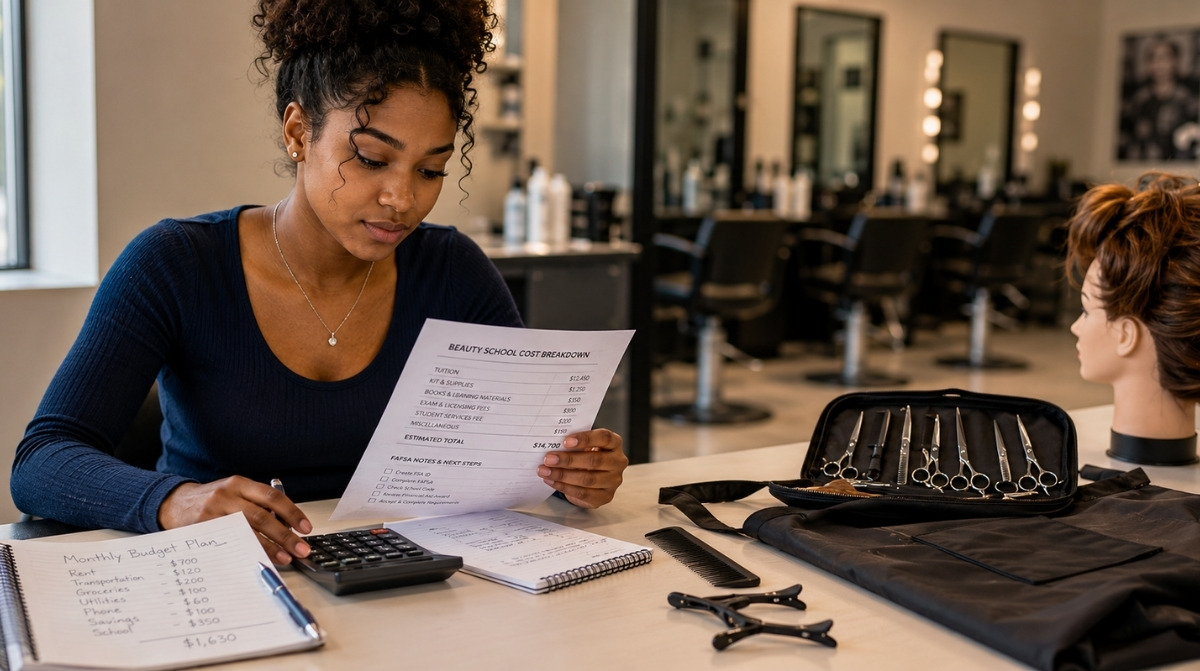
You should also request the school’s full cost of attendance, not only the tuition amount. A complete budget may include tuition, required fees, books, course materials, supplies, equipment, transportation, and licensing-related costs. This matters because cost of attendance is often the figure used when calculating how much financial aid for cosmetology school you may qualify for.

How FAFSA Works for Eligible Beauty Programs

A student writes financial aid questions in a notebook beside enrollment papers, a calculator, and a laptop inside a beauty school classroom.

Many students want to know whether they can use FAFSA for cosmetology school tracks. Federal student aid may be available for trade programs when both the institution and the specific program are eligible to participate in Title IV federal student aid programs. Accreditation can help show that a school meets certain standards, but it is not the only thing to verify. The U.S. Department of Education maintains Federal School Code Lists for institutions participating in Title IV student aid, so students should confirm that the school appears under the correct campus or institution name.

Submitting the Free Application for Federal Student Aid (FAFSA) can help eligible students access federal Pell Grants, federal student loans, and other aid. However, a cosmetology school with FAFSA approval may handle disbursements differently from a traditional college. Universities often release aid by academic term. Many beauty schools, by contrast, measure progress through clock hours, which track the actual time students spend in class, training, and supervised practice.

At a cosmetology school with financial aid, funds may be released in installments tied to completed hours and weeks of instruction rather than simple calendar dates. The Federal Student Aid Handbook explains that payment periods for clock-hour programs are based on successful completion of clock hours and weeks of instructional time. As explained by the Continental School of Beauty Financial Guides, aid in beauty school is often released in segments as students pass specific program milestones. Because of this structure, poor attendance can delay clock-hour completion, slow financial aid disbursements, and leave a student with a temporary balance until required hours are caught up.

Before enrolling, ask the financial aid office whether you can use FAFSA for cosmetology school options at that exact campus. You should also ask which Federal School Code to use, whether your program is measured in clock hours or credit hours, and when aid is expected to be disbursed.

Grants, Scholarships, and Other Help You Do Not Have to Repay

A financial aid advisor speaks with a prospective beauty school student about scholarships, payment options, and program costs in a salon classroom.

If your goal is to graduate with less debt, start by looking for financial aid for cosmetology school that does not require repayment. The largest federal source of need-based grant aid is the Federal Pell Grant, which is calculated through the FAFSA process. For the 2026–27 award year, the maximum Federal Pell Grant scheduled award is $7,395, although the actual amount a student receives depends on eligibility, enrollment status, program structure, and federal aid rules.

Students should also look for specialized grants for cosmetology school from private foundations, professional associations, and beauty brands. As noted by the American Association of Cosmetology Schools, non-profit organizations such as Beauty Changes Lives offer seasonal scholarships that may help cover tuition, tools, supplies, or other training expenses for qualifying students.

Students with family responsibilities may also find demographic-based support, such as cosmetology grants for single mothers or training assistance for displaced workers, low-income adults, and career changers. These awards are not always labeled specifically for cosmetology. Local workforce boards, community foundations, vocational rehabilitation agencies, and nonprofit job-training programs may offer vouchers or tuition support for approved career-training programs.

State aid can also help reduce costs, but students should verify every detail before making plans around it. For example, the Georgia Student Finance Commission provides the HOPE Career Grant to HOPE Grant-qualified students enrolled in selected high-demand programs of study. Students should not assume every beauty or personal care program qualifies. The safer move is to check the current eligible program list and ask the school’s financial aid office whether the exact program is approved. Similarly, students reviewing Paul Mitchell The School Arkansas financial aid pathways should ask whether Arkansas workforce funding, vocational rehabilitation support, or other regional training resources can apply before counting on those funds.

Students with military backgrounds may wonder if does VA pay for cosmetology school training. Veterans and eligible dependents can often use GI Bill® education benefits for approved trade school training. The VA GI Bill Comparison Tool notes that Post-9/11 GI Bill benefits can be used at colleges, universities, trade schools, apprenticeships, and for licensing or certification tests, including cosmetology license tests. To use VA benefits for a beauty program, the school or program must be approved for VA benefits. Students should speak with the school’s VA certifying official to confirm tuition coverage, book and supply support, licensing-test coverage, and housing allowance details.

529 Plans, Tax Credits, and Payment Plans

If grants and scholarships do not cover the full balance, other funding tools may help close the gap. Families often ask whether can 529 be used for cosmetology school programs. According to the latest Chase Investment Insights on 529 Rules, 529 funds have generally been usable for college, graduate, and vocational school tuition and fees, books, supplies, and certain education-related costs. Newer federal rules also expanded 529 use for qualified postsecondary credentialing expenses, including tuition, fees, books, equipment, exam fees, and costs required for earning or maintaining certain professional credentials.

Students should still be careful with the phrase “tax-free.” For federal tax purposes, 529 withdrawals are generally tax-free when used for qualified education expenses, but state tax treatment can vary. Saving for College notes that some states may define qualified expenses differently, so families should keep receipts, match withdrawals to qualified expenses in the same tax year, and check state rules before using 529 money for licensing or credentialing costs.

If you are figuring out how to pay for cosmetology school without financial aid, you may not need the entire balance saved before your first class. A common question is whether do you have to pay for cosmetology school upfront. Many beauty schools offer internal installment plans that divide the remaining balance across the length of the program. Some plans may be interest-free, while others may include fees, late penalties, or withdrawal-balance rules. Before signing, read the enrollment agreement carefully so you understand what happens if your schedule, attendance, or enrollment status changes.

Tax credits may also help reduce part of your education cost later. You can potentially claim your cosmetology school expenses on taxes through the federal Lifetime Learning Credit if the school is an eligible educational institution and you meet IRS requirements. If you have been wondering if can you claim cosmetology school on taxes, the IRS Lifetime Learning Credit equals 20% of the first $10,000 in qualified education expenses, up to a maximum of $2,000 per tax return. This is a tax credit, not a deduction, and it is non-refundable. That means it can reduce tax you owe, but it will not create a refund if you do not owe enough tax.

Be Careful With “Free Cosmetology School” Promises

While researching funding options, you may see ads or articles claiming that you can find a cosmetology school for free. Some of these claims are misleading. Unaccredited online entities may use “free school” language to collect personal information or sell certificates that do not qualify students for a state licensing exam.

A real zero-out-of-pocket beauty education usually requires combining several legitimate funding sources. A student might use a Federal Pell Grant, private scholarships, state workforce support, VA benefits, vocational rehabilitation assistance, institutional aid, or a payment plan to lower the final balance. The right combination depends on income, residency, military status, program approval, school eligibility, and scholarship deadlines.

Instead of chasing shortcuts, students should focus on choosing training that can support long-term career goals. According to data from the U.S. Bureau of Labor Statistics, employment for barbers, hairstylists, and cosmetologists is projected to grow 5% from 2024 to 2034, which is faster than the average for all occupations.

Industry career resources from the Boulevard 2026 Cosmetology Career Outlook also show that structured beauty training can lead toward salon services, bridal styling, beauty entrepreneurship, film production makeup, color specialization, salon management, and related paths. Some graduates may explore advanced esthetics or medical spa support roles, but those services can be heavily regulated and may require a separate license, additional training, or medical supervision depending on the state. Because beauty credentials can open several different career questions, it is helpful to read about whether you can work as an esthetician, barber, lash tech, or nail tech with a cosmetology license. It is also useful to understand the broader careers you can pursue with a cosmetology license before choosing a training path. A properly licensed and accredited program helps students build a foundation that fits their state’s legal scope of practice.

Take the Next Step With a Clear Funding Plan

Investing in beauty education is a major decision, and the right funding plan can make the process feel much more manageable. Once you understand tuition, required supplies, financial aid timing, grants, scholarships, 529 rules, tax credits, and payment options, you can compare your choices with more confidence.

To learn how the enrollment process works at Neosho Beauty & Barber College, visit the Enrollment page and review the next steps. You can also use the contact form below this article to ask questions, request more details, and connect with the admissions team about your program options.

Financial Aid Questions Students Often Ask

Can I keep working while I attend beauty school?

Yes, but it depends on the school’s available schedules and how much time you can realistically commit. Some beauty schools offer full-time, part-time, or evening options, which may help students continue working while completing required training hours. Because clock-hour programs depend heavily on attendance, students should choose a schedule they can maintain consistently.

What if I withdraw or need a leave of absence?

Because many trade programs are measured by clock hours, a leave of absence can pause progress and affect future financial aid disbursements. If you withdraw permanently, the financial aid office uses federal return-of-aid rules to calculate how much aid was earned based on the completed portion of the payment period. Depending on the situation, a student may owe a remaining balance to the school or may have to repay unearned aid.

Can financial aid include licensing exam costs?

It may, but students should ask the school how those costs are handled. The Federal Student Aid Handbook explains that for programs requiring professional licensure, certification, or a first professional credential, cost of attendance must include an allowance for costs such as licensing exam fees and application costs. Timing still matters because some fees may need to be paid while the student is still enrolled. Students may also be able to use 529 funds for eligible professional licensing or credentialing costs if the expense qualifies under federal and state rules.

Are beauty school scholarships hard to win?

Some national scholarships are competitive, but many local and industry-specific awards receive fewer applications than students expect. Scholarship committees may consider creative goals, financial need, community involvement, work ethic, and career plans, not only grades. Students who clearly understand what they want to do with their license often have stronger material for scholarship applications.

Nail Tech Program vs. Cosmetology: Your Guide to Choosing the Right Beauty Career Path

Choosing a career in the beauty industry is a lot more than just having a knack for aesthetics; it is a strategic move into a world that is becoming more specialized by every passing year. If you are standing at the starting line right now, you are probably weighing the pros and cons of a cosmetology or nail technician program to see which one actually matches the lifestyle you want to lead.

I often tell people that this choice isn’t just about picking a school. It is about deciding if you want to be a beauty polymath who can do it all, or a technical specialist who dominates a specific niche. Today’s beauty market is looking for more than just talent; it rewards deep technical skill, a rock-solid understanding of sanitation, and real expertise. Your education is going to dictate how fast you can get licensed, what services you can legally offer, and how safely you can handle professional-grade products.

Core Facts for Your Career Path

  • Speed to the Finish Line: A nail technology program is usually the quickest way to get your license and start your own business. Depending on where you are, these programs often range from 300 to 600 hours.
  • A Growing Market: The nail salon industry is currently seeing a 10.7% compound annual growth rate (CAGR), according to Technavio (2025). This is actually beating out many other general beauty sectors.
  • The Safety Standard: Professional training is where you build the habits that protect you and your clients. While new federal laws like MoCRA are adding oversight for products, your school training is what helps you navigate OSHA safety rules in a real-world salon environment.
  • Higher Earning Potential: When you specialize, you can often charge premium prices. This works best when you combine top-tier technique with a unique service menu that keeps clients coming back.

Generalist vs. Specialist: How Do You Want to Work?

A high-quality realistic photo of a beauty school training studio featuring two students: one practicing hair styling on a mannequin and the other performing a professional manicure at a specialized station.

When I look at the difference between cosmetology and nail technology, people usually ask me what they can do, but I think the better question is how they want to work.

Cosmetology is the broader path. It is designed for the professional who wants chair sovereignty – the power to change their service menu whenever a new trend hits the market. You get trained in the chemistry of hair, the physiology of the skin, and the structure of nails. It is a longer commitment, but it gives you the most variety in terms of your daily routine.

On the other hand, a nail tech program is a deep dive into one specific area. Instead of learning everything from haircuts to facials, you spend your hours focusing intensely on nail chemistry, product safety, nail diseases, and intricate artistry. To help you see what that curriculum actually looks like, I recommend checking out this 2026 career kickstart guide for nail technology, which goes into the foundational steps of the craft.

The 2026 Regulatory Landscape

It is worth noting that beauty products are seeing more federal eyes on them than ever before. Under MoCRA, manufacturers and distributors are now required to report serious adverse events to the FDA. Meanwhile, OSHA still requires every salon to have Safety Data Sheets for any hazardous products. A high-quality beauty program helps you understand these chemical risks and sanitation standards so you are protected the moment you start working.

Your Identity: Technician or Artist?

A high-resolution, realistic close-up of a professional nail artist meticulously painting an intricate blue and gold design on a client's nail at a weathered wooden workstation featuring a gel curing lamp and artistic sketches.

I’ve noticed there is often a bit of a gap between being a nail technician or nail artist. Think of your license as your floor – it is the legal requirement you need to work. Your branding, however, is your ceiling.

In a professional nail technology program, you learn the technical why behind every how. You’ll study things like nail structure and product chemistry to make sure you aren’t over-filing or damaging a client’s natural nails. While a technician provides a standard service, a nail artist provides a total transformation. In 2026, the graduates who are really winning are the ones using their technical foundation to open specialized niche studios.

If you go the cosmetology route, your options go way beyond the manicure desk. This license allows you to move into editorial work, film sets, or even becoming a brand educator. If you’re curious about where that path can take you, take a look at these 10 careers you can pursue with a cosmetology license, including some surprising remote roles.

ROI: Getting Your Business Running Faster

If you are looking for the best time-to-income ratio, the nail technology program is the clear winner. You can usually finish your hours and be sitting behind a professional desk in less than six months. For an entrepreneur who wants to start their own brand or rent a salon suite quickly without a year of school debt, this is a very attractive path.

That said, the cosmetology or nail technician program debate often ends with people choosing the former for the career safety net. It takes longer to complete, but you are almost immune to downturns in a specific niche. If nails aren’t trending one year, you can lean into hair or skin services without needing a new license.

The $9.48 Billion Market Trend

We are seeing a trend called premiumization right now. While the whole beauty industry is growing, research from Technavio’s 2025-2029 Nail Salon Market Report shows that the specialized nail sector is expanding at that impressive 10.7% CAGR. People are moving away from all-in-one salons and looking for specialty boutiques where they know they are getting expert care.

Wellness and Clinical Precision

A professional nail technician wearing blue gloves and scrubs, meticulously arranging sanitized metal implements in a stainless steel tray at a clean, modern workstation in a high-end beauty training lab.

One thing that really separates a professional education from learning on your own in 2026 is the focus on the biology of the nail. Professional tools are everywhere, but they don’t give you the technical base to manage physiological risks.

There is a major shift toward wellness-first protocols. For example, a 2020 study in Skin Appendage Disorders showed that specific nail-strengthening formulas could improve nail hardness by 26.7% over 84 days for people with brittle nails. As a pro, you learn how to integrate these evidence-backed products into your care.

We are also seeing a lot of buzz around dry manicure techniques. A 2025 review on Advanced Dry Manicure Techniques suggests these protocols might reduce risks associated with water soaking, like nail plate expansion. This is the kind of high-level knowledge that makes you a reliable pro in the eyes of your clients.

Which Path Should You Choose?

Choosing between a cosmetology or nail technician program really comes down to what you want your daily life to look like.

  • Choose Cosmetology if you love variety and want the freedom to jump between hair, skin, and nails whenever the market changes.
  • Choose Nail Technology if you have a great eye for detail, a love for the science of products, and a goal to own a specialized studio as fast as possible.

Your future isn’t defined by the license alone; it is about the mastery you claim over your craft.

Ready to Start Your Journey?

The beauty industry in 2026 needs more than just people who can do the work – it needs visionaries. At Neosho Beauty College, we’ve spent over 40 years helping students turn their passion into a real-world career. I believe in a salon-ready approach, which means we focus on bridging the gap between the classroom and the high-end professional world from day one.

When you join us, you’re stepping into a legacy of excellence that dates back to 1983. We focus on providing the mentorship you need to turn your ambitions into a sustainable, high-growth career. If you’re ready to see the difference for yourself, I invite you to come visit us. You can walk through our facilities, meet the instructors, and see if this is the right fit for your future.

You can find out more about the next steps on our Enrollment page. If you have questions or want to chat with our team, feel free to fill out the contact form at the bottom of this page. Let’s start building your legacy together.

FAQ: The Reality Check

What if I get a Nail Tech license but want to do hair later?
You would need to go back and enroll in a full cosmetology program. Some of your hours might transfer depending on the state board, but the hair-specific modules would have to be completed from scratch. I usually suggest the specialist path only if you’re sure hair isn’t your main interest.

Is the nail technology program market too crowded in 2026?
The demand is still incredibly high, but you have to stand out. The U.S. Bureau of Labor Statistics projects a 7% growth for manicurists and pedicurists through 2034. In my experience, specialization and quality of service matter much more than how many salons are on your block.

Can a cosmetology license get me into a medical spa?
It is a great foundation, but med-spa work usually requires extra training or specific certifications depending on the machines or treatments being used. Always check your local state requirements for medical-grade services.

How You Can Get a Cosmetology License: A Full Guide (With or Without School)

Starting a career in the beauty industry is one of the most rewarding moves you can make, but I know the first few steps often feel like a total whirlwind. One minute you are dreaming of creating the perfect balayage or mastering a flawless set of nails, and the next, you are staring at a state board website trying to figure out what a thousand hours actually looks like in real life.

I want to strip away the confusion and give you a straightforward guide on how to get a cosmetology license. Whether you are looking for the fastest route through a classroom or wondering about alternative ways to train, this is your roadmap to getting behind the chair.

Confirm What Your State Actually Requires

Before you buy a single pair of shears, you need to understand that every state has its own set of cosmetology license requirements. There is no single national rule, so your first task is to visit the website for your specific state board of cosmetology.

You are looking for a few key things: the total number of training hours required, whether they use a national or state-specific exam, and what the application fees look like. For instance, California usually requires at least 1,000 hours of instruction. In Virginia, they recently implemented a 1,000-hour cosmetology curriculum as well. Because these rules can change, checking your state board directly is the only way to be 100% sure you are on the right track.

Choosing Your Path: School vs. Apprenticeship

There are generally two ways to get your training done, and the right one for you depends on how you learn best.

Path A: Traditional Cosmetology School

Enrolling in a cosmetology school is the most popular choice because it is structured. You get a mix of classroom theory and hands-on practice in a student salon. If you are looking for a community and a clear graduation date, this is usually the way to go.

Path B: Apprenticeship (The “Without School” Route)

If you have searched for how to get a cosmetology license without school, you might have come across the idea of a cosmetology apprenticeship. In reality, get cosmetology license without school usually means a Registered Apprenticeship.

For example, California has had an apprenticeship route that serves as a lower-cost alternative for some. It is a great way to see the business side of beauty early on, but keep in mind that not every state offers this option. You can use Apprenticeship.gov to see if there is an opportunity near you.

Mapping Out Your Timeline

One of the most common questions I get is how long does it take to get a cosmetology license. The answer mostly comes down to your schedule. If you attend school full-time, you can often finish in under a year. If you are working another job and attending part-time, it might take closer to two years.

Don’t forget to account for the paperwork at the end. For instance, California notes that online applications are processed much faster, while mailed applications can take up to 8 weeks to process. Always apply for cosmetology license status online if you can!

Understanding the Costs and Logistics

Investing in beauty school means paying for tuition, your professional kit, and eventually your cosmetology state board exam fees. Many people use federal student aid to help cover the costs. You can check if a school is eligible by looking them up in the Federal Student Aid school code search tool.

If you are curious about tax benefits, the IRS notes that some trade schools are considered eligible institutions for education credits, but you should definitely double-check that with a tax professional based on your specific situation.

Preparing for the Big Exam

The final hurdle is the cosmetology state board exam. This usually consists of a written portion and a practical portion where you demonstrate your skills.

If you are wondering how to pass cosmetology state board exam, the secret isn’t just knowing how to do hair—it is knowing the procedures. Most states follow the NIC Candidate Information Bulletins, which tell you exactly what the proctors are looking for. Vendors like Prometric also publish helpful bulletins that outline how testing works. I always tell my readers to practice their sanitation and setup until it becomes second nature.

Moving and Renewing Your License

Once you are licensed, you need to keep it active. Most states require a cosmetology license renewal every few years. For example, New York licenses are valid for four years and can be renewed online. In Texas, you renew online and disclose any status changes.

If life takes you to a new state, you will need to look into a cosmetology license transfer from state to state, which is often called reciprocity. Some states, like Virginia, are even joining a licensure compact to make this process much easier for stylists by early 2026.

Managing Special Requirements

I know some people worry that their background or personal situation might hold them back. Here is the reality:

  • Identification: Some boards, like the one in California, are authorized to accept an ITIN if you do not have a Social Security number.
  • Backgrounds: If you have a criminal history, many states evaluate applications on a case-by-case basis. Being honest during your application is always the best move.
  • Florida Reinstatement: Be careful in states like Florida, where a license can become null and void if you miss the deadlines.

Your Quick Checklist to Getting Licensed

  1. Verify your state board website for hour requirements.
  2. Choose between a state-approved school or an apprenticeship.
  3. Complete your training hours and get your graduation certificate.
  4. Submit your application for the state board (use online portals like BreEZe if available).
  5. Study the official NIC bulletins and pass your tests.
  6. Receive your license and keep it somewhere safe!

Start Your Career at Neosho Beauty College

If you are ready to stop dreaming and start doing, finding the right school is the biggest step you can take. At Neosho Beauty College, we focus on giving you more than just the hours you need to graduate; we want to give you the confidence to succeed in a real salon environment.

Our goal is to help you navigate the entire process from enrollment to your first job interview. We know the licensing path can feel overwhelming, but you don’t have to walk it alone.

If you are ready to find out more, you can learn all about the next steps on our Enrollment page. If you have specific questions or want to see the school for yourself, please fill out the contact form right below, and we will reach out to help you map out your best path forward.

Can Anyone Get Into Cosmetology School? What You Actually Need to Know Before Applying

I’ve spent a lot of time talking to people who are ready to trade their office chair or retail shift for a styling chair, but they often hesitate at the very first step. There is a common fear that the door might be locked if your educational background isn’t traditional or if you haven’t been doing hair since you were five years old. I want to clear up the confusion about who these programs are actually designed for and what you really need to get started.

When you look at how to enroll in cosmetology school, it’s easy to feel overwhelmed by the fine print, but the process is usually much more straightforward than people think. I’m going to walk you through how the requirements work and how we handle things here at Neosho Beauty College.

Why This Feels So Confusing: The Three Different Gatekeepers

One thing I always tell prospective students is that there isn’t just one single set of rules. You actually have to satisfy three different groups, and they don’t always ask for the same things. This is usually why the answers you find online seem so contradictory.

Admissions at the School Level

Every school has its own internal standards for who they accept. This usually involves an interview and a look at your background to make sure you’re a good fit for the pace of the program.

The State Board Standards

This is the most critical part because it’s about your future license. In Missouri, we follow the rules set by the Missouri State Board of Cosmetology and Barber Examiners. They have specific age and education minimums that every school must follow so that you are eligible to take your exams after graduation.

Federal Funding Rules

If you are looking for financial assistance through the government, the rules for your education status might be a bit stricter. If you don’t have a high school diploma or a GED, there are specific ability to benefit state process and eligible career pathway programs that can sometimes bridge the gap.

GED, No Diploma, No GED: What That Means for You

I get asked all the time if someone can go to cosmetology school without a diploma or if it’s possible to join with a GED. The good news is that for most people, a GED is treated exactly like a high school diploma. If you have that equivalency, you have already checked off one of the biggest cosmetology education requirements.

If you currently have neither a diploma nor a GED, things are a bit more nuanced but not necessarily impossible. Some people look for cosmetology schools without ged or diploma requirements, but you have to be careful here. While some schools might offer a way to start your training while you work on your GED, you usually need that credential finished before you can apply for your actual state license. It’s always best to have a clear plan for your high school equivalency so you don’t hit a wall right when you’re ready to start working.

Starting Early: High School Students and Age Limits

If you’re still in your teens and wondering how old to go to cosmetology school, you might be surprised to learn how early you can start. In Missouri, many students begin their journey at 16 or 17 years old.

There are even options for cosmetology for high school students where you can earn hours while still finishing your regular classes. If you are under 18, you will simply need a parent or guardian to sign your enrollment paperwork. Starting at 16 or 17 is actually a brilliant move because it means you could be a fully licensed professional by the time your friends are only halfway through a traditional four-year college degree.

Is Getting Accepted Actually Difficult? What Blocks People

I often hear people worrying about how hard is it to get into cosmetology school or if they have enough natural talent to be accepted. I want to be very clear: beauty school isn’t like a fine arts academy where you have to prove you’re already a master before you can learn.

Most of the time, the things that actually hold people back aren’t a lack of talent, but rather simple logistics. You might run into delays because of:

  • Missing Paperwork: Not having your birth certificate, ID, or transcripts ready to go.
  • Class Capacity: State laws limit how many students we can have per instructor, so sometimes a start date simply fills up.
  • Funding Timing: Waiting too long to finish your FAFSA or personal financial plan.

So, while not everyone gets into their preferred start date instantly, it’s usually a matter of getting your documents in order rather than a competitive audition.

Practical Steps for Getting Started Without Feeling Misled

If you want a clear answer on whether you can start right now, I suggest taking a very direct approach. First, check the Missouri state board website to see the current training hour requirements and age rules.

Once you know the state rules, look for a school that aligns with those goals. When you visit a campus, I recommend asking very specific questions about how they handle your specific education status and what their specific cosmetology qualifications are for new students. If you don’t have a diploma, ask them if they have a clear written policy on the ability to benefit path so you aren’t left guessing.

Who This Career Is Really For (and How to Win)

In my experience, the students who thrive aren’t always the ones who were the best at doing their own hair in high school. The people who really succeed are the ones who show up, stay consistent, and aren’t afraid to make mistakes on a mannequin head.

Beauty school is for people who value a career that is hands-on and social. It’s for people who are okay with the fact that skill comes from repeating a technique a hundred times, not just from being born with it. If you’ve had a non-traditional education or you’re worried about fitting in, just know that the beauty industry is built on people from all walks of life.

Your Training at Neosho Beauty College

At Neosho Beauty College, we are dedicated to helping you turn your passion into a professional license. We make sure our programs are fully aligned with Missouri state standards so you can feel confident in your education.

Our programs focus on the actual skills you need for the workforce:

  • Master Cosmetologist
  • Esthetician
  • Nail Technician
  • Instructor Training

Take the Next Step

I highly recommend looking through our admissions requirements on our website to see exactly what you’ll need to bring with you. If you’re ready to see the clinic floor in person and get a feel for the environment, I’d love to have you in for a tour. Our contact form is right below, and our team is ready to help you navigate the process.

The Ultimate Truth About Cosmetology Jobs Without License Requirements

If you’ve been scouring the internet for ways to break into the beauty world without a license, I know exactly where you’re coming from. You aren’t trying to be reckless; you’re just trying to be realistic about your future.

Maybe you’re itching to start earning a paycheck now rather than later. Maybe the cost of school feels like a huge mountain to climb, or you’re just plain frustrated by the conflicting advice you see on social media. One person says you’re fine, another says you’ll get fined – it is exhausting.

I want to clear the air for you. Let’s talk about what cosmetology without a license actually looks like legally, where that “red line” is drawn, and how you can start building a career today while staying completely on the safe side of the law.

License vs Certification vs Business Permit: What You Actually Need

This is usually where the most confusion happens, so let’s break it down in plain English. I like to think of these as three different keys to three different doors.

A Professional License

Think of this as your legal green light. It is the permission granted by the state to actually perform services on another human being. States care about this because beauty work often involves chemicals, sharp tools, and sanitation risks. Without this, you generally cannot practice cosmetology.

A Professional Certification

A certification is basically a medal of skill. It proves you took a specific course (like for lash extensions or advanced makeup). While it looks great on a resume and builds trust, it does not replace a state license. Having a certificate doesn’t automatically mean you can legally charge for that service in a professional setting.

A Business License

This is all about paperwork and taxes. Even if the job you’re doing doesn’t require a beauty license, you still need a business permit if you’re selling products or running a shop. This is about being a legal business entity, not about your hands-on skills.

A quick way to remember it:
License = permission to touch, certification = proof of skill, business license = permission to trade.

How the Law Decides What Needs a License

Most state boards don’t regulate based on how “pretty” the result is; they regulate based on risk and safety.

Usually, you’ll find that a license is mandatory if the work involves:

  • Cutting hair or altering its structure
  • Using strong chemicals (like dyes, relaxers, or deep chemical peels)
  • Tools that require high-level sanitation
  • Anything that could potentially break the skin or cause an infection

Services that stay “on the surface” are often less restricted. This is why you’ll hear so many different stories – every state has its own idea of what “surface-level” means. It is why one person might tell you that you can do makeup without a cosmetology license in their town, while someone a state over says it is a big no-no. Two people can swear opposite things and both be right depending on where they live.

Beauty Careers You Can Step Into Right Now

If your main goal is to get your foot in the door and start making money, there are plenty of cosmetology jobs without license requirements that are both fun and legal.

Behind-the-Scenes and Creative Roles

These are fantastic for building a network and learning the “business” side of beauty without any legal stress:

  • Beauty Retail and Sales: Working at a beauty supply store or a high-end counter.
  • Salon Coordinator: Managing the front desk, bookings, and client experience.
  • Content Creation: I see so many people making a full-time living doing reviews, tutorials, and beauty blogging.
  • Beauty Writing: Writing for brands, blogs, or industry newsletters.
  • Consulting: Helping people pick the right products and routines without actually applying them to their skin.

Product-Based Side Hustles

You can absolutely own a beauty-related business without being a licensed pro. Many people ask, “Can I own a salon without a cosmetology license?” and the answer is often yes! You just have to hire licensed pros to do the actual hair and skin work while you handle the management side.

Other product ideas include:

  • Creating and selling your own press-on nail brand.
  • Retailing beauty tools or accessories.
  • Selling digital guides, like “Skincare Checklists” or hair styling routines.

Lashes, Nails, Hair, and Makeup: Where Is the Legal Line?

This is where the questions get specific. Let’s look at the “big” categories and where the legal lines usually fall.

Lashes and Microblading

In most states, the answer is a bit tricky. Because you’re working with strong adhesives so close to the eyes, many boards require you to be a licensed esthetician or cosmetologist. So, if you’re wondering, “can I be a lash tech without a cosmetology license?”, you really need to check your specific state board. Similarly, can you do microblading without a cosmetology license? Usually no, as it is often treated as permanent makeup or body art.

Nails and Hair

If you are doing a full mani-pedi with cuticle cutting, you almost certainly need a license. However, if you are selling custom-made press-on nails, you are in a safe lane. For hair, can you be a barber without a cosmetology license? Generally, anything involving shears or hair dye requires a professional license.

Makeup Artistry

This is often the most flexible area. People often ask, “can you be a makeup artist without a license?” In many places, “application only” is allowed. However, if you want to work on a professional film set or in a high-end salon, they will usually require a license for insurance reasons.

How to Check the Rules Without Getting Overwhelmed

If you want a solid plan to move forward, I recommend doing a little targeted research. Every state has a specialized agency – usually the Board of Cosmetology and Barber Examiners – that writes the rulebook for your local area.

To get the most accurate answers, try these steps:

  • Visit the official website for your state’s Board of Cosmetology. They almost always have an “FAQ” or “Laws and Rules” section.
  • Look for specific details on the service you want to offer. For instance, if you are wondering about the specifics of being a nail tech without a cosmetology license or the logistics of how to open a hair salon without a cosmetology license, the board will have the exact legal wording you need.
  • Keep an eye out for “scope of practice” documents. These tell you exactly what you can and can’t do with (or without) a specific license.

Building a Career You Can Be Proud Of

At the end of the day, there are ways to work in the industry today, but the real “limitless” careers with a cosmetology license are where the big opportunities sit. Having a license doesn’t just keep you legal – it gives you the confidence to charge what you’re worth.

I’ve seen so many people start with a small product business and then realize they want to be the ones behind the chair. If you’re curious about how to take that next step and want to see what professional training looks like at our schools, I’d love to help you find your path.

I’ve left a contact form right below this post. If you want to get to know more about our programs and how we help students get started, just fill it out and we will be in touch!

10+ Careers You Can Pursue With a Cosmetology License (Including Remote!)

Most people assume that getting a cosmetology license means you are destined to stand behind a styling chair for the rest of your life. While the salon is a classic choice, I have seen first-hand that this license is actually a versatile key that can unlock dozens of different career paths. Whether you want to work in a high-end spa, teach the next generation, or even find a way to work from your laptop, there are plenty of cosmetology career opportunities waiting for you.

I want to break down what you can actually do with your credentials, moving past the basics to look at the “offline” and “remote” options that actually pay the bills and keep you inspired.

Get Clear on Your Scope of Practice First

Before I dive into specific cosmetology occupations, I always give this piece of advice: know what your specific license allows you to do in your state. Regulations can change depending on where you are located. For instance, two people might both be “licensed,” but one might have a specialty license that allows for different services.

If you are curious about how specific these rules get, you can look at official guides like the one from Texas which details exactly what is allowed under different categories. Also, if you are dreaming of a home-based setup, keep in mind that many states treat these as regulated businesses rather than just a casual “side gig.” For a look at how strict those standards can be, check out California’s home salon guidance. Checking with your local state board before you pick a niche can save you a lot of time and money later.

Traditional and In-Person Career Paths

Salon and Specialty Studio Roles

This is the most common route, but don’t think for a second that it is just “one job.” Within the salon world, you can focus on:

  • Precision cutting and shaping
  • Advanced hair coloring and chemical treatments
  • High-end blowouts and extension work
  • Bridal and special event styling

When people ask about a cosmetology jobs salary, it is important to look at the averages while knowing that specialists often earn much more. According to the Bureau of Labor Statistics, the median pay for hairstylists and cosmetologists was roughly $16.95 per hour (May 2024), with about 84,200 job openings expected every year for the next decade.

Skin and Nail Care

If you enjoy detailed, routine-oriented work, you might find your niche in skin or nails. The BLS notes that skincare specialists earn a median of about $19.98 per hour, while manicurists and pedicurists are around $16.66 per hour (May 2024). I find that these paths are excellent for building a very loyal, recurring client base.

Senior and Specialized Care

One of the most stable professions in cosmetology involves working with senior living communities. Companies like Resident Salon Services hire pros to work directly within these facilities. It often means more predictable hours and a built-in audience, which is a huge plus if you are tired of the “hustle” of traditional salon marketing.

Creative and Niche Industries

If you have a flair for the dramatic or a passion for storytelling, you might look into:

  • Media and Performance: This includes film, television, and theatrical work. The IATSE Local 706 guidance points out that a license is often required for hair stylists working on professional sets.
  • Medical Support and Wigs: Many licensed professionals specialize in wig customization for medical hair loss. The American Cancer Society and the National Alopecia Areata Foundation provide resources on how these services can sometimes be covered by insurance as “cranial prostheses.”
  • Mortuary Cosmetology: This is a very specific niche where you prepare individuals for funeral viewings. It is not for everyone, but it is deeply rewarding for those who want to provide comfort to families during difficult times.

Corporate And Remote Careers: Can You Work From Home?

One question I see a lot on platforms like Reddit is: “can a licensed cosmetologist work from home?” The answer is yes, but it usually isn’t hands-on styling.

Remote Color Consulting

Companies like eSalon frequently hire licensed pros for online colorist roles. You use your expertise to help customers pick the right shades and troubleshoot their application via video or chat.

Brand Support and Education

Many corporate jobs with a cosmetology license involve working for major beauty brands. You could be a product educator, a sales representative, or part of a technical support team that helps salons understand new chemical lines. These are often cosmetology jobs with benefits like 401k plans and health insurance, which can be harder to find in independent booth rental situations.

Digital Content Creation

You can also leverage your license to create educational content. Whether it is tutorials for other pros or product reviews for consumers, your license gives you the authority that “unlicensed influencers” lack.

Starting Your Journey At Neosho Beauty College

If you are looking at these options and thinking “I want a piece of that,” the first step is choosing a school that prepares you to be “salon ready.” At Neosho Beauty College, we have been training beauty professionals since 1983, and I think that 40-year history really shows in how we approach education.

Programs Designed For Your Goals

We don’t just offer one generic track. You can choose the path that fits your specific interest:

  • Master Cosmetologist: A comprehensive 1,500-hour program that covers everything from hair and skin to nails and salon management.
  • Esthetician: A 450-hour program for those who want to focus strictly on skin health, facials, and advanced treatments.
  • Nail Technician: A 400-hour program perfect for those who want to master manicures, pedicures, and nail enhancements.
  • Instructor Training: If you have been in the industry and want to move into education, our 600-hour course prepares you to teach the next generation.

Why Neosho?

What I personally appreciate about the Neosho Beauty College approach is that we are accredited by NACCAS (National Accrediting Commission of Career Arts and Sciences). This means we meet high national standards, and it allows us to offer financial aid to students who qualify for the Cosmetology, Esthetics, or Instructor programs.

We focus on building a strong foundation of both technical skills and business ethics. Whether you want to pursue highest paying careers in cosmetology or you are looking for cosmetology jobs that pay well while offering a flexible lifestyle, you need that solid base first. Our campus in Neosho, Missouri, is designed to be a personalized environment where you aren’t just a number in a huge lecture hall.

Take The Next Step

If you are still wondering what careers can you get with a cosmetology license, I highly recommend coming in to see the school for yourself. The easiest way to know if it’s right for you is to book a 30-minute, no-obligation tour of the campus. You can see the clinic floor in action and ask all your questions about tuition and schedules directly.