

The nail world is shifting fast in 2026. While everyone still wants beautiful nail art, the real measure of a luxury service is how safe it actually is. The best technicians today are the ones who blend science with style. They know how to protect the client while making their nails look amazing.
To move from being a beginner to a leader in this industry, you have to change how you think. It is about protecting the client as much as beautifying the hands. If you are just starting your journey, I suggest looking through this 2026 career kickstart guide for nail technology to get a solid grasp of the basics. Providing high-level aftercare advice in nail technology is one of your best tools for building trust. It shows that you are a reliable expert who understands the biology of the nail plate.
Essential Tips for New Professionals
- Mastering Microbiology: Success starts with being able to identify pathogens and prevent infections, even in high-end settings.
- Understanding Tools: Most salon UV lamps are used for curing gel, not for medical treatments. Knowing these limits helps you guide your clients correctly.
- Professional Growth: Earning a medical nail technician certificate helps you work safely with clients who have higher health risks.
- Smart Aftercare: The industry is moving toward products like fungal nail patches with hydrogel technology that can help support nail healing.
The Science of Safety: Managing Microorganisms
In any strong beauty program, the first lesson is usually about the “bio-burden.” This refers to the amount of microorganisms living on a surface or tool. To handle this safely, every professional should be able to list the four types of organisms that are pertinent to nail technology: bacteria, fungi, viruses, and parasites.
Understanding these four groups is about more than just passing a test. It is about knowing how they behave in a damp salon environment. Bacteria can enter and colonize a tiny skin tear very quickly. Fungi often thrive in the dark, wet spaces created when a nail enhancement starts to lift away from the natural nail.
Good infection control requires “mechanical debridement.” This means physically removing the sticky layer of bacteria before using chemical disinfectants. If you do not scrub first, the disinfectant might not reach the germs underneath. According to the 2026 Sunset Review Report by the California Board of Barbering and Cosmetology, poor disinfection is still a main cause of infections like ringworm, even in high-end salons.
The data show that as salons offer more complex services, the risk of injury can increase. This proves that a beautiful salon is no substitute for real safety protocols. In today’s market, safety is a major competitive advantage.
The Truth About UV and Laser Treatments
Clients are very health-conscious now, and they often ask about “medical” gadgets. One of the most common questions is whether UV technology can kill nail fungus.
Limits of UV Light
To answer this, you have to know the difference between sanitizing and treating a condition. There is specialized UV technology that fights nail fungus in medical clinics, but those machines use much higher intensities than standard salon lamps.
If a client has an active infection, gel polish can actually make it worse by trapping moisture and blocking out oxygen. The CT.gov Infection Control Guidelines state that UV light boxes are meant for dry storage, not for sterilization.
How Lasers Factor In
Clients also ask whether laser technology works for nail fungus in general. Based on the Medical Policy SURG.00138 from Healthy Blue Louisiana, lasers are best used as an adjunct therapy. They help slow fungal growth with heat, but they rarely solve the problem entirely on their own. By understanding the limits of laser technology for nail fungus, you can give your clients better advice about when to see a doctor.
Better Aftercare: Protecting the Client’s Investment
The most important period for nail health is the few weeks between appointments. If a client is not taking care of their natural protective barrier at home, the work you do in the chair will not last.
Modern Solutions for Home Care
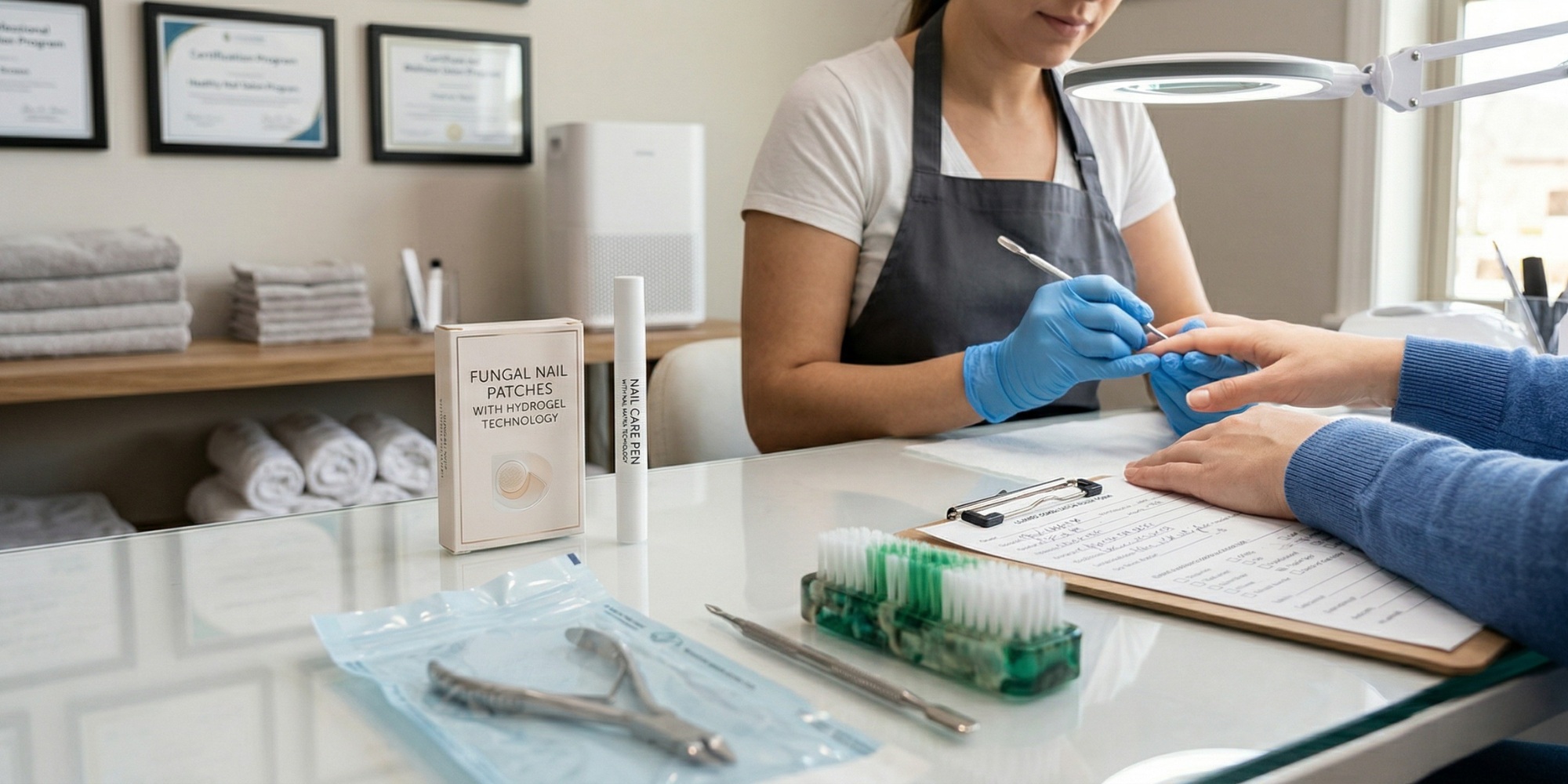
Regular creams often fail because they cannot get through the thick nail plate. To address this, we use better delivery systems. For nails that need extra support, I often suggest using fungal nail patches. By using hydrogel technology, these patches keep the nail hydrated so the keratin becomes more porous. This allows the ingredients to reach the nail bed much more effectively than simple drops that dry up quickly.
We also focus on the “matrix,” which is where the nail grows. To keep this area healthy, I recommend a nail care pen with Nail Matrix Technology for daily use. These products deliver nutrients directly to the base of the nail. When you nourish the tissue where new cells are formed, you help the client grow a much stronger foundation.
The Right Tools for Hygiene
The tools your clients use at home are just as important as yours. While you are building your skills, you should also look at this nail tech skills checklist to see what a professional kit needs. For home care, using a Salmon hygiene technology nail brush is much better than using a cheap, porous brush. These brushes have special bristles that resist bacteria, so the client is not putting germs back under their nails while cleaning.
Research from Research Nester (2026) shows that the world is moving toward wellness products that actually work. People are moving away from simple marketing labels and looking for products backed by real science.
Becoming a Clinical Specialist
A standard license is just the start. If you want to earn more and work with clients who have specific health needs, such as those with diabetes, getting a medical nail technician certificate is one of the best paths forward.
This training takes you beyond basic beauty and into “medical pedicuring.” It can also help your business qualify for a Healthy Nail Salon Recognition Program. Being part of a healthy nail salon program shows your community that you care about chemical safety and clean air.
This is very important because the FDA’s 2026 General Wellness Framework draws a clear line around health-related claims. Having official training is one of the safest and most credible ways to talk about superior hygiene standards in your business.
Take the Next Step in Your Career
Starting your career at the right place makes all the difference. At Neosho Beauty College, we focus on helping you become a leader in the industry. We want our students to graduate with a full understanding of the safety principles and advanced aftercare strategies discussed here.
The future of this field belongs to the people who understand the science behind the service. Whether you want to open a medical-grade salon or work with top wellness brands, we are here to give you that edge. Your journey from student to specialist starts with a strong foundation in safety, skill, and art.
You can learn more about how to join us by visiting our Enrollment page. We would love to help you build your future in the beauty industry. If you have any questions, please fill out the contact form at the bottom of this page so we can connect.
FAQ: Safety & Technology
Can I use a regular LED lamp to treat an infection? No. While there is medical-grade UV technology for nail fungus, salon lamps are only designed to harden gel. They do not have the intensity needed to kill fungal spores.
How is a nail care pen different from regular oil? Basic oils mostly sit on top of the skin. A nail care pen with Nail Matrix Technology is designed to absorb more effectively into the base of the nail to support the growth of healthy new cells.
Why should my salon join a Healthy Nail Salon Program? Being part of a Healthy Nail Salon Recognition Program is a strong trust signal. It shows clients that you follow recognized safety standards, which helps them feel more confident in your services.