Mastering Nail Salon Hygiene and Pro Aftercare Advice for Nail Technology

The nail world is shifting fast in 2026. While everyone still wants beautiful nail art, the real measure of a luxury service is how safe it actually is. The best technicians today are the ones who blend science with style. They know how to protect the client while making their nails look amazing.

To move from being a beginner to a leader in this industry, you have to change how you think. It is about protecting the client as much as beautifying the hands. If you are just starting your journey, I suggest looking through this 2026 career kickstart guide for nail technology to get a solid grasp of the basics. Providing high-level aftercare advice in nail technology is one of your best tools for building trust. It shows that you are a reliable expert who understands the biology of the nail plate.

Essential Tips for New Professionals

  • Mastering Microbiology: Success starts with being able to identify pathogens and prevent infections, even in high-end settings.
  • Understanding Tools: Most salon UV lamps are used for curing gel, not for medical treatments. Knowing these limits helps you guide your clients correctly.
  • Professional Growth: Earning a medical nail technician certificate helps you work safely with clients who have higher health risks.
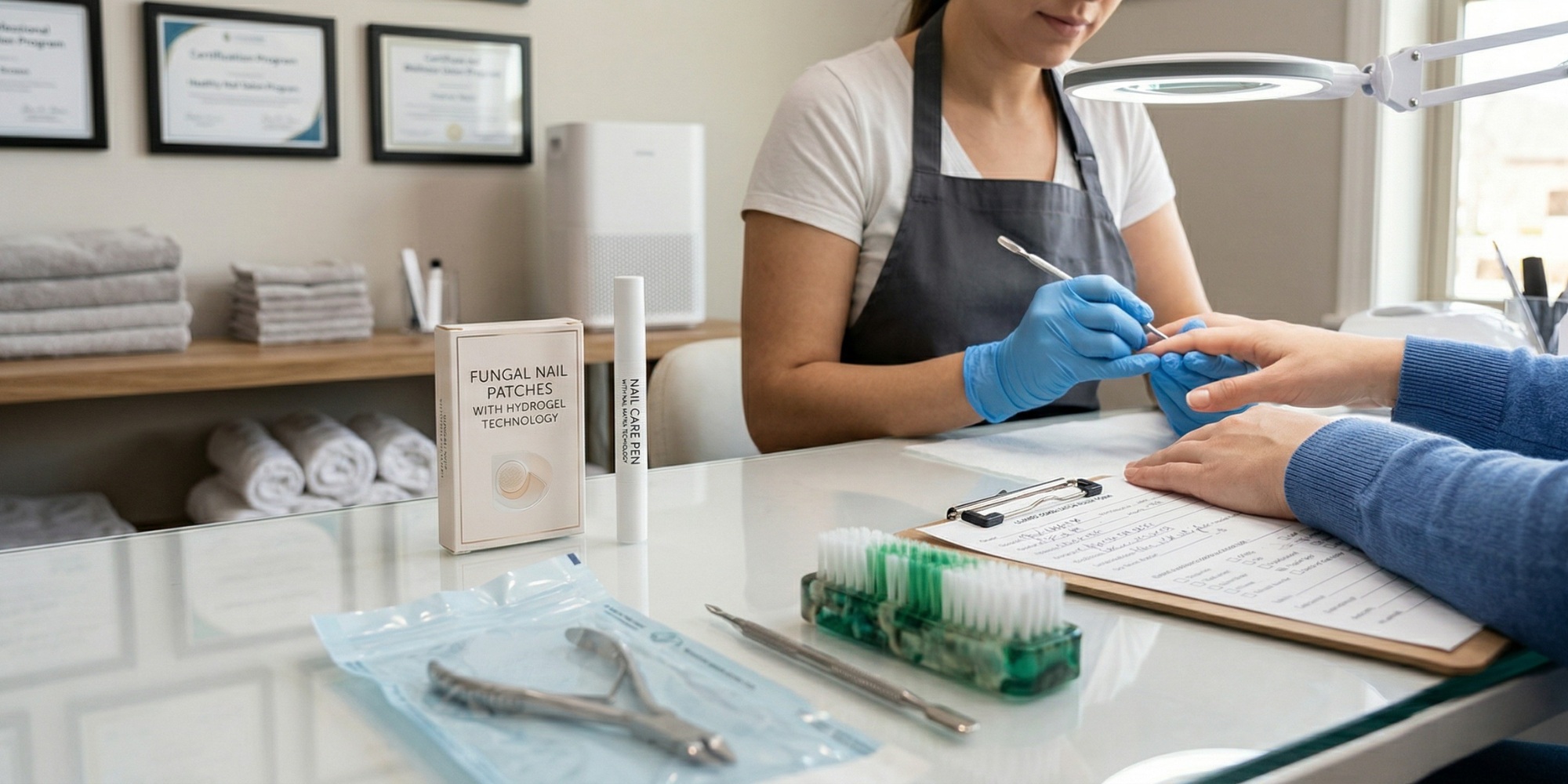
  • Smart Aftercare: The industry is moving toward products like fungal nail patches with hydrogel technology that can help support nail healing.

The Science of Safety: Managing Microorganisms

In any strong beauty program, the first lesson is usually about the “bio-burden.” This refers to the amount of microorganisms living on a surface or tool. To handle this safely, every professional should be able to list the four types of organisms that are pertinent to nail technology: bacteria, fungi, viruses, and parasites.

Understanding these four groups is about more than just passing a test. It is about knowing how they behave in a damp salon environment. Bacteria can enter and colonize a tiny skin tear very quickly. Fungi often thrive in the dark, wet spaces created when a nail enhancement starts to lift away from the natural nail.

Good infection control requires “mechanical debridement.” This means physically removing the sticky layer of bacteria before using chemical disinfectants. If you do not scrub first, the disinfectant might not reach the germs underneath. According to the 2026 Sunset Review Report by the California Board of Barbering and Cosmetology, poor disinfection is still a main cause of infections like ringworm, even in high-end salons.

The data show that as salons offer more complex services, the risk of injury can increase. This proves that a beautiful salon is no substitute for real safety protocols. In today’s market, safety is a major competitive advantage.

The Truth About UV and Laser Treatments

Clients are very health-conscious now, and they often ask about “medical” gadgets. One of the most common questions is whether UV technology can kill nail fungus.

Limits of UV Light

To answer this, you have to know the difference between sanitizing and treating a condition. There is specialized UV technology that fights nail fungus in medical clinics, but those machines use much higher intensities than standard salon lamps.

If a client has an active infection, gel polish can actually make it worse by trapping moisture and blocking out oxygen. The CT.gov Infection Control Guidelines state that UV light boxes are meant for dry storage, not for sterilization.

How Lasers Factor In

Clients also ask whether laser technology works for nail fungus in general. Based on the Medical Policy SURG.00138 from Healthy Blue Louisiana, lasers are best used as an adjunct therapy. They help slow fungal growth with heat, but they rarely solve the problem entirely on their own. By understanding the limits of laser technology for nail fungus, you can give your clients better advice about when to see a doctor.

Better Aftercare: Protecting the Client’s Investment

The most important period for nail health is the few weeks between appointments. If a client is not taking care of their natural protective barrier at home, the work you do in the chair will not last.

Modern Solutions for Home Care

Regular creams often fail because they cannot get through the thick nail plate. To address this, we use better delivery systems. For nails that need extra support, I often suggest using fungal nail patches. By using hydrogel technology, these patches keep the nail hydrated so the keratin becomes more porous. This allows the ingredients to reach the nail bed much more effectively than simple drops that dry up quickly.

We also focus on the “matrix,” which is where the nail grows. To keep this area healthy, I recommend a nail care pen with Nail Matrix Technology for daily use. These products deliver nutrients directly to the base of the nail. When you nourish the tissue where new cells are formed, you help the client grow a much stronger foundation.

The Right Tools for Hygiene

The tools your clients use at home are just as important as yours. While you are building your skills, you should also look at this nail tech skills checklist to see what a professional kit needs. For home care, using a Salmon hygiene technology nail brush is much better than using a cheap, porous brush. These brushes have special bristles that resist bacteria, so the client is not putting germs back under their nails while cleaning.

Research from Research Nester (2026) shows that the world is moving toward wellness products that actually work. People are moving away from simple marketing labels and looking for products backed by real science.

Becoming a Clinical Specialist

A standard license is just the start. If you want to earn more and work with clients who have specific health needs, such as those with diabetes, getting a medical nail technician certificate is one of the best paths forward.

This training takes you beyond basic beauty and into “medical pedicuring.” It can also help your business qualify for a Healthy Nail Salon Recognition Program. Being part of a healthy nail salon program shows your community that you care about chemical safety and clean air.

This is very important because the FDA’s 2026 General Wellness Framework draws a clear line around health-related claims. Having official training is one of the safest and most credible ways to talk about superior hygiene standards in your business.

Take the Next Step in Your Career

Starting your career at the right place makes all the difference. At Neosho Beauty College, we focus on helping you become a leader in the industry. We want our students to graduate with a full understanding of the safety principles and advanced aftercare strategies discussed here.

The future of this field belongs to the people who understand the science behind the service. Whether you want to open a medical-grade salon or work with top wellness brands, we are here to give you that edge. Your journey from student to specialist starts with a strong foundation in safety, skill, and art.

You can learn more about how to join us by visiting our Enrollment page. We would love to help you build your future in the beauty industry. If you have any questions, please fill out the contact form at the bottom of this page so we can connect.

FAQ: Safety & Technology

Can I use a regular LED lamp to treat an infection? No. While there is medical-grade UV technology for nail fungus, salon lamps are only designed to harden gel. They do not have the intensity needed to kill fungal spores.

How is a nail care pen different from regular oil? Basic oils mostly sit on top of the skin. A nail care pen with Nail Matrix Technology is designed to absorb more effectively into the base of the nail to support the growth of healthy new cells.

Why should my salon join a Healthy Nail Salon Program? Being part of a Healthy Nail Salon Recognition Program is a strong trust signal. It shows clients that you follow recognized safety standards, which helps them feel more confident in your services.
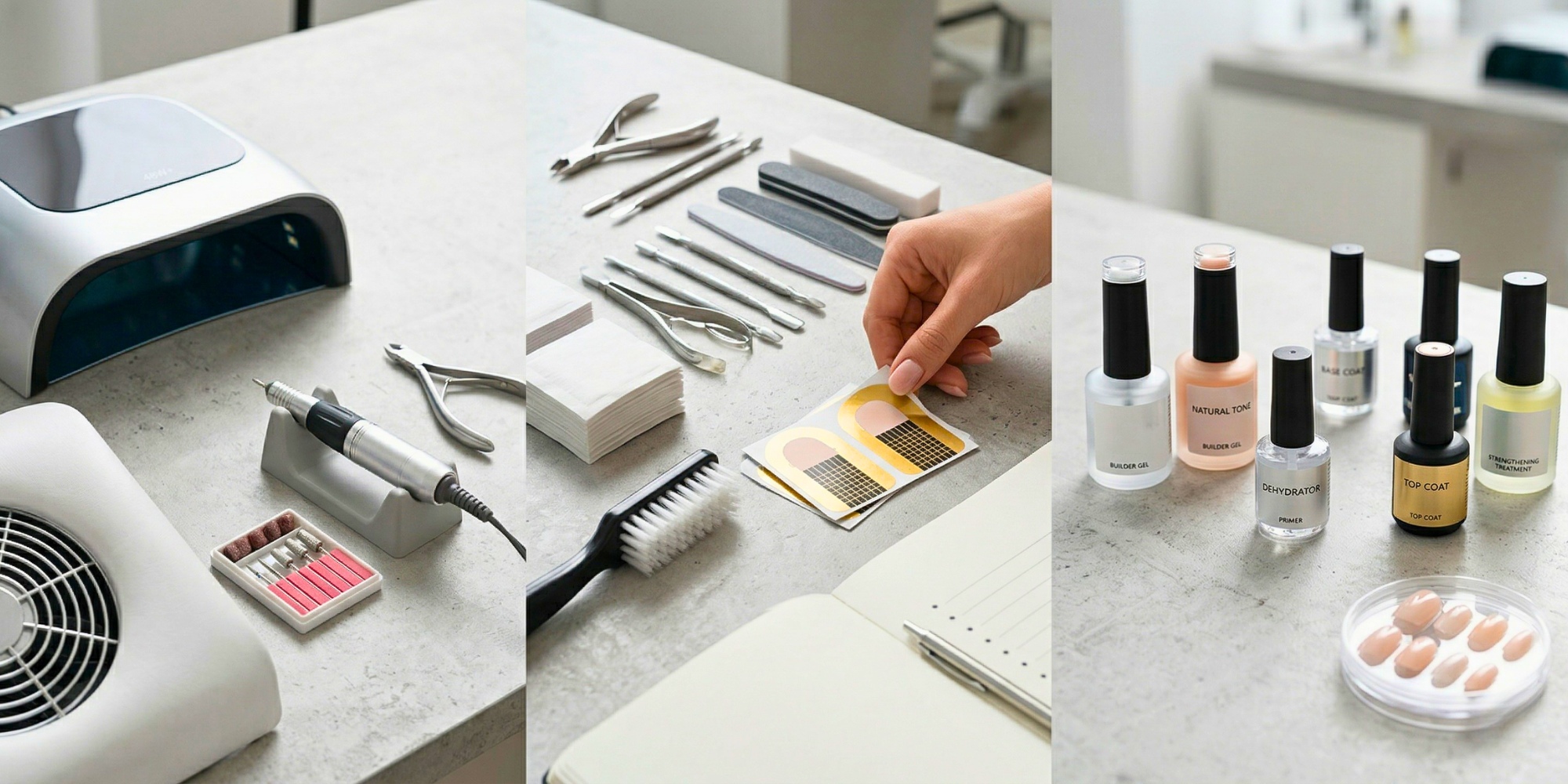

What Every Professional Needs: A Nail Tech Skills Checklist of Core Procedures and Essential Tools

Starting the journey from a beauty lover to a licensed professional is really about looking past the surface. It involves a deep dive into nail technology procedures and the science of keeping the nail structure strong while ensuring chemical safety. I remember when I first started, watching a pro sculpt extensions seemed like magic, but I eventually realized it’s just the result of learning specific motor skills and understanding the tools in your hand.

The industry in 2026 has transitioned toward a more clinical standard often called medical-grade manicuring. If you are trying to figure out how to bridge the gap between basic salon work and advanced artistry, our 2026 career kickstart guide is a great way to map out your professional future. Recent data from Business Research Insights shows that over 32% of clients now have sensitivities to common chemicals, which means now is the time to become a specialist who focuses on health.

Key Takeaways

  • Market Trends: The industry is on a path to reach $122.7 billion by 2035, with a major focus on skin-first and clinical-grade services.
  • Legal Compliance: Because of MoCRA, we have to understand product chemistry to stay in line with new FDA safety standards and recall powers.
  • Advanced Methods: Modern success is built on Builder-in-a-Bottle (BIAB) and precise e-filing techniques rather than old-school, heavy acrylics.
  • Health Science: Bioactive ingredients like calcium silicate are now clinically shown to boost nail thickness by 39%, shifting our role toward being health consultants.

Checking Your 2026 Starter Kit

I know that the initial startup costs and the time it takes to learn a new trade can feel a bit daunting. To help you plan things out, I recommend looking over the requirements and tuition for nail technicians so you can move forward with a clear plan. When you start building your own nail technology kit, I find it helpful to divide your purchases into four distinct groups to understand what are the 4 types of nail technology tools you’ll be using:

  1. Equipment: These are the permanent assets, like your UV/LED lamps and high-torque E-files.
  2. Implements: These are multi-use steel tools, such as nippers and pushers.
  3. Materials: These are your disposables, including files, buffers, and wipes.
  4. Professional Products: This covers the chemistry, like dehydrators, primers, and gels.

When I think about what beginner nail techs need, I always tell them to put their own health first. Your nail technology tools should definitely include a HEPA-filtered dust extraction system. In today’s world, this isn’t just a luxury – it’s a necessity for a long career.

The Architecture of Professional Tools

I see a lot of beginners spend way too much money on the latest polish colors while neglecting the “workhorse” tools that actually make the business run. When we look at what nail technicians use, we have to separate our daily materials from our long-term investments.

Understanding Permanent Items

In a professional setting, students often ask: what are permanent items utilized in nail technology known as? Put simply, these are your equipment and multi-use implements. Unlike things you throw away, these items stay with you. Investing in high-quality stainless steel nippers and 48W+ UV/LED lamps is the foundation of your workspace. I always suggest getting autoclave-ready steel to make sure you can meet the high clinical standards for sanitation.

Hygiene and Professional Standards

Sanitation today is about much more than just a quick soak. Advanced nail technology tools like a salmon hygiene technology nail brush are now standard because their bristles don’t harbor bacteria while they help with deep cleaning. Using these kinds of specialized tools is the quickest way to show your clients that you take their safety seriously.

The 2026 Regulatory Environment

Based on the FDA’s MoCRA updates, knowing your brands is now a legal requirement. In 2026, the FDA has the power to pull products used in nail technology off the market if there are safety concerns. Understanding product chemistry is no longer just a bonus; it’s a legal part of being a professional.

Structural Mastery and Extensions

The Geometry of a Perfect Set

Being a premium tech in 2026 means creating “Quiet Luxury” extensions that look natural but are incredibly strong. To do this, I focus on two main pillars: the C-curve and the Apex.

  • The C-curve is the horizontal arch of the nail. Just like a bridge, this arch provides the structural strength needed so the nail doesn’t stay flat and weak.
  • The Apex is the highest point from a side view. This is the stress point of the nail. When I place the bulk of the product here, it helps the nail absorb impacts without breaking.

The Secret of Nail Forms

Learning how to put on a nail form is one of the most important skills I teach. Unlike plastic tips, a form lets you sculpt an extension that fits the unique shape of a client’s finger. Mastering how to put nail form templates on correctly – so they are flush against the skin – prevents the structural failures that lead to painful breaks later on.

Building with Strength

Once the form is in place, I choose my materials carefully. Many pros are now moving toward things like Diva nail technology builder gel systems. According to recent salon trend reports, these structured manicures allow for 20-30% higher service prices because they protect the nail’s lipid barrier while remaining very durable.

E-Files and Bioactive Science

Mastering the E-File

The e-file is probably the most misunderstood part of a nail care nail equipment list. When you learn how to use an e-nail, you aren’t just “drilling.” You’re doing a precise micro-exfoliation. Using diamond bits at low speeds allows you to clean up the nail edges with surgical accuracy, which helps your gel stay on much longer.

The Science of Healthy Nails

We are currently in an era that prioritizes the biological health of the nail. Products like OPI Nail Envy original strengthener with Tri-Flex Technology are designed to mimic the nail’s natural keratin. By understanding how Tri-Flex Technology creates a flexible shield and how a nail care pen with nail matrix technology supports the growth center of the nail, you can offer services that actually repair damage. This is essential for helping clients who have suffered from over-filing in the past.

The Evolution of Press-ons

If you think press-ons are just for home use, you should look at press-on nail technology today. In 2026, many pros are creating custom gel sets for high-end clients. Knowing what are nail press-ons in a professional context – hand-painted, bespoke sets – allows you to earn money even when you aren’t at your station.

Clinical Research Insight

A 2025 clinical study from MDPI showed that bioactive formulas with calcium silicate can increase nail strength by 64% in a month. Your value as a professional goes up when you can explain the science behind the nail technology products you choose.

Aftercare and Your Professional Path

Managing Mechanical Stress

My work doesn’t stop once the polish is dry. I always give my clients specific after care advice for nail technology to help them manage mechanical stress. If I can teach them not to use their nails as tools, my work stays perfect, and I get those five-star reviews that help my career grow.

Building a Future

The nail market is growing fast and is expected to hit $122.7 billion by 2035. While some salons are struggling, specialists who understand these nail tools and uses are thriving. By choosing a path that emphasizes advanced tools nail technicians use, you are setting yourself up for success.

Ready to Start Your Career?

The move toward health-focused and medical-grade services is a huge opportunity for new specialists. At Neosho Beauty College, I believe in a hands-on approach that prepares you for the real world. We make sure you are comfortable with the professional nail technology tools and the various products used in nail technology that top-tier salons expect.

If you are ready to see what your future looks like, I invite you to come visit us. You can see how our programs work, meet the instructors, and experience the energy of our campus.

To find out more about how to join us, you can look at the details in Enrollment and see what it takes to get started. You can also use the contact form at the end of this article to ask us anything or schedule a time to stop by. I’m looking forward to helping you build your career!

FAQ: Tips for New Techs

What tools do you need to do nails at home compared to a professional setting?
Home kits usually don’t have the power of professional nail care equipment. At school, I teach students to use high-torque files and specific LED lamps that ensure the gel cures fully, which helps prevent the allergies often caused by weaker consumer-grade gear.

How should I choose the best products used in nail technology for my kit?
I always recommend system consistency. If you use the base, color, and topcoat from the same brand, the chemical bonds are designed to work together. This is the best way to stop the lifting and peeling that can frustrate clients.

What do nail techs use in a clinical-style salon?
You will need specific things for nail techs like an autoclave for sterilization and high-quality e-file bits. I also suggest using hypoallergenic and HEMA-free products in your nail technology kit to keep your clients’ skin safe and healthy.

Do You Actually Need a Certificate to Be a Nail Tech? Breaking Down Requirements, Time, and Tuition

I remember when I first started experimenting with gel kits at home and realized just how much I loved the process of creating something beautiful. It’s a common story for many of us in the beauty world, but the jump from doing nails for fun to doing them as a career involves a lot more than just artistic skill. Navigating the professional landscape in 2026 means dealing with new safety regulations and a much higher standard of accountability from clients. If you are starting to look into making this your full-time job, it helps to check out a career kickstart guide to see how the industry is evolving this year before you get caught up in the paperwork.

What You Should Know Upfront

  • A nail technician certificate is a great educational milestone, but you actually need a nail technology license to legally charge for your work.
  • Clients in 2026 are looking for the safety premium, with over 20% choosing salons based on their medical-grade cleaning standards.
  • Transparency matters when looking at how much a nail tech program cost, including your tools and fees.
  • New federal rules like MoCRA mean every professional needs to be an expert in product safety and chemicals.

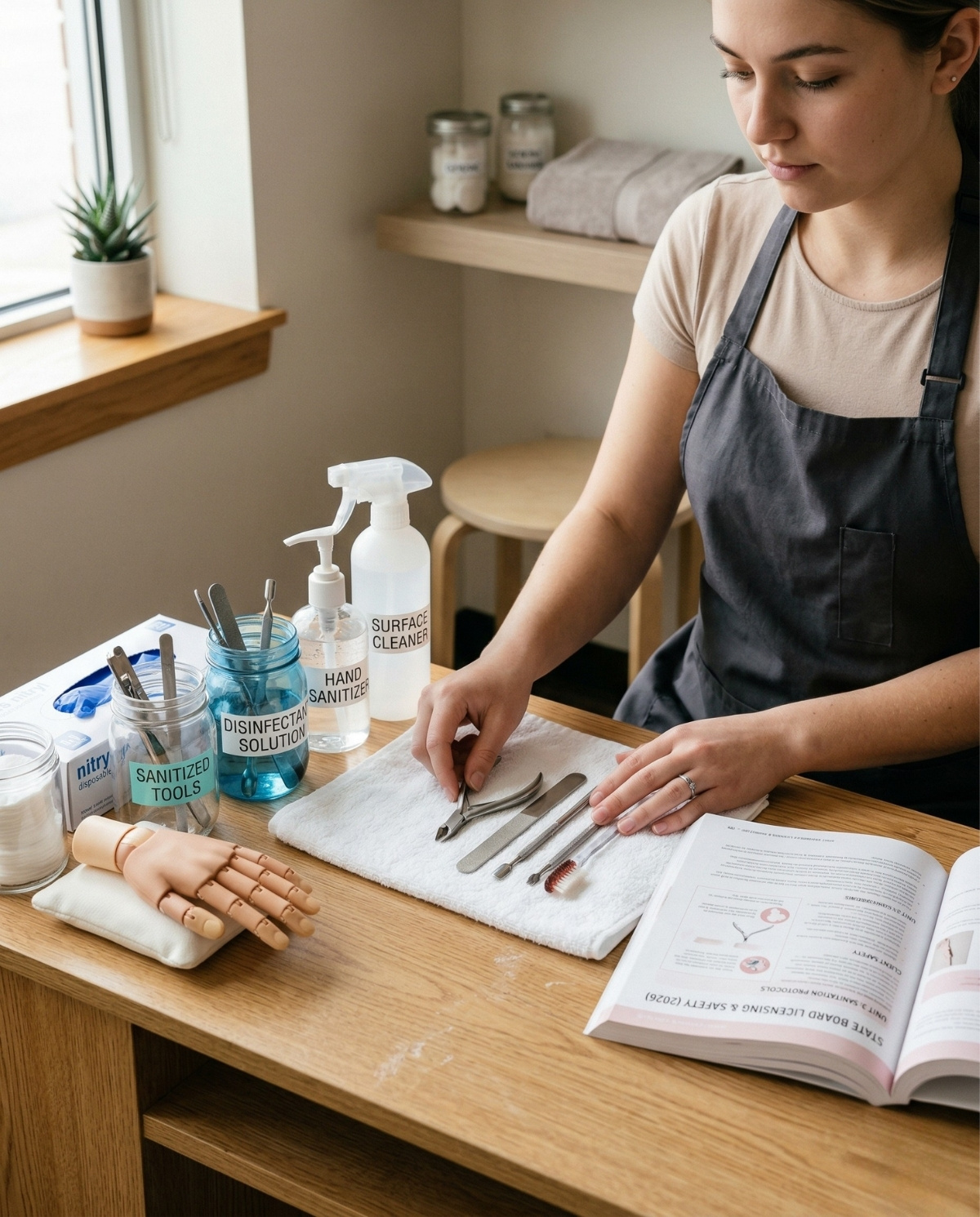
A seated woman in a grey apron meticulously arranges various metal manicuring tools like clippers, files, and pushers on a clean white towel atop a wooden desk. Her hands select the implements. On the table are clearly labeled bottles of 'SURFACE CLEANER', 'HAND SANITIZER', 'DISINFECTANT SOLUTION', and a jar for 'SANITIZED TOOLS', along with a box of blue nitryl gloves and an articulated training hand model on a cushion. A textbook with partially visible text related to licensing and safety guides is open, illuminated by natural light from a window.

The Legal Side: Certificates vs. Licenses

I see a lot of people getting confused about whether a diploma is the same thing as a permit to work. It’s one of the most important distinctions you’ll make when starting out.

Educational Goals and Legal Reality

If you are wondering whether you can do nails with a certificate, the answer usually depends on who you are doing them for. You can use a certificate from an online course to show your friends you know what you’re doing, but to work in a salon and get paid, you must have a nail technology license from the state.

A certificate shows you completed your classes, while the license proves you meet the nail technology requirements set by the state health board. When you choose a state approved nail technician program, your credentials become a lot more valuable. In 2026, many states are part of the Interstate Cosmetology Compact, which makes it much easier for licensed pros to move their business to a different state without starting their education from scratch.

New Federal Safety Standards

The industry has shifted quite a bit recently because of the Modernization of Cosmetics Regulation Act (MoCRA). According to the U.S. Food & Drug Administration, there is now much more oversight on the chemicals used in professional products. This means that as a professional, I have to be more than just an artist; I have to be a safety expert. Operating without a proper license in this new environment carries a lot more risk than it used to.

The Training Process: Hours and Exams

Picking the right nail technology program is really your first big business move. It’s often helpful to compare a nail tech program vs cosmetology to make sure you aren’t spending time and money on classes you don’t actually need for your specific goals.

How Many Hours Are Required?

I often get asked how long is a nail program or how long does it take to train as a nail technician. In 2026, most states focus on competency, but you’re still usually looking at 300 to 600 hours. For example, at a manicuring school in Missouri like Neosho Beauty College, the program is typically 400 hours. Full-time students can often finish in about 3 months, while part-time students might take around 6 months.

You might hear about a nail technician apprenticeship as an alternative. While it sounds like a good way to earn while you learn, keep in mind that apprenticeship hours are usually double what you’d spend in school. You also might miss out on the structured nail technology theory that is so important for passing the written part of your exams.

Passing the State Board

The final hurdle is the nail technology exam. To get ready for the nail technology state board, modern schools now use digital simulators and a nail technology state board practice test. These tools focus heavily on things like chemical storage and how to handle blood exposure, which are huge parts of the 2026 exam format.

The Cost of Starting Your Career

Let’s talk about the financial side of things. I know the idea of school debt can be stressful, so it’s important to look at the total investment.

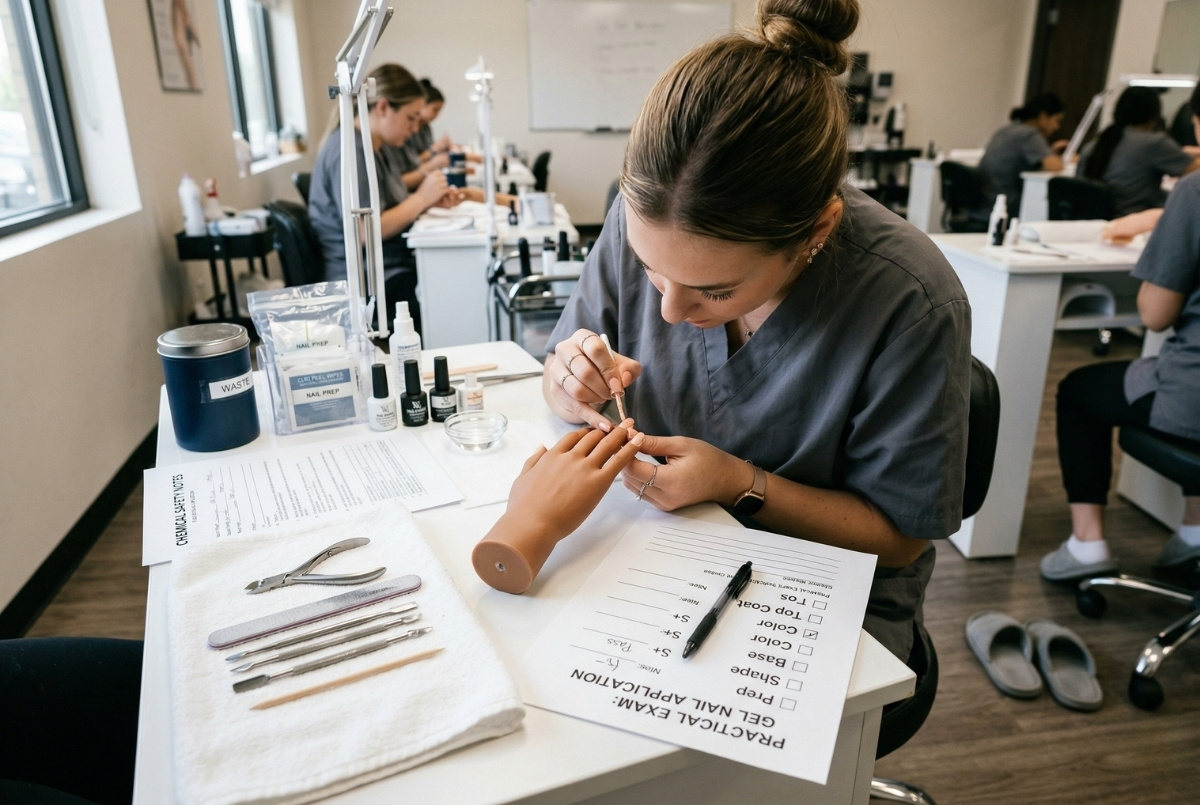
A nail technician student in a gray uniform carefully applying gel to a practice hand at a clean workstation, featuring an exam checklist, sanitized stainless steel tools on a towel, and chemical safety notes in a professional training salon.

Calculating Your Total Investment

When you ask how much is nail technology school, you have to look past just the tuition. You need to consider the total cost of attendance, which includes your equipment and books. At Neosho Beauty College, we prioritize transparency so you know exactly what you’re paying for. A quality nail technology school will usually bundle your tuition with a professional kit that has all the high-end tools you need to start working immediately. This prevents you from having to spend hundreds of extra dollars on supplies halfway through your course.

Funding Your Education

There are more ways to pay for your certificate in nail technology than there used to be. The federal government is expanding access to Workforce Pell Grants for short-term programs starting in July 2026. You can also look into scholarships for nail technology through organizations like Beauty Changes Lives. Most schools also offer internal payment plans to help you manage the cost while you study.

The 2026 Job Market

The market right now isn’t looking for the cheapest services; it’s looking for the safest ones. According to Business Research Insights, a significant portion of customers will only visit licensed technicians because they are worried about salon hygiene. This shift has actually helped drive up what we can earn.

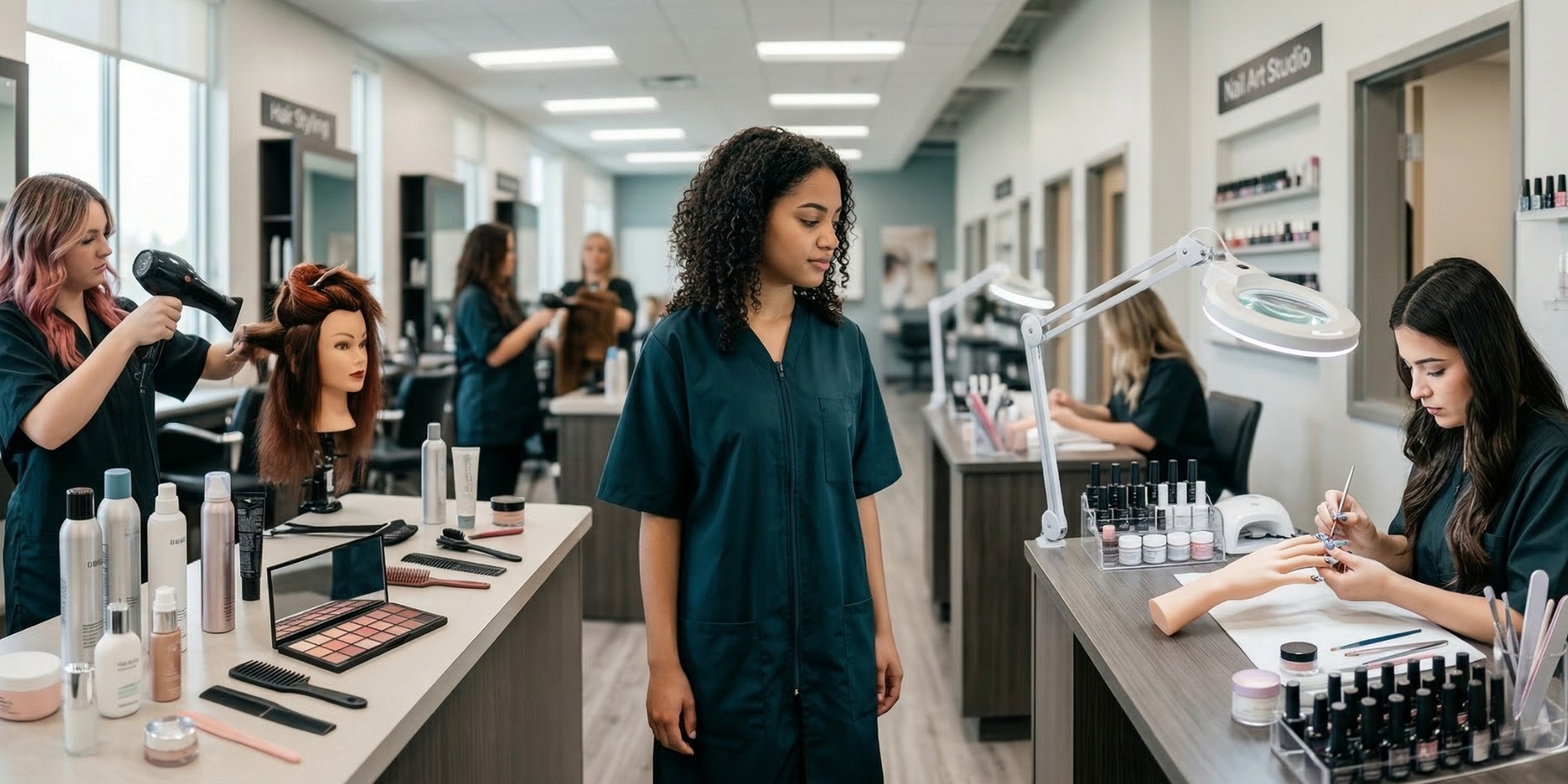
A smiling female nail technician in a sage green apron standing beside a tidy, professional manicure station. The bright boutique salon features warm neutral decor, a framed certificate on the wall, and organized sanitation tools.

What You Can Expect to Earn

Based on Indeed’s data from March 2026, the pay for nail technicians is looking very positive:

  • The national average base pay is around $23.68 per hour.
  • Experienced pros in the industry can command rates over $50 per hour.
  • In luxury boutique markets, some specialized rates are hitting as high as $94.94 per hour.

Remember, these numbers are just the base. Your actual take-home pay usually increases quite a bit once you add in tips and commissions on products.

Ready to Start Your Professional Journey?

I’ve seen how much a career in beauty can change someone’s life, and now that you understand the legal landscape for 2026, you’re in a great position to start. The key is to find a place that doesn’t just teach you how to paint nails, but how to lead the industry with speed, precision, and chemical literacy.

If you want to see what our environment is like and meet the instructors who help our students succeed, I highly encourage you to come visit. Seeing the clinic floor in action is the best way to visualize your own future success.

You can find out more about how to get started in Enrollment. If you have any specific questions, please feel free to use the contact form we’ve left below this article, and I’ll be happy to help you map out your path.

Frequently Asked Questions

What is the difference between a Level 2 and Level 3 nail technician certificate? A Level 2 certificate usually covers standard services like manicures and basic enhancements. Level 3 is for those who want to master advanced chemical compositions and medical-grade sanitation.

Can I go to nail school online in 2026? Many schools use a hybrid model now. You can often do your theory work online, but you still have to complete your hands-on hours at a physical manicuring school to qualify for your license.

How does the Interstate Compact work? This 2026 initiative allows a licensed tech to work in several different states without having to retake the board exam, making your license a much more flexible asset for your career.

Nail Tech Program vs. Cosmetology: Your Guide to Choosing the Right Beauty Career Path

Choosing a career in the beauty industry is a lot more than just having a knack for aesthetics; it is a strategic move into a world that is becoming more specialized by every passing year. If you are standing at the starting line right now, you are probably weighing the pros and cons of a cosmetology or nail technician program to see which one actually matches the lifestyle you want to lead.

I often tell people that this choice isn’t just about picking a school. It is about deciding if you want to be a beauty polymath who can do it all, or a technical specialist who dominates a specific niche. Today’s beauty market is looking for more than just talent; it rewards deep technical skill, a rock-solid understanding of sanitation, and real expertise. Your education is going to dictate how fast you can get licensed, what services you can legally offer, and how safely you can handle professional-grade products.

Core Facts for Your Career Path

  • Speed to the Finish Line: A nail technology program is usually the quickest way to get your license and start your own business. Depending on where you are, these programs often range from 300 to 600 hours.
  • A Growing Market: The nail salon industry is currently seeing a 10.7% compound annual growth rate (CAGR), according to Technavio (2025). This is actually beating out many other general beauty sectors.
  • The Safety Standard: Professional training is where you build the habits that protect you and your clients. While new federal laws like MoCRA are adding oversight for products, your school training is what helps you navigate OSHA safety rules in a real-world salon environment.
  • Higher Earning Potential: When you specialize, you can often charge premium prices. This works best when you combine top-tier technique with a unique service menu that keeps clients coming back.

Generalist vs. Specialist: How Do You Want to Work?

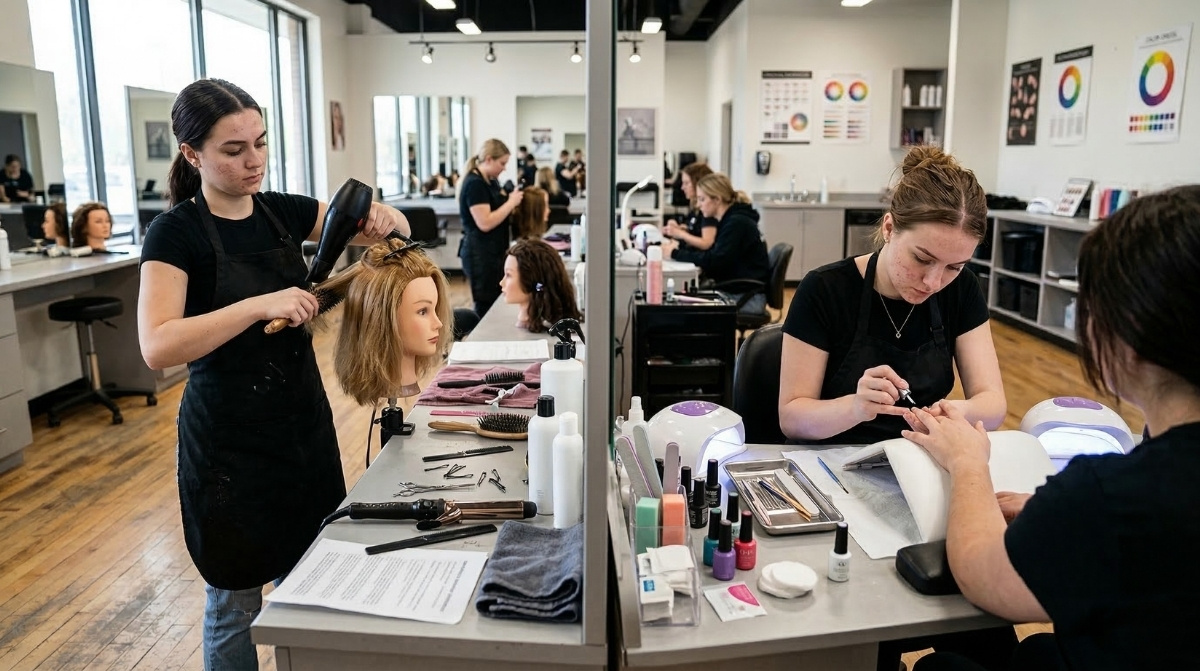
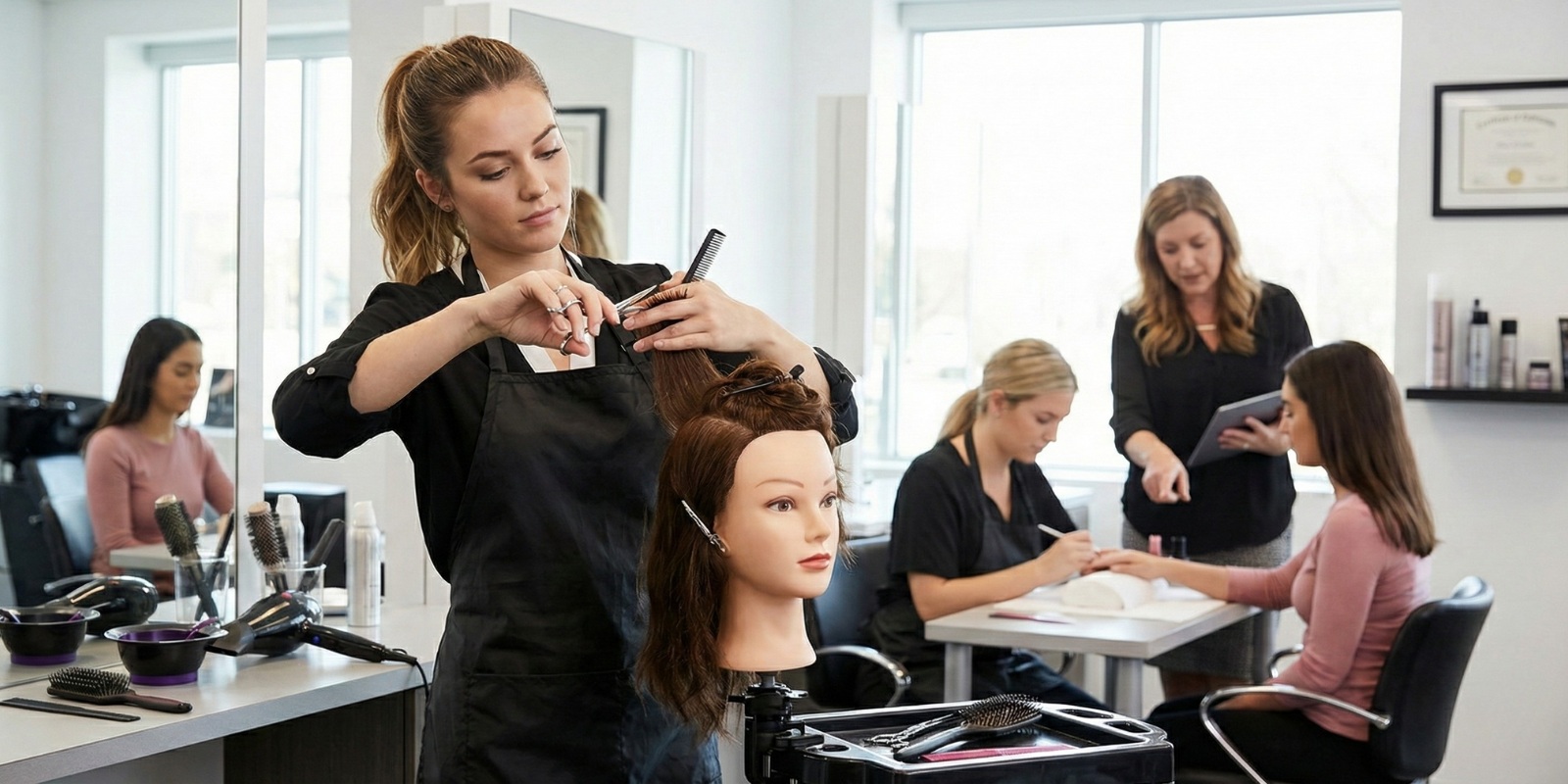
A high-quality realistic photo of a beauty school training studio featuring two students: one practicing hair styling on a mannequin and the other performing a professional manicure at a specialized station.

When I look at the difference between cosmetology and nail technology, people usually ask me what they can do, but I think the better question is how they want to work.

Cosmetology is the broader path. It is designed for the professional who wants chair sovereignty – the power to change their service menu whenever a new trend hits the market. You get trained in the chemistry of hair, the physiology of the skin, and the structure of nails. It is a longer commitment, but it gives you the most variety in terms of your daily routine.

On the other hand, a nail tech program is a deep dive into one specific area. Instead of learning everything from haircuts to facials, you spend your hours focusing intensely on nail chemistry, product safety, nail diseases, and intricate artistry. To help you see what that curriculum actually looks like, I recommend checking out this 2026 career kickstart guide for nail technology, which goes into the foundational steps of the craft.

The 2026 Regulatory Landscape

It is worth noting that beauty products are seeing more federal eyes on them than ever before. Under MoCRA, manufacturers and distributors are now required to report serious adverse events to the FDA. Meanwhile, OSHA still requires every salon to have Safety Data Sheets for any hazardous products. A high-quality beauty program helps you understand these chemical risks and sanitation standards so you are protected the moment you start working.

Your Identity: Technician or Artist?

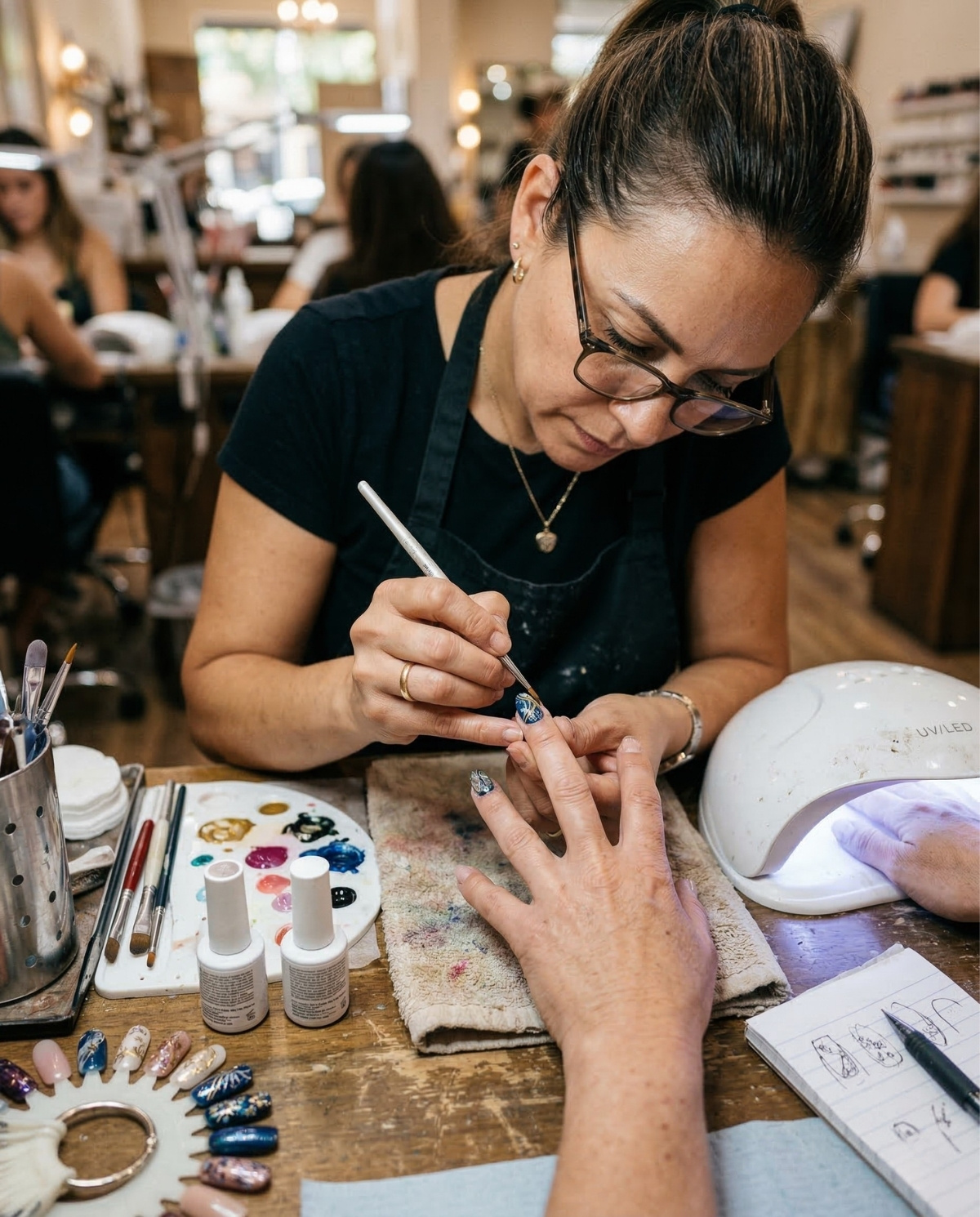
A high-resolution, realistic close-up of a professional nail artist meticulously painting an intricate blue and gold design on a client's nail at a weathered wooden workstation featuring a gel curing lamp and artistic sketches.

I’ve noticed there is often a bit of a gap between being a nail technician or nail artist. Think of your license as your floor – it is the legal requirement you need to work. Your branding, however, is your ceiling.

In a professional nail technology program, you learn the technical why behind every how. You’ll study things like nail structure and product chemistry to make sure you aren’t over-filing or damaging a client’s natural nails. While a technician provides a standard service, a nail artist provides a total transformation. In 2026, the graduates who are really winning are the ones using their technical foundation to open specialized niche studios.

If you go the cosmetology route, your options go way beyond the manicure desk. This license allows you to move into editorial work, film sets, or even becoming a brand educator. If you’re curious about where that path can take you, take a look at these 10 careers you can pursue with a cosmetology license, including some surprising remote roles.

ROI: Getting Your Business Running Faster

If you are looking for the best time-to-income ratio, the nail technology program is the clear winner. You can usually finish your hours and be sitting behind a professional desk in less than six months. For an entrepreneur who wants to start their own brand or rent a salon suite quickly without a year of school debt, this is a very attractive path.

That said, the cosmetology or nail technician program debate often ends with people choosing the former for the career safety net. It takes longer to complete, but you are almost immune to downturns in a specific niche. If nails aren’t trending one year, you can lean into hair or skin services without needing a new license.

The $9.48 Billion Market Trend

We are seeing a trend called premiumization right now. While the whole beauty industry is growing, research from Technavio’s 2025-2029 Nail Salon Market Report shows that the specialized nail sector is expanding at that impressive 10.7% CAGR. People are moving away from all-in-one salons and looking for specialty boutiques where they know they are getting expert care.

Wellness and Clinical Precision

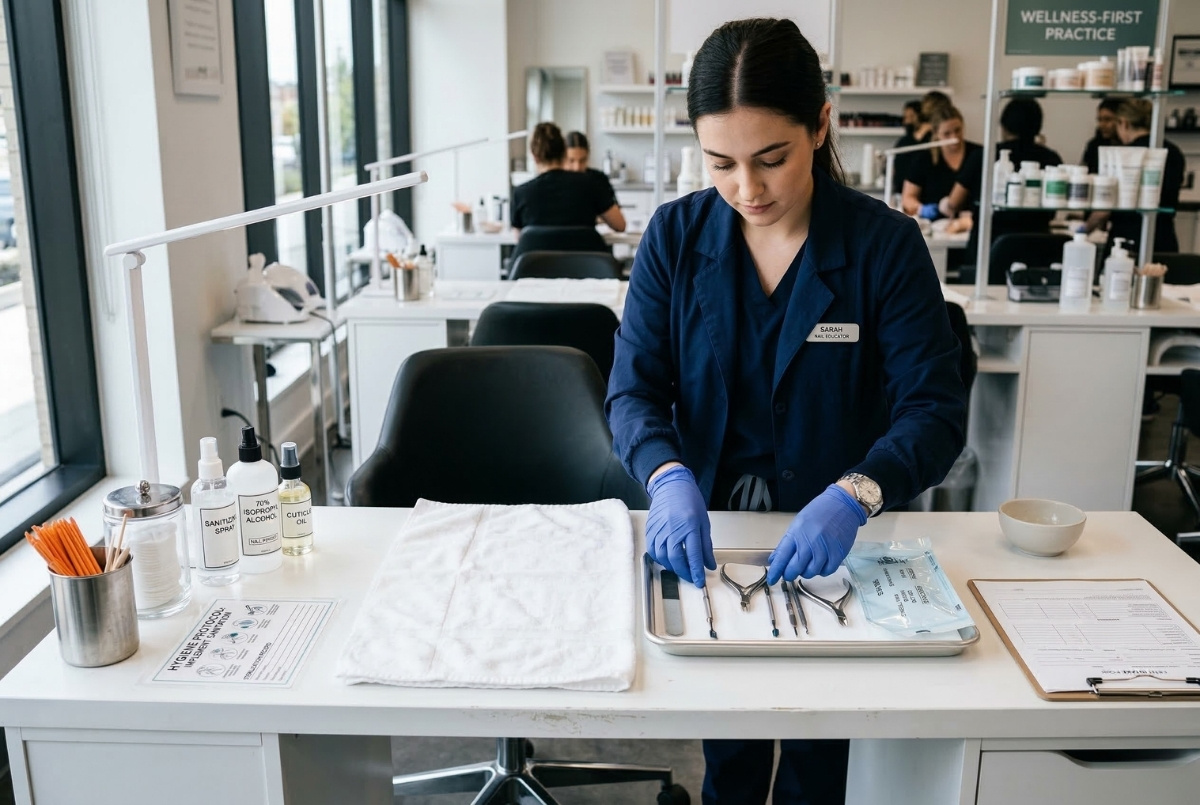
A professional nail technician wearing blue gloves and scrubs, meticulously arranging sanitized metal implements in a stainless steel tray at a clean, modern workstation in a high-end beauty training lab.

One thing that really separates a professional education from learning on your own in 2026 is the focus on the biology of the nail. Professional tools are everywhere, but they don’t give you the technical base to manage physiological risks.

There is a major shift toward wellness-first protocols. For example, a 2020 study in Skin Appendage Disorders showed that specific nail-strengthening formulas could improve nail hardness by 26.7% over 84 days for people with brittle nails. As a pro, you learn how to integrate these evidence-backed products into your care.

We are also seeing a lot of buzz around dry manicure techniques. A 2025 review on Advanced Dry Manicure Techniques suggests these protocols might reduce risks associated with water soaking, like nail plate expansion. This is the kind of high-level knowledge that makes you a reliable pro in the eyes of your clients.

Which Path Should You Choose?

Choosing between a cosmetology or nail technician program really comes down to what you want your daily life to look like.

  • Choose Cosmetology if you love variety and want the freedom to jump between hair, skin, and nails whenever the market changes.
  • Choose Nail Technology if you have a great eye for detail, a love for the science of products, and a goal to own a specialized studio as fast as possible.

Your future isn’t defined by the license alone; it is about the mastery you claim over your craft.

Ready to Start Your Journey?

The beauty industry in 2026 needs more than just people who can do the work – it needs visionaries. At Neosho Beauty College, we’ve spent over 40 years helping students turn their passion into a real-world career. I believe in a salon-ready approach, which means we focus on bridging the gap between the classroom and the high-end professional world from day one.

When you join us, you’re stepping into a legacy of excellence that dates back to 1983. We focus on providing the mentorship you need to turn your ambitions into a sustainable, high-growth career. If you’re ready to see the difference for yourself, I invite you to come visit us. You can walk through our facilities, meet the instructors, and see if this is the right fit for your future.

You can find out more about the next steps on our Enrollment page. If you have questions or want to chat with our team, feel free to fill out the contact form at the bottom of this page. Let’s start building your legacy together.

FAQ: The Reality Check

What if I get a Nail Tech license but want to do hair later?
You would need to go back and enroll in a full cosmetology program. Some of your hours might transfer depending on the state board, but the hair-specific modules would have to be completed from scratch. I usually suggest the specialist path only if you’re sure hair isn’t your main interest.

Is the nail technology program market too crowded in 2026?
The demand is still incredibly high, but you have to stand out. The U.S. Bureau of Labor Statistics projects a 7% growth for manicurists and pedicurists through 2034. In my experience, specialization and quality of service matter much more than how many salons are on your block.

Can a cosmetology license get me into a medical spa?
It is a great foundation, but med-spa work usually requires extra training or specific certifications depending on the machines or treatments being used. Always check your local state requirements for medical-grade services.

What Are Manicuring and Nail Technology? Your 2026 Career Kickstart Guide

I remember spending countless hours at my desk trying to get a set of nails just right, wondering if this was just a creative hobby or something I could actually do for a living. In 2026, the beauty industry has transformed. It isn’t just about basic service anymore; it is a specialized blend of chemistry and hand health. This guide is my professional introduction to nail technology, designed to help you transition from a dedicated enthusiast into a high-earning, licensed specialist.

Crucial Insights for New Professionals

  • Market Potential: The industry is seeing steady growth of 7% through 2034, largely because high-manual dexterity roles are incredibly difficult for AI to replicate.
  • Financial Outlook: In luxury markets, specialized technicians are seeing a significant manicuring and nail technology salary that can range between $34 and $94 per hour.
  • Modern Safety: Regulations in 2026 have pushed for TPO-free and HEMA-free chemistry, making a formal education in toxicology more important than ever.

The Science Behind the Style: More Than Just Polish

To truly get a handle on the nail technology meaning in the current era, I believe you have to look past the aesthetic of the final look. Modern technicians act more like surface chemists. Every service I provide involves managing a chemical reaction called polymerization on a living surface. Understanding how UV light interacts with specific formulas to create a bond without damaging the natural nail is what separates a true pro from an amateur.

Defining the Role of a Technician in 2026

When people ask what are nail techs in the current market, I usually describe them as the primary care providers for the hands. Beyond the artistic side, your job involves being able to identify various nail pathologies. A trained professional can tell the difference between a simple bruise and something as serious as subungual melanoma. I see us as the first line of defense for a client’s hand health, which is why getting your license is so vital for public safety.

The Toxicology Shift: Safety First

The shift toward safer products is a major talking point in the industry right now. According to the New Rules of Nail Care from StyleSpeak, the move away from certain chemicals has changed how we approach service. Education today isn’t just about application; it’s about knowing how to read a Safety Data Sheet (SDS) to ensure you are using biocompatible formulas. For those of you just starting out, resources like HONA’s Knowledge Hub are great for mastering product chemistry before you even begin your first day of school.

Navigating the Career Path and Economic Reality

There is often some confusion regarding manicuring vs nail technology. In most areas, your manicuring license is your legal permission to perform services for pay. However, your nail technology training is what gives you a competitive edge. While a manicurist might focus on basic maintenance, a nail technologist is trained to engineer structures – like balancing the apex of an extension to prevent trauma to the natural nail.

Longevity: Nail Technology for Beginners

For anyone looking into nail technology for beginners, I always emphasize ergonomic longevity. I’ve seen many self-taught artists leave the industry after just a few years due to neck strain or carpal tunnel. A professional program teaches you the proper biomechanics – how to position your chair and hold your tools – to ensure you can enjoy a long and healthy career.

Salary Tiers and Job Security

Data from the U.S. Bureau of Labor Statistics Occupational Outlook shows that this field has a bright outlook with tens of thousands of job openings projected annually. While general statistics on trends from Indeed can give you a baseline, I’ve found that those who focus on medical manicuring or architectural enhancements often command much higher rates in high-demand hubs.

The 2026 Aesthetic: Soft Minimalism and Tech

The dominant style in 2026 has shifted toward soft minimalism. As noted in Vogue Scandinavia’s report on non-negotiable nail trends, milky whites and clean, clinical-grade health are the top priorities. This trend is less about flashy art and more about perfect shaping and natural nail integrity.

Integrating Modern Tech Into the Salon

We are also seeing technology become a major partner in the salon. According to SNS Chairs’ analysis of 2026 market trends, the use of augmented reality is growing. High-end salons now use AR to simulate a look for a client before any filing begins, which helps ensure they walk away happy with their service.

Start Your Professional Chapter at Neosho Beauty College

If you have the passion and the eye for detail, the only thing you are missing is the right foundation. At Neosho Beauty College, I know that our goal is to help you move beyond the hobbyist stage and into a professional environment. We focus on making sure you are salon ready from the moment you graduate, with the technical skills and business knowledge you need to succeed in the modern market.

I encourage you to take that first step toward your new career and see our campus for yourself. You can find out more about our application process and current opportunities on our Enrollment page. If you have any questions about how to get started, please feel free to fill out the contact form we’ve left at the end of this article, and we will be happy to help you find your place in the industry.

Frequently Asked Questions

Can I perform medical services with a standard license?
A standard license allows for cosmetic treatments. To work in a medical capacity, you would need to pursue an advanced certification that focuses on aseptic techniques for high-risk clients.

How long does it take to complete the training in Missouri?
Missouri has specific hour requirements for licensure, and the time it takes to finish can vary depending on whether you are attending on a full-time or part-time basis.

Is the market currently oversaturated?
While the budget-end of the market can be busy, there is actually a shortage of specialists who understand clean beauty and toxicology. Clients are actively looking for professionals who prioritize health over speed.

What does soft minimalism mean in 2026?
It is a trend that focuses on perfect architectural shaping, like the C-curve, and using negative space. It’s a sophisticated look that highlights the health of the hand.

How You Can Get a Cosmetology License: A Full Guide (With or Without School)

Starting a career in the beauty industry is one of the most rewarding moves you can make, but I know the first few steps often feel like a total whirlwind. One minute you are dreaming of creating the perfect balayage or mastering a flawless set of nails, and the next, you are staring at a state board website trying to figure out what a thousand hours actually looks like in real life.

I want to strip away the confusion and give you a straightforward guide on how to get a cosmetology license. Whether you are looking for the fastest route through a classroom or wondering about alternative ways to train, this is your roadmap to getting behind the chair.

Confirm What Your State Actually Requires

Before you buy a single pair of shears, you need to understand that every state has its own set of cosmetology license requirements. There is no single national rule, so your first task is to visit the website for your specific state board of cosmetology.

You are looking for a few key things: the total number of training hours required, whether they use a national or state-specific exam, and what the application fees look like. For instance, California usually requires at least 1,000 hours of instruction. In Virginia, they recently implemented a 1,000-hour cosmetology curriculum as well. Because these rules can change, checking your state board directly is the only way to be 100% sure you are on the right track.

Choosing Your Path: School vs. Apprenticeship

There are generally two ways to get your training done, and the right one for you depends on how you learn best.

Path A: Traditional Cosmetology School

Enrolling in a cosmetology school is the most popular choice because it is structured. You get a mix of classroom theory and hands-on practice in a student salon. If you are looking for a community and a clear graduation date, this is usually the way to go.

Path B: Apprenticeship (The “Without School” Route)

If you have searched for how to get a cosmetology license without school, you might have come across the idea of a cosmetology apprenticeship. In reality, get cosmetology license without school usually means a Registered Apprenticeship.

For example, California has had an apprenticeship route that serves as a lower-cost alternative for some. It is a great way to see the business side of beauty early on, but keep in mind that not every state offers this option. You can use Apprenticeship.gov to see if there is an opportunity near you.

Mapping Out Your Timeline

One of the most common questions I get is how long does it take to get a cosmetology license. The answer mostly comes down to your schedule. If you attend school full-time, you can often finish in under a year. If you are working another job and attending part-time, it might take closer to two years.

Don’t forget to account for the paperwork at the end. For instance, California notes that online applications are processed much faster, while mailed applications can take up to 8 weeks to process. Always apply for cosmetology license status online if you can!

Understanding the Costs and Logistics

Investing in beauty school means paying for tuition, your professional kit, and eventually your cosmetology state board exam fees. Many people use federal student aid to help cover the costs. You can check if a school is eligible by looking them up in the Federal Student Aid school code search tool.

If you are curious about tax benefits, the IRS notes that some trade schools are considered eligible institutions for education credits, but you should definitely double-check that with a tax professional based on your specific situation.

Preparing for the Big Exam

The final hurdle is the cosmetology state board exam. This usually consists of a written portion and a practical portion where you demonstrate your skills.

If you are wondering how to pass cosmetology state board exam, the secret isn’t just knowing how to do hair—it is knowing the procedures. Most states follow the NIC Candidate Information Bulletins, which tell you exactly what the proctors are looking for. Vendors like Prometric also publish helpful bulletins that outline how testing works. I always tell my readers to practice their sanitation and setup until it becomes second nature.

Moving and Renewing Your License

Once you are licensed, you need to keep it active. Most states require a cosmetology license renewal every few years. For example, New York licenses are valid for four years and can be renewed online. In Texas, you renew online and disclose any status changes.

If life takes you to a new state, you will need to look into a cosmetology license transfer from state to state, which is often called reciprocity. Some states, like Virginia, are even joining a licensure compact to make this process much easier for stylists by early 2026.

Managing Special Requirements

I know some people worry that their background or personal situation might hold them back. Here is the reality:

  • Identification: Some boards, like the one in California, are authorized to accept an ITIN if you do not have a Social Security number.
  • Backgrounds: If you have a criminal history, many states evaluate applications on a case-by-case basis. Being honest during your application is always the best move.
  • Florida Reinstatement: Be careful in states like Florida, where a license can become null and void if you miss the deadlines.

Your Quick Checklist to Getting Licensed

  1. Verify your state board website for hour requirements.
  2. Choose between a state-approved school or an apprenticeship.
  3. Complete your training hours and get your graduation certificate.
  4. Submit your application for the state board (use online portals like BreEZe if available).
  5. Study the official NIC bulletins and pass your tests.
  6. Receive your license and keep it somewhere safe!

Start Your Career at Neosho Beauty College

If you are ready to stop dreaming and start doing, finding the right school is the biggest step you can take. At Neosho Beauty College, we focus on giving you more than just the hours you need to graduate; we want to give you the confidence to succeed in a real salon environment.

Our goal is to help you navigate the entire process from enrollment to your first job interview. We know the licensing path can feel overwhelming, but you don’t have to walk it alone.

If you are ready to find out more, you can learn all about the next steps on our Enrollment page. If you have specific questions or want to see the school for yourself, please fill out the contact form right below, and we will reach out to help you map out your best path forward.

Can Anyone Get Into Cosmetology School? What You Actually Need to Know Before Applying

I’ve spent a lot of time talking to people who are ready to trade their office chair or retail shift for a styling chair, but they often hesitate at the very first step. There is a common fear that the door might be locked if your educational background isn’t traditional or if you haven’t been doing hair since you were five years old. I want to clear up the confusion about who these programs are actually designed for and what you really need to get started.

When you look at how to enroll in cosmetology school, it’s easy to feel overwhelmed by the fine print, but the process is usually much more straightforward than people think. I’m going to walk you through how the requirements work and how we handle things here at Neosho Beauty College.

Why This Feels So Confusing: The Three Different Gatekeepers

One thing I always tell prospective students is that there isn’t just one single set of rules. You actually have to satisfy three different groups, and they don’t always ask for the same things. This is usually why the answers you find online seem so contradictory.

Admissions at the School Level

Every school has its own internal standards for who they accept. This usually involves an interview and a look at your background to make sure you’re a good fit for the pace of the program.

The State Board Standards

This is the most critical part because it’s about your future license. In Missouri, we follow the rules set by the Missouri State Board of Cosmetology and Barber Examiners. They have specific age and education minimums that every school must follow so that you are eligible to take your exams after graduation.

Federal Funding Rules

If you are looking for financial assistance through the government, the rules for your education status might be a bit stricter. If you don’t have a high school diploma or a GED, there are specific ability to benefit state process and eligible career pathway programs that can sometimes bridge the gap.

GED, No Diploma, No GED: What That Means for You

I get asked all the time if someone can go to cosmetology school without a diploma or if it’s possible to join with a GED. The good news is that for most people, a GED is treated exactly like a high school diploma. If you have that equivalency, you have already checked off one of the biggest cosmetology education requirements.

If you currently have neither a diploma nor a GED, things are a bit more nuanced but not necessarily impossible. Some people look for cosmetology schools without ged or diploma requirements, but you have to be careful here. While some schools might offer a way to start your training while you work on your GED, you usually need that credential finished before you can apply for your actual state license. It’s always best to have a clear plan for your high school equivalency so you don’t hit a wall right when you’re ready to start working.

Starting Early: High School Students and Age Limits

If you’re still in your teens and wondering how old to go to cosmetology school, you might be surprised to learn how early you can start. In Missouri, many students begin their journey at 16 or 17 years old.

There are even options for cosmetology for high school students where you can earn hours while still finishing your regular classes. If you are under 18, you will simply need a parent or guardian to sign your enrollment paperwork. Starting at 16 or 17 is actually a brilliant move because it means you could be a fully licensed professional by the time your friends are only halfway through a traditional four-year college degree.

Is Getting Accepted Actually Difficult? What Blocks People

I often hear people worrying about how hard is it to get into cosmetology school or if they have enough natural talent to be accepted. I want to be very clear: beauty school isn’t like a fine arts academy where you have to prove you’re already a master before you can learn.

Most of the time, the things that actually hold people back aren’t a lack of talent, but rather simple logistics. You might run into delays because of:

  • Missing Paperwork: Not having your birth certificate, ID, or transcripts ready to go.
  • Class Capacity: State laws limit how many students we can have per instructor, so sometimes a start date simply fills up.
  • Funding Timing: Waiting too long to finish your FAFSA or personal financial plan.

So, while not everyone gets into their preferred start date instantly, it’s usually a matter of getting your documents in order rather than a competitive audition.

Practical Steps for Getting Started Without Feeling Misled

If you want a clear answer on whether you can start right now, I suggest taking a very direct approach. First, check the Missouri state board website to see the current training hour requirements and age rules.

Once you know the state rules, look for a school that aligns with those goals. When you visit a campus, I recommend asking very specific questions about how they handle your specific education status and what their specific cosmetology qualifications are for new students. If you don’t have a diploma, ask them if they have a clear written policy on the ability to benefit path so you aren’t left guessing.

Who This Career Is Really For (and How to Win)

In my experience, the students who thrive aren’t always the ones who were the best at doing their own hair in high school. The people who really succeed are the ones who show up, stay consistent, and aren’t afraid to make mistakes on a mannequin head.

Beauty school is for people who value a career that is hands-on and social. It’s for people who are okay with the fact that skill comes from repeating a technique a hundred times, not just from being born with it. If you’ve had a non-traditional education or you’re worried about fitting in, just know that the beauty industry is built on people from all walks of life.

Your Training at Neosho Beauty College

At Neosho Beauty College, we are dedicated to helping you turn your passion into a professional license. We make sure our programs are fully aligned with Missouri state standards so you can feel confident in your education.

Our programs focus on the actual skills you need for the workforce:

  • Master Cosmetologist
  • Esthetician
  • Nail Technician
  • Instructor Training

Take the Next Step

I highly recommend looking through our admissions requirements on our website to see exactly what you’ll need to bring with you. If you’re ready to see the clinic floor in person and get a feel for the environment, I’d love to have you in for a tour. Our contact form is right below, and our team is ready to help you navigate the process.

The Ultimate Truth About Cosmetology Jobs Without License Requirements

If you’ve been scouring the internet for ways to break into the beauty world without a license, I know exactly where you’re coming from. You aren’t trying to be reckless; you’re just trying to be realistic about your future.

Maybe you’re itching to start earning a paycheck now rather than later. Maybe the cost of school feels like a huge mountain to climb, or you’re just plain frustrated by the conflicting advice you see on social media. One person says you’re fine, another says you’ll get fined – it is exhausting.

I want to clear the air for you. Let’s talk about what cosmetology without a license actually looks like legally, where that “red line” is drawn, and how you can start building a career today while staying completely on the safe side of the law.

License vs Certification vs Business Permit: What You Actually Need

This is usually where the most confusion happens, so let’s break it down in plain English. I like to think of these as three different keys to three different doors.

A Professional License

Think of this as your legal green light. It is the permission granted by the state to actually perform services on another human being. States care about this because beauty work often involves chemicals, sharp tools, and sanitation risks. Without this, you generally cannot practice cosmetology.

A Professional Certification

A certification is basically a medal of skill. It proves you took a specific course (like for lash extensions or advanced makeup). While it looks great on a resume and builds trust, it does not replace a state license. Having a certificate doesn’t automatically mean you can legally charge for that service in a professional setting.

A Business License

This is all about paperwork and taxes. Even if the job you’re doing doesn’t require a beauty license, you still need a business permit if you’re selling products or running a shop. This is about being a legal business entity, not about your hands-on skills.

A quick way to remember it:
License = permission to touch, certification = proof of skill, business license = permission to trade.

How the Law Decides What Needs a License

Most state boards don’t regulate based on how “pretty” the result is; they regulate based on risk and safety.

Usually, you’ll find that a license is mandatory if the work involves:

  • Cutting hair or altering its structure
  • Using strong chemicals (like dyes, relaxers, or deep chemical peels)
  • Tools that require high-level sanitation
  • Anything that could potentially break the skin or cause an infection

Services that stay “on the surface” are often less restricted. This is why you’ll hear so many different stories – every state has its own idea of what “surface-level” means. It is why one person might tell you that you can do makeup without a cosmetology license in their town, while someone a state over says it is a big no-no. Two people can swear opposite things and both be right depending on where they live.

Beauty Careers You Can Step Into Right Now

If your main goal is to get your foot in the door and start making money, there are plenty of cosmetology jobs without license requirements that are both fun and legal.

Behind-the-Scenes and Creative Roles

These are fantastic for building a network and learning the “business” side of beauty without any legal stress:

  • Beauty Retail and Sales: Working at a beauty supply store or a high-end counter.
  • Salon Coordinator: Managing the front desk, bookings, and client experience.
  • Content Creation: I see so many people making a full-time living doing reviews, tutorials, and beauty blogging.
  • Beauty Writing: Writing for brands, blogs, or industry newsletters.
  • Consulting: Helping people pick the right products and routines without actually applying them to their skin.

Product-Based Side Hustles

You can absolutely own a beauty-related business without being a licensed pro. Many people ask, “Can I own a salon without a cosmetology license?” and the answer is often yes! You just have to hire licensed pros to do the actual hair and skin work while you handle the management side.

Other product ideas include:

  • Creating and selling your own press-on nail brand.
  • Retailing beauty tools or accessories.
  • Selling digital guides, like “Skincare Checklists” or hair styling routines.

Lashes, Nails, Hair, and Makeup: Where Is the Legal Line?

This is where the questions get specific. Let’s look at the “big” categories and where the legal lines usually fall.

Lashes and Microblading

In most states, the answer is a bit tricky. Because you’re working with strong adhesives so close to the eyes, many boards require you to be a licensed esthetician or cosmetologist. So, if you’re wondering, “can I be a lash tech without a cosmetology license?”, you really need to check your specific state board. Similarly, can you do microblading without a cosmetology license? Usually no, as it is often treated as permanent makeup or body art.

Nails and Hair

If you are doing a full mani-pedi with cuticle cutting, you almost certainly need a license. However, if you are selling custom-made press-on nails, you are in a safe lane. For hair, can you be a barber without a cosmetology license? Generally, anything involving shears or hair dye requires a professional license.

Makeup Artistry

This is often the most flexible area. People often ask, “can you be a makeup artist without a license?” In many places, “application only” is allowed. However, if you want to work on a professional film set or in a high-end salon, they will usually require a license for insurance reasons.

How to Check the Rules Without Getting Overwhelmed

If you want a solid plan to move forward, I recommend doing a little targeted research. Every state has a specialized agency – usually the Board of Cosmetology and Barber Examiners – that writes the rulebook for your local area.

To get the most accurate answers, try these steps:

  • Visit the official website for your state’s Board of Cosmetology. They almost always have an “FAQ” or “Laws and Rules” section.
  • Look for specific details on the service you want to offer. For instance, if you are wondering about the specifics of being a nail tech without a cosmetology license or the logistics of how to open a hair salon without a cosmetology license, the board will have the exact legal wording you need.
  • Keep an eye out for “scope of practice” documents. These tell you exactly what you can and can’t do with (or without) a specific license.

Building a Career You Can Be Proud Of

At the end of the day, there are ways to work in the industry today, but the real “limitless” careers with a cosmetology license are where the big opportunities sit. Having a license doesn’t just keep you legal – it gives you the confidence to charge what you’re worth.

I’ve seen so many people start with a small product business and then realize they want to be the ones behind the chair. If you’re curious about how to take that next step and want to see what professional training looks like at our schools, I’d love to help you find your path.

I’ve left a contact form right below this post. If you want to get to know more about our programs and how we help students get started, just fill it out and we will be in touch!

10+ Careers You Can Pursue With a Cosmetology License (Including Remote!)

Most people assume that getting a cosmetology license means you are destined to stand behind a styling chair for the rest of your life. While the salon is a classic choice, I have seen first-hand that this license is actually a versatile key that can unlock dozens of different career paths. Whether you want to work in a high-end spa, teach the next generation, or even find a way to work from your laptop, there are plenty of cosmetology career opportunities waiting for you.

I want to break down what you can actually do with your credentials, moving past the basics to look at the “offline” and “remote” options that actually pay the bills and keep you inspired.

Get Clear on Your Scope of Practice First

Before I dive into specific cosmetology occupations, I always give this piece of advice: know what your specific license allows you to do in your state. Regulations can change depending on where you are located. For instance, two people might both be “licensed,” but one might have a specialty license that allows for different services.

If you are curious about how specific these rules get, you can look at official guides like the one from Texas which details exactly what is allowed under different categories. Also, if you are dreaming of a home-based setup, keep in mind that many states treat these as regulated businesses rather than just a casual “side gig.” For a look at how strict those standards can be, check out California’s home salon guidance. Checking with your local state board before you pick a niche can save you a lot of time and money later.

Traditional and In-Person Career Paths

Salon and Specialty Studio Roles

This is the most common route, but don’t think for a second that it is just “one job.” Within the salon world, you can focus on:

  • Precision cutting and shaping
  • Advanced hair coloring and chemical treatments
  • High-end blowouts and extension work
  • Bridal and special event styling

When people ask about a cosmetology jobs salary, it is important to look at the averages while knowing that specialists often earn much more. According to the Bureau of Labor Statistics, the median pay for hairstylists and cosmetologists was roughly $16.95 per hour (May 2024), with about 84,200 job openings expected every year for the next decade.

Skin and Nail Care

If you enjoy detailed, routine-oriented work, you might find your niche in skin or nails. The BLS notes that skincare specialists earn a median of about $19.98 per hour, while manicurists and pedicurists are around $16.66 per hour (May 2024). I find that these paths are excellent for building a very loyal, recurring client base.

Senior and Specialized Care

One of the most stable professions in cosmetology involves working with senior living communities. Companies like Resident Salon Services hire pros to work directly within these facilities. It often means more predictable hours and a built-in audience, which is a huge plus if you are tired of the “hustle” of traditional salon marketing.

Creative and Niche Industries

If you have a flair for the dramatic or a passion for storytelling, you might look into:

  • Media and Performance: This includes film, television, and theatrical work. The IATSE Local 706 guidance points out that a license is often required for hair stylists working on professional sets.
  • Medical Support and Wigs: Many licensed professionals specialize in wig customization for medical hair loss. The American Cancer Society and the National Alopecia Areata Foundation provide resources on how these services can sometimes be covered by insurance as “cranial prostheses.”
  • Mortuary Cosmetology: This is a very specific niche where you prepare individuals for funeral viewings. It is not for everyone, but it is deeply rewarding for those who want to provide comfort to families during difficult times.

Corporate And Remote Careers: Can You Work From Home?

One question I see a lot on platforms like Reddit is: “can a licensed cosmetologist work from home?” The answer is yes, but it usually isn’t hands-on styling.

Remote Color Consulting

Companies like eSalon frequently hire licensed pros for online colorist roles. You use your expertise to help customers pick the right shades and troubleshoot their application via video or chat.

Brand Support and Education

Many corporate jobs with a cosmetology license involve working for major beauty brands. You could be a product educator, a sales representative, or part of a technical support team that helps salons understand new chemical lines. These are often cosmetology jobs with benefits like 401k plans and health insurance, which can be harder to find in independent booth rental situations.

Digital Content Creation

You can also leverage your license to create educational content. Whether it is tutorials for other pros or product reviews for consumers, your license gives you the authority that “unlicensed influencers” lack.

Starting Your Journey At Neosho Beauty College

If you are looking at these options and thinking “I want a piece of that,” the first step is choosing a school that prepares you to be “salon ready.” At Neosho Beauty College, we have been training beauty professionals since 1983, and I think that 40-year history really shows in how we approach education.

Programs Designed For Your Goals

We don’t just offer one generic track. You can choose the path that fits your specific interest:

  • Master Cosmetologist: A comprehensive 1,500-hour program that covers everything from hair and skin to nails and salon management.
  • Esthetician: A 450-hour program for those who want to focus strictly on skin health, facials, and advanced treatments.
  • Nail Technician: A 400-hour program perfect for those who want to master manicures, pedicures, and nail enhancements.
  • Instructor Training: If you have been in the industry and want to move into education, our 600-hour course prepares you to teach the next generation.

Why Neosho?

What I personally appreciate about the Neosho Beauty College approach is that we are accredited by NACCAS (National Accrediting Commission of Career Arts and Sciences). This means we meet high national standards, and it allows us to offer financial aid to students who qualify for the Cosmetology, Esthetics, or Instructor programs.

We focus on building a strong foundation of both technical skills and business ethics. Whether you want to pursue highest paying careers in cosmetology or you are looking for cosmetology jobs that pay well while offering a flexible lifestyle, you need that solid base first. Our campus in Neosho, Missouri, is designed to be a personalized environment where you aren’t just a number in a huge lecture hall.

Take The Next Step

If you are still wondering what careers can you get with a cosmetology license, I highly recommend coming in to see the school for yourself. The easiest way to know if it’s right for you is to book a 30-minute, no-obligation tour of the campus. You can see the clinic floor in action and ask all your questions about tuition and schedules directly.

Can You Do It All? Working as an Esthetician, Barber, Lash Tech, or Nail Tech with a Cosmetology License?

If you have just finished school or you’re currently looking at your license and wondering exactly where the boundaries are, I know exactly how you feel. I see this specific question all the time – people have a cosmetology license and they want to know if they can specialize in lashes, go full-time on nails, offer facial treatments, or even move into a barbershop.

The big point of confusion usually comes down to one thing: cosmetology is a very broad license, but its reach is not identical in every state. It doesn’t really matter what your boss says or what a specific salon owner “allows” – what matters is the legal scope of practice defined by your state board.

Why Your License Isn’t a Universal Key

In the U.S., every state has the power to decide what falls under the umbrella of “cosmetology.”

For instance, New York clearly explains that cosmetology covers skin care (esthetics), nail specialty, and even some barbering services like trimming beards. On the other hand, Texas has very specific guides that separate what a Cosmetology Operator can do versus what they cannot – like using a straight razor, which is strictly for barbers.

If you are asking, “Can I work as an esthetician with a cosmetology license?” the answer always depends on your local board. For our community here in Missouri, you’ll be looking at the Missouri Board of Cosmetology and Barber Examiners.

My 5-Minute Checklist for Adding New Services

Before I ever suggest someone adds a new service to their menu or pivots their career path, I recommend these quick verification steps:

  • Find your state’s official board website (licensing agency).
  • Look for documents titled “Scope of Practice,” “Rules and Regulations,” or “Industry Bulletins.”
  • Search for the specific service you want to offer: whether that’s eyelash extensions, chemical peels, or straight-razor shaving.
  • If the wording is still a bit fuzzy, send a quick email to the board. Keep their written reply for your records.

States like California are great about this – they release “Industry Bulletins” for things like microneedling or lash services so there is zero guesswork. Texas also centralizes these guides so you know exactly what is allowed for your specific license type.

Can I Work as an Esthetician With a Cosmetology License?

In most states, the answer is a solid yes for basic services. Cosmetology almost always includes the fundamentals of skin care.

Florida and New York are perfect examples; both explicitly include “skin care services” and “waxing” within the cosmetology definition. But there is a line you need to be aware of.

The “Basic” vs. “Advanced” Divide

I usually explain it like this:

  • Basic services: These are your classic facials, surface-level cleansing, masks, and most waxing. These are generally covered.
  • Advanced procedures: This is where things get tricky. In Illinois, for example, the board is very strict about procedures that affect the living layers of the skin. They even have a list of prohibited practices.

In California, the board has been very vocal about microneedling and derma-rolling, stating that these are not within the scope of any board licensee.

Watch Your Title

One detail that often gets missed is your professional title. Even if you can legally perform a facial, some states might not allow you to call yourself an “Esthetician” unless you hold that specific specialty license. According to the National Coalition of Estheticians Association, using the wrong title in your marketing or website can actually lead to issues with the board.

Can I Be a Nail Tech With a Cosmetology License?

This is usually the most straightforward “yes” you will get. In states like Texas and Florida, the cosmetology license specifically covers manicuring, pedicuring, and the application of artificial nails.

If you are wondering, “Can I do nails with a cosmetology license in Texas?” or elsewhere, you are usually in the clear. However, just because you are legally allowed doesn’t mean you should skip advanced training. Most boards and employers prioritize sanitation and safe product handling. Proper training in hygiene and ventilation is what really protects your license in the long run.

Do I Need a Cosmetology License to Do Lashes?

Lashes are the biggest “gray area” for many. I often see people confuse a certificate from a private 2-day course with a legal license scope.

In California, the board is very firm: applying eyelash extensions or strips is only within the scope of a licensed cosmetologist or esthetician. Texas handles it by offering a specific Eyelash Extension Specialty license, but they also allow a full Cosmetology Operator to perform those same services.

The Real-World Risk: Liability

Beyond the law, you have to think about insurance. I’ve seen threads on professional forums like SalonGeek where new techs are stressed about whether their insurance covers them when they move from lash lifts to extensions. Even if the law says you can do it, you must ensure your professional liability policy is on the same page.

Working as a Barber with a Cosmetology License

This is where the most surprises happen. While hair cutting overlaps heavily, the “shaving line” is the big one.

In many states, the major difference is often the tool. Texas explicitly states that cosmetologists cannot use or advertise straight-razor shaving for money – that is reserved for Class A Barbers. However, in New York, the cosmetology license actually includes the ability to shave and trim beards.

If you want to move from one to the other, many states offer a crossover program. This is a shorter course that allows you to get your barber license after cosmetology (or vice-versa) without starting from zero.

A Warning on Working Without a License

I get the temptation. People want to start earning money as a nail tech or lash artist “without a license” while they are still in school. But the risks are massive. Many states, including Texas, use very specific language like “cannot perform or advertise” for compensation without the proper credentials.

The best move is to stay within legal boundaries. Finish your hours, get that license, and then you can build your career without looking over your shoulder.

Your Path Forward: Starting Your Career at Neosho Beauty College

If all of this licensing talk has you thinking about your own career path, choosing a school that understands these regulations is the first step.

At Neosho Beauty College, we focus on preparing you for the real-world requirements here in Missouri. Whether you want a broad license or a specialized one, we have the tracks to get you there:

The All-In-One Route

If you want the most flexibility, our Master Cosmetology program (1,500 hours) is the way to go. It’s designed to give you a foundation in hair, skin, and nails all in one pathway. This is perfect if you want to be able to “do it all” in a salon setting.

The Specialist Tracks

If you already know exactly what you love, you can dive straight into:

Take the Next Step

The best way to figure out which program fits your goals is to come see the campus for yourself. You can reach out to us at admission@neoshobeautycollege.com or call us at (417) 451-7216 to schedule a tour. We’d love to show you the clinic floor and help you map out your future in the beauty industry.