

Transferring an Out-of-State Cosmetology License: Requirements, Hours, and Exams
Main Points to Remember
- Licensing Terms Vary: “Reciprocity” and “endorsement” do not have uniform definitions across state boards. Both can refer to obtaining a new state license using an existing out-of-state credential, but each board sets its own standards.
- The Compact Is Still Being Implemented: Twelve states have joined the Cosmetology Licensure Compact, but cosmetologists cannot obtain multistate licenses through it yet.
- Fewer School Hours May Not Be a Barrier: A destination state may consider your active license, examination history, or professional experience instead of requiring you to complete every missing training hour.
- Official Records Can Delay Approval: Certifications, transcripts, and examination records may need to come directly from the original board, school, or testing provider. Submission rules and processing times vary.
Relocating can open the door to new clients, new professional connections, and a completely different market. Unfortunately, the licensing process can interrupt that momentum if you do not know what the new state expects.
The instructions published by different boards are not always easy to compare. One state may refer to reciprocity, another may use endorsement, and a third may simply publish an out-of-state application. Applicants may also worry that their previous education will not count or that they will be unable to earn income while waiting for approval.
The process becomes more manageable when you concentrate on the destination board’s actual requirements. Your current license, original education, examinations, professional experience, and license history may all influence how the board evaluates your application.
Why Reciprocity and Endorsement Do Not Mean the Same Thing Everywhere

When looking for information about transferring a cosmetology license, you will often see the terms reciprocity and endorsement. It is important not to assume that every board uses these labels in the same way.
Reciprocity can describe the recognition of a license issued by another jurisdiction. In some regulated professions, the term refers to a formal agreement between two states. A cosmetology board, however, may call its general out-of-state application process reciprocity even when no mutual agreement exists.
Endorsement commonly refers to issuing a new license after evaluating a credential obtained elsewhere. The destination board may review whether the license is active, how the applicant originally qualified, which examinations were completed, whether the applicant has professional experience, and whether disciplinary restrictions exist.
Official terminology illustrates this inconsistency. The Georgia State Board of Cosmetology and Barbers explains that Georgia does not reciprocate with other states but permits qualified professionals to apply by endorsement. The Nevada State Board of Cosmetology, on the other hand, identifies its out-of-state pathway as reciprocity.
Instead of relying on the name of the process, read the application instructions and eligibility criteria published by the state where you want to work.
Although online applications are now common, not every required document can necessarily be uploaded by the applicant. The issuing board, beauty school, examination company, or former employer may need to provide certain records separately.
What to Know About the Cosmetology Licensure Compact
The Cosmetology Licensure Compact is intended to make multistate practice easier for eligible cosmetologists in participating jurisdictions. Joining the compact, however, is not the same as being ready to issue multistate licenses.
The Council of State Governments National Center for Interstate Compacts currently lists twelve member states: Alabama, Arizona, Colorado, Delaware, Kansas, Kentucky, Maryland, Ohio, Pennsylvania, Tennessee, Virginia, and Washington.
According to the official Cosmetology Licensure Compact website, multistate licenses are not available yet. Until the compact’s administrative systems are operational, cosmetologists must continue applying through the existing out-of-state licensing process of each destination state.
When implementation is complete, eligible cosmetologists will apply for a multistate license through their home state. Applicants will generally need to reside in a compact member state, hold an active and unencumbered cosmetology license issued by that state, and pay the applicable fees.
An unencumbered license is one that is not suspended, revoked, restricted, or subject to conditions limiting the holder’s authority to practice. The term does not necessarily mean that the licensee has never had a complaint or a disciplinary matter that has already been resolved.
A multistate license will provide authorization to practice in other compact states. Nevertheless, a cosmetologist must comply with the scope-of-practice, safety, sanitation, and professional-conduct requirements of the state where a service is performed.
What a Destination Board May Examine
Each state establishes its own standards for determining whether an out-of-state cosmetologist qualifies for a new license. Depending on the jurisdiction and application pathway, the board may review the following:
- Current Credential: Some endorsement or reciprocity pathways require an active license in good standing. An expired credential may lead to reinstatement, examination, or another application route.
- License Certification: An official certification may identify the license category, current status, original issue date, examination history, and disciplinary record.
- Training and Testing: The board may request transcripts, curriculum information, completed training hours, or evidence of passing an approved professional examination.
- Identification and Disclosures: Requirements may include government-issued identification, a Social Security number or another permitted tax identifier, lawful-presence documentation, and information about convictions or professional discipline.
- Local Regulatory Test: Acceptance of a previous professional examination does not always eliminate a destination state’s law, sanitation, or jurisprudence test.
- Fees and Additional Expenses: Applicants may encounter charges for the application, certifications, testing, fingerprinting, translations, or temporary authorization.
Nevada provides one current example. The state charges a nonrefundable $325 reciprocity application fee and requires applicants to pass a 25-question Nevada State Law Test with a score of at least 75 percent. These conditions appear on the Nevada State Board of Cosmetology transfer page.
For a wider comparison of education, examination, renewal, and mobility rules, review our guide to cosmetology licensing requirements across different states. Because fees, statutes, and administrative procedures can change, verify the final instructions directly with the destination board.
Why a Copy of Your License May Not Be Enough
A wall certificate or wallet card does not always show when a license was first issued, how the licensee qualified, which examinations were passed, or whether the credential has ever been disciplined. A destination board may therefore ask for an official license certification.
Procedures depend on the states involved. California generally requires certification to be transmitted directly by the issuing jurisdiction, as described in the California Board of Barbering and Cosmetology reciprocity FAQ.
Nevada follows different procedures depending on the issuing jurisdiction. Its board can check online licensing records for applicants from many states, while professionals licensed in certain other jurisdictions must arrange for direct certification. Applicants should therefore follow the destination board’s specific document instructions instead of assuming that one procedure applies nationwide.
Incomplete examination records, inconsistent names, missing certifications, disciplinary review, and licenses held in several states can extend the process. Request necessary records early and use the destination board’s current processing information when estimating your timeline.
How Boards Address Differences in Training Hours
Having fewer educational hours than the destination state requires for its own students does not always mean that you must complete the entire numerical difference.
New York, for example, uses a 1,000-hour cosmetology school pathway, while Georgia requires 1,500 hours for students completing a Georgia cosmetology program. A licensed New York cosmetologist relocating to Georgia is not automatically required to obtain another 500 school hours.
The Georgia State Board of Cosmetology and Barbers states that an actively licensed out-of-state professional may apply by endorsement without completing additional hours, even when the applicant’s original education included fewer hours than Georgia requires.
This is possible because the rules for first-time students are not necessarily the same as those for already licensed professionals. Initial licensure standards determine how someone first enters the profession, while endorsement standards determine how an existing credential will be evaluated.
When original training hours are lower, the destination board may consider several possible routes.
1. Acceptance of an Existing Active License
Some states concentrate on whether the applicant holds a current, unrestricted credential rather than requiring the original education to match the destination state’s school-hour total exactly.
California is one example. A qualifying professional with a current out-of-state license that is active, unrestricted, and in good standing may obtain a California license through reciprocity without taking the California written examination. The conditions are outlined in the California Board’s reciprocity information.
The board may still investigate how the applicant first qualified, particularly when the current license was obtained through reciprocity rather than through education and examination in the issuing state.
2. Substitution of Qualified Professional Experience
Certain states permit documented practice to compensate for some missing education or to establish eligibility under an examination-based route.
No universal experience-to-hours formula exists. Each board determines the kind of practice it will accept, the conversion method, and the documentation applicants must provide.
For certain out-of-state examination applicants, California treats every three months of qualifying practice as the equivalent of 100 training hours. This conversion is stated in the California Board’s licensing requirements.
A board that grants experience credit may request employer affidavits, earnings records, tax documents, business records, or official license histories. Submit only the evidence required by the applicable application or requested by the board.
3. Completion of Targeted Additional Education
When more education is necessary, the applicant may not have to repeat a complete cosmetology course. An approved school may be permitted to review the previous transcript and award credit for eligible training.
Transfer credit is not automatic. The amount accepted depends on the destination board’s rules and the receiving institution’s approved policy. A school cannot independently promise that every previously earned hour will count.
Before paying tuition, contact the destination board to determine whether supplemental training is required, how many hours or subjects must be completed, and whether the instruction must come from a school approved in that state. Whenever possible, keep a written copy of the board’s response.
4. Completion of a Law or Professional Examination
Sometimes the deciding issue is not an applicant’s training total. The board may instead need evidence that the professional understands local regulations or has passed an acceptable licensing examination.
Nevada requires reciprocity applicants to complete its state-law test. Georgia can require further examination when an applicant cannot prove passage of an accepted written and practical examination. Depending on the jurisdiction, another applicant might face a theory, practical, state-law, jurisprudence, or combined testing requirement.
Examination conditions should be investigated separately from educational-hour requirements.
Why Comparing Hour Totals Can Be Misleading
School-hour numbers provide only one part of the licensing picture. A board may also consider the status and age of a license, professional experience, previous examinations, credential category, and legally authorized services.
Licenses with similar names do not always have equivalent scopes. Nevada specifically explains that it does not recognize Florida’s Full Specialist credential because its training and scope are not comparable to Nevada’s separate licenses for nail technology and esthetics.
Applicants should therefore compare the legal scope and license classification in both states, not merely the number of hours listed for each program.
Examples of Different State Approaches
The following states illustrate why applicants should avoid applying a single national rule:
- Georgia: According to the Georgia State Board of Cosmetology and Barbers, Georgia uses endorsement rather than reciprocity. An actively licensed professional in good standing may apply even when the applicant’s original schooling involved fewer hours. Additional testing generally is not necessary when the professional can document passing a national or state-approved written and practical examination in English. Someone who has held licenses in several states must provide verification from every state of licensure. Georgia licensees generally complete five continuing education hours for renewal, subject to applicable exemptions. The Georgia cosmetology rules allocate three of those hours to approved health and safety education, while the other two may address approved professional topics.
- Arkansas: Arkansas requires 1,500 education hours for its initial cosmetology school route, but already licensed out-of-state professionals use the separate process provided by the Arkansas Department of Health Cosmetology Section. The 1,500-hour initial requirement should not be interpreted automatically as an hour-for-hour deficiency for every reciprocity applicant. The current Arkansas cosmetology candidate bulletin also includes a state-law testing component. Since the final requirements can depend on how the applicant earned the original license, the applicant should obtain an individual decision from the Cosmetology Section before enrolling for more hours.
Situations That Could Require New Examinations
Whether a professional must repeat a theory test, practical test, or state-law examination is determined by the destination board. The identity of the organization that developed the original examination does not settle the question by itself.
Many jurisdictions use examinations developed by the National Interstate Council of State Boards of Cosmetology, commonly called NIC. Adoption is not uniform, however. A board may use an NIC theory examination, an NIC practical examination, both portions, or another testing system.
A passing NIC score from one jurisdiction is not automatically accepted everywhere. The destination board determines whether the applicant’s previous test meets its standards and whether the score must be officially verified.
The NIC testing maps show that states work with different boards and test-administration companies. Before relocating, ask the destination board:
- Which theory and practical examinations qualify for an out-of-state application?
- Does the board require the previous examination to have been completed in English?
- Who must transmit the official examination results?
- Will I need to complete a separate state-law or jurisprudence test?
- What happens if my original jurisdiction did not administer a practical examination?
Georgia generally waives additional testing when an endorsement applicant proves passage of an approved written and practical examination in English. Nevada requires its law examination and may require other tests based on the applicant’s circumstances.
California also demonstrates why dividing jurisdictions into “NIC states” and “non-NIC states” can produce inaccurate conclusions. The state eliminated practical examinations for its license categories effective January 1, 2022, according to the California Board of Barbering and Cosmetology. At the same time, eligible out-of-state professionals may receive a California license through reciprocity without completing the California written examination.
If the destination board requires you to test again, our cosmetology exam preparation guide reviews written-test subjects, practical skills, sanitation procedures, and productive study methods. You should still obtain the destination state’s current candidate bulletin because its required components and testing procedures may be different.
Keep Evidence of the Examinations You Passed
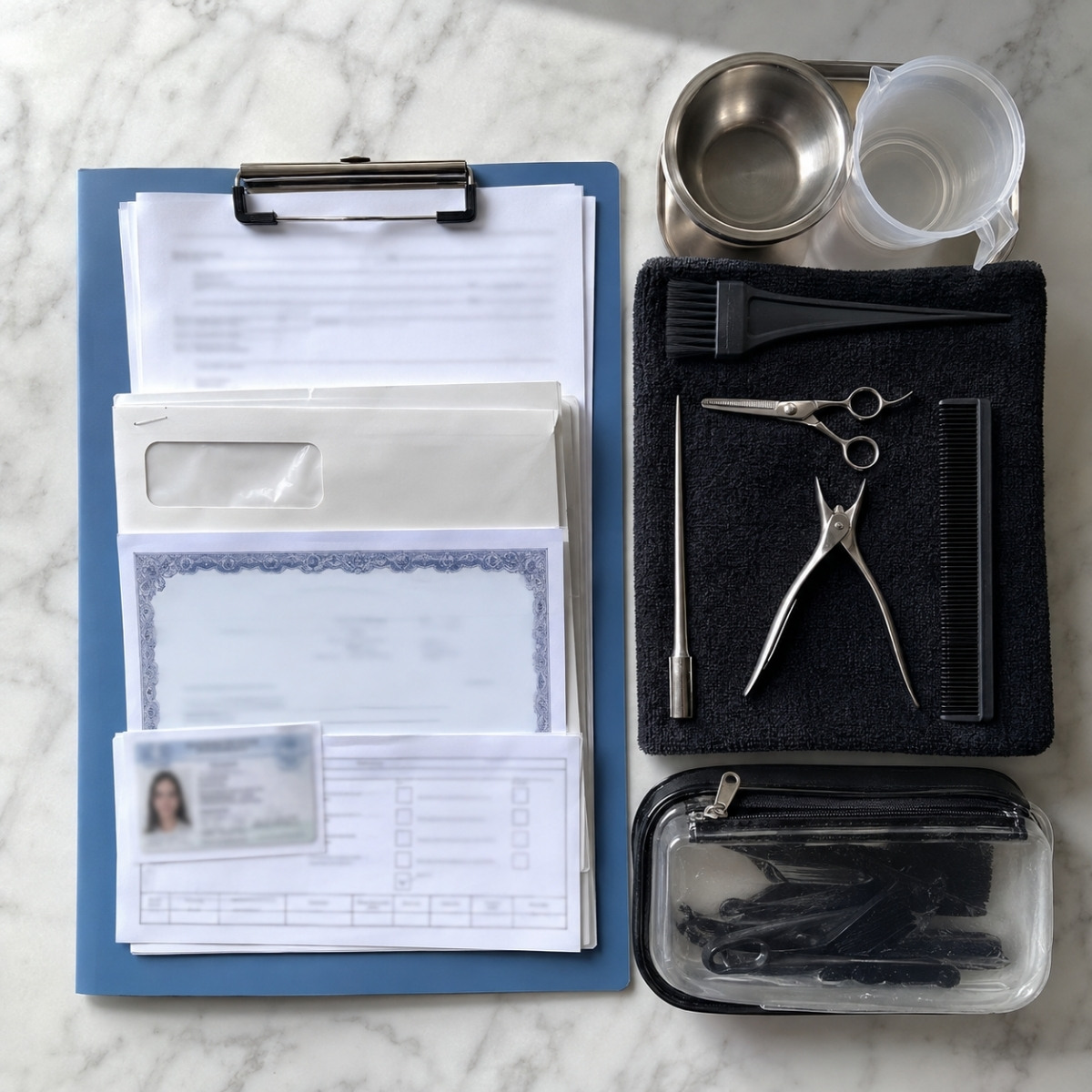
A license card may confirm that you are licensed without identifying the exact written or practical examinations completed. When a destination board requires proof of particular testing components, an official score report or detailed license certification may be necessary.
These records can be especially important when the examination provider has changed, the license was first issued many years ago, or the applicant’s present credential was obtained through reciprocity.
Requesting records before relocating can help you discover possible testing problems while your original school, licensing authority, and testing provider are still easier to contact.
A Practical Transfer Plan From Research to Approval
The following sequence can help you organize the process and reduce the possibility of an avoidable interruption in employment:
- Match the License Categories: Determine which destination-state credential corresponds most closely to your existing license, including its authorized scope of practice.
- Locate the Official Out-of-State Application: Use the destination board’s current endorsement, reciprocity, or out-of-state licensing instructions.
- Verify Your Testing Background: Identify the theory and practical examinations you passed and ask whether they meet the destination state’s standards.
- Arrange the Required Certifications: Follow the board’s directions for online verification or official certification from every jurisdiction where you have held a license.
- Collect Supporting Evidence as Needed: Requested materials might include transcripts, curriculum records, score reports, legal name-change documents, employment affidavits, tax evidence, disciplinary orders, or certified translations.
- Request a Decision About Training Deficiencies: Do not register for extra education until the board determines whether additional hours are required and explains what will be accepted.
- File a Complete Application: Submit the required forms and fees, then watch for deficiency notices or requests for clarification.
- Preserve Your Current License: If possible, keep the existing credential active until the new state has issued its license. Some simplified pathways depend on active licensure.
- Do Not Work Without Authorization: A receipt, pending application, or permission to schedule an examination may not authorize professional services. Wait until the required license, temporary permit, or other valid authorization has been issued.
Separate Portability Rules for Military Households
Service members and military spouses may have access to accelerated review, temporary recognition, fee reductions, or other occupational-license portability measures. These protections are not necessarily part of the standard reciprocity or endorsement process.
Eligibility may depend on military orders, residence, active license status, and whether the destination state considers the two professional licenses substantially equivalent. Military applicants should examine both the board’s military instructions and any relevant federal portability protections before choosing the ordinary transfer route.
Preparing Today for Future Career Mobility
Interstate licensing requirements demonstrate why the quality of your original education and the availability of your records can matter long after graduation.
Completing a program approved by the relevant state licensing authority helps show that your training satisfied the standards for your first license. Institutional accreditation may provide separate benefits related to educational oversight or financial aid, but it does not guarantee automatic acceptance of every hour in another state.
Effective cosmetology education should extend beyond individual beauty techniques. Students also need a foundation in sanitation, chemical safety, professional conduct, consultation, and the legal limits of the services they may perform.
Keep personal copies of important documents whenever possible, including your official transcript, curriculum information, examination results, original license details, name-change records, and continuing education certificates. Recovering these materials can become more difficult years after completing school.
If you are preparing to enter the industry or deciding what to do after graduation, our resource on licensing and career options after cosmetology school can help you connect your education, first license, and early professional experience with your longer-term plans.
Questions About Moving a Cosmetology License
Is there a standard processing time for an interstate license application?
No national processing timeline applies to every cosmetology board. Approval time depends on the destination state, whether the application is complete, the method used to verify licenses, examination requirements, and any additional review connected to the applicant’s history.
Missing documents, inconsistent names, several previous licenses, and incomplete disciplinary records may cause delays. Consult the destination board’s current processing information before committing to a starting date with an employer.
May I provide services while the new application is pending?
You may work only when the destination state has issued a license, valid temporary permit, or another authorization that legally permits you to perform the services.
A payment receipt or pending online status generally is not professional authorization. Unlicensed practice can result in penalties, disciplinary consequences, and complications with the application under review.
How should I handle a lower original training-hour total?
Contact the destination board before returning to school. A lower number of original hours does not automatically mean that every missing hour must be completed.
The board might consider your active credential, accepted examinations, verified work history, supplemental education, or another out-of-state licensing provision. Obtain the board’s determination before paying for additional instruction.
Will another state automatically accept my NIC results?
No. Although a destination board may recognize previous NIC examinations, automatic transfer of scores should not be assumed. The board determines which components satisfy its rules and whether official verification or further testing is required.
Does cosmetology authorize identical skin and nail services nationwide?
No. Cosmetology often includes certain hair, skincare, and nail services, but the precise scope differs among states. It may also be more limited than the authority attached to a separate esthetics or nail-technology credential.
Lasers, advanced exfoliation, deeper chemical treatments, and some cosmetic devices may require additional credentials or may be reserved for medical professionals. Follow the scope-of-practice laws in the state where the client receives the service.
Can cosmetologists already use the multistate compact in all member states?
No. Twelve states have enacted the Cosmetology Licensure Compact, but the multistate licensing system is not currently available to practitioners. Existing state application procedures remain in effect until implementation is complete.
When multistate licenses become available, applicants will need to meet the compact’s eligibility standards, including residence in a member state, an active and unencumbered license from that home state, and payment of the required fees.
Plan for a Beauty Career With Room to Grow
A sustainable career begins with education that supports both immediate licensing requirements and future professional goals. Neosho Beauty and Barber College offers training pathways in cosmetology, esthetics, manicuring, and instructor education at its Neosho, Missouri campus.
To explore admission requirements and the steps for getting started, visit the school’s enrollment information.
You may also use the contact form below to ask questions, connect with the admissions team, arrange a campus visit, and learn which training option best fits your goals.