

What Is Esthetician School Like? A Real Look at Classes, Costs, and Training
You may have spent years refining your skincare routine and reading every ingredient label you could find before deciding to pursue esthetics professionally. Moving from your bathroom mirror to a professional treatment room is a major transition, and it is completely normal to feel both excitement and some nerves. Many future students wonder whether they can really master the clinical theory, sanitation standards, and technical skills the profession requires.
This guide takes a closer look at what modern esthetics education actually involves. It is a structured, hands-on path that can turn your interest in skincare into a professional career.
Key Takeaways
- Rising Demand: The U.S. Bureau of Labor Statistics projects that employment for skincare specialists will grow 7% from 2024 to 2034, which is faster than the average for all occupations.
- Skill-Focused Learning: Modern esthetics training emphasizes skin barrier health, ingredient science, sanitation, and client safety alongside hands-on service practice.
- Regulation Awareness: Understanding MoCRA and state board rules is important for maintaining professional standards and client safety.
- Training Variations: Requirements vary by state, ranging from as few as 220 hours in some specialty pathways to as many as 1,000 hours in some states.
- Financial Potential: Median wages are reported at $19.98 per hour, though specialized roles or business ownership may increase earnings.
What Is Esthetician School Like?

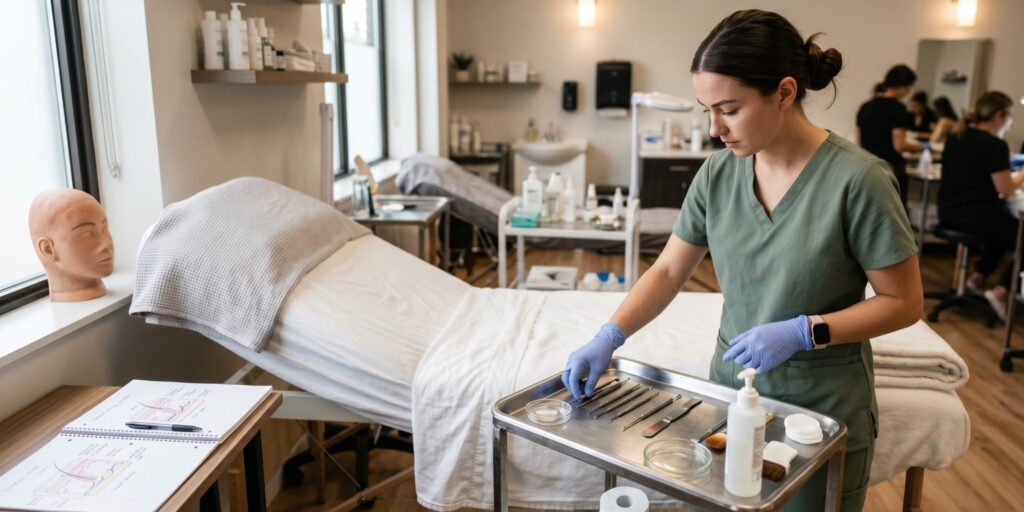
Modern esthetics training often feels more like a professional clinic than a traditional classroom. A strong program balances theory with repetition. Students study skin anatomy, chemistry, sanitation, and consultation methods, then apply that knowledge in supervised practice.
During esthetician training, students learn how to perform consultations, identify skin concerns within their scope of practice, and maintain sanitation standards. Most programs divide time between classroom instruction and hands-on clinic work. Students commonly practice client communication, treatment documentation, room setup, and disinfection procedures that help prepare them for the pace of professional practice.
The Science Behind the Glow: What You Learn
It is common to feel intimidated by the science side of esthetics, but that foundation is what supports safe and effective practice. Students need to understand why treatment steps matter for skin health, barrier protection, and client safety.

Biology, Chemistry, and Safety
Students spend significant time learning skin anatomy, barrier function, product chemistry, ingredient interactions, contraindications, and sanitation. They also learn to recognize when a visible condition falls outside their professional scope so they can refer a client to a medical professional. Knowing those boundaries is one of the most important parts of esthetics education.
Developing Your Technical Skills
Hands-on coursework commonly includes cleansing techniques, facial movements, extractions, hair removal, and other service fundamentals. Students learn to perform these services safely and precisely to help protect skin integrity and avoid unnecessary trauma. Even students who plan to focus on clinical-style skincare still benefit from understanding how cosmetic and professional-use products function in treatment settings.
The Path to Licensure: Hours and Requirements
The logistics of training are shaped mainly by each state’s rules. These requirements determine how long school takes and how quickly a student can become eligible for licensure.
- Missouri: 750 hours for an esthetician license.
- Texas: 750 hours for training.
- Florida: 220 hours for a facial specialty or 400 hours for a full specialty.
- Georgia: 1,000 hours of training.
- Arizona: 600 hours under current state requirements.
If speed matters to you, your path depends on your state and your schedule. Full-time programs can often be completed in a matter of months, while part-time formats may take longer. While some theory may be offered in hybrid form, practical training still has to be completed in person to satisfy state requirements. For more details on the process, you can check out this complete guide to school and licenses.
Safety and Compliance in 2026
The Modernization of Cosmetics Regulation Act (MoCRA) has placed greater attention on cosmetic safety and recordkeeping. Estheticians mainly focus on safe work practices, recognizing reaction signs, and documenting incidents appropriately while following state board rules and workplace policies.
Investing in Your Career: Costs and Funding
The price of esthetician school varies depending on the location, the program, and what is included in tuition and kit costs. Many programs fall into the several-thousand-dollar range, so it is smart to check what tuition covers and whether books, kits, or supplies are billed separately.
Financial aid eligibility depends on the institution. Students who want to use FAFSA or other aid options should verify that directly with the school instead of assuming eligibility. Comparing total cost, scheduling flexibility, licensure preparation, and job-placement support is often more useful than looking only at headline tuition.
Preparing for Your First Day
Before starting, students should confirm both their school’s admission requirements and their state’s licensing standards. These rules vary. For example, NeoSho Beauty College states that applicants must be at least 18 years old and have a high school diploma or GED.
Once enrolled, students may receive books, supplies, and practical tools used during training, depending on the school. Early practice may begin on mannequins or classmates before students move into supervised work with real clients. That is where confidence begins to build as theory, safety, and technique come together.
The Final Step: The State Board Exam

The final hurdle is licensure. Depending on the state, that may involve a written exam, a practical exam, or both. Students typically spend the last phase of training reviewing sanitation, safety, state law, and service procedures so they are prepared for the licensing process.
After licensure, income can vary widely. The Bureau of Labor Statistics reports a median wage of $19.98 per hour for skincare specialists, while Beauty Insurance Plus notes that more specialized, luxury, or business-owner paths may increase earnings further.
Start Your Journey Today
Choosing the right beauty school is about more than just completing hours. You want an environment where you can build discipline, technique, and professional confidence. Proper training makes the difference between simply learning procedures and building a long-term career in the beauty industry.
If you are ready to take the next step, you can look into NeoSho Beauty College’s Enrollment options to explore the path that fits your goals. You can also fill out the contact form at the bottom of the page to get more information or schedule a time to speak with the school about getting started.
FAQ: Common Questions
Can I go to school while working? Many schools offer part-time or flexible scheduling options to help working adults manage training, though schedules vary by school.
Is it hard to get accepted? Admission is usually based on meeting age, education, and school-specific enrollment requirements rather than a competitive GPA.
Can a nurse go to esthetician school? Yes. Many nurses choose esthetics training to expand into skincare-focused or medically adjacent beauty settings, though the services they may perform depend on state law.
What is a master esthetician? This depends on the state. Some states use a separate advanced or master esthetician license, while others do not.
Do I need a license for a home studio? In most states, yes. Paid skincare services generally require proper licensure, and the workspace may also need to comply with local zoning, sanitation, and business rules.